Showing posts with label Baghdad. Show all posts

Tuesday, January 28, 2014

When Did Barboursville, West Virginia Turn Into Baghdad?

In Baghdad, one of the innocent bystander victims of the violence there was a man on his roof (the roof is like an extra room to the house).  He peered over the roof to sneak a peek as U. S. soldiers on patrol were ‘sweeping’ the streets (I always thought that an odd turn-of-phrase) and one of them shot him, fearing, I suppose, he was a sniper.  He wasn’t.  He was just a man on a roof and he is dead.

This past weekend, in Barboursville, West Virginia, two brothers were killed as one showed the other the piece of property he had just bought in order to build a home for his family one.  As the property-owning brother unlocked the shed, his ‘neighbor’ shot and killed them both with a long gun of some sort from his own bedroom window.  The shooter told the police the men were on his property, entering his shed.  But they weren’t.  They weren’t on his property and it wasn’t his shed.  WSAZ

But even if it had been, when did Barboursville, West Virginia become Baghdad, where the order of the day was shoot first and ask questions later?

Our mistrust of others is a problem worth considering that I think is actually (or should be) part of the gun conversation in these United States.

What is wrong with us (or at least some of us) that we think our assumptions about people are so certain that we are 'free' to take deadly force to act out those assumptions?

When did we approve a world in which shoot first is even a possibility?

What on earth are we so afraid of? Statistics actually show crime rates going down.

Barbooursville, WV (like a lot of other places where this happens) isn't a particularly dangerous place. Why on earth have we nurtured a grudge-culture that assumes we are under attack all the time? When did the crazy lie become our defining reality? I know all the usual suspects. What I'm curious about is what we, the so-called ordinary citizens are doing to either feed or squelch the beast?

For the fact is that we do not live in Baghdad.  So why do so many act as if we do?

Ah Lord . . .


Saturday, April 20, 2013

Vigils & Bombs


It felt bad – real bad – last night to be watching moment-by-moment developments in Watertown.  If I lived there, I’d need to know.  But as it was, I truly felt like a voyeur.  And I had to remind myself that these were events about real people unfolding in real time.

With that reminder, I was able to do the one constructive thing I had to offer – pray.  And so I prayed – for the young man probably still a boy in many ways . . . for the police . . . for the folks living there ejected from their homes or ‘sheltering in place’ (such a benign-sounding phrase for being held hostage to a situation not of their own making) . . . for a peaceful end to such a horrific beginning . . .

Thus did my watching move away from atavistic curiosity to vigil.

And thus did I give thought to those all over the world living with such dangers every day.  Having spent some time in Baghdad, I considered the difference of bombings that happen daily versus those that happen so rarely.

As a civilian in Baghdad where bombings are a regular and often daily occurrence, you stop briefly to
determine where, in relation to you, the bombing happened.  When the first one goes off, if it’s close, you retreat because experience has taught you that another is coming soon.  In the immediate aftermath, you only go closer to help the wounded if you’re already so close that you know you can’t run far enough fast enough.

And if it’s some distance away, you simply resume what you were doing before the blast after checking to find out where it was and calling those you know in that area to make sure they’re okay.  And if you’re a praying person, you offer up a prayer as you go about your life.

Like anything else, violence quite easily becomes a norm to which we adapt.  That isn’t to say it doesn’t change us – it does.  But the needs and desires of day-to-day life simply work themselves around the reality, much like a tree engrafts a rock into its root system.

The only problem is I’m not sure which is the rock and which is the tree.

So today I pray for all the peoples of the world: Lord, enable and empower we human beings to work, to strive, to dedicate ourselves to make violence such a rare thing that no one need adapt themselves to its reality, its demands, its reactions.  May fear find no place in our lives.  May vengeance be left to You.  May all children grow into the reality You dream of for us all.  May it begin with me.

Thursday, February 28, 2013

A Wee Canto on a Life: Mourning the Death of Abu Hani


I only just now learned that Abu Hani died in December.  He was headed home to Baghdad.  It was a car accident.  A car accident.

Abu Hani was our landlord in Baghdad.  He survived Saddam Hussein, car bombs in his neighborhood, a mortar falling on his apartment building, thieves, and the day-to-day of dodging, weaving and dancing that was and has been life in Iraq for so long.

He and his family survived what we call the first Gulf War, hiding in a barn outside Baghdad.  They survived sanctions.  They survived escaping from Baghdad and the threat of the Jordanians to return Abu Hani to Iraq by force.  That may be my favorite Abu Hani story of all.

Along with millions of Iraqis, he finally fled his beloved Iraq to come to Amman.  His wife Um Hani was already there.  When he arrived, Jordanian officials told the passengers they would have to turn around and fly back to Iraq.

Time passed; Abu Hani argued and stalled long enough to ‘miss’ the return flight and as it got later in the day and into evening, he went to the hamam (the restroom) and changed into his pajamas, rolled out a blanket on the airport chairs and proceeded to make his place for the night.  When the officials challenged him, he calmly told them, “What do you mean I cannot do this?  I live here now.  This is my home.  From now on, I live in the airport because you won’t let me enter and go to my apartment in Amman with my wife.  So this is now my home.  I am very tired; I think I’ll get some rest.”

He rolled over and made as if to go to sleep.

Finally, the officials, mortified by the situation they had created, relented and agreed that Abu Hani could enter, but made him promise to tell none of his friends who had also come.  Of course he swore and of course he told them all.

On election day, Abu Hani took us walking around the neighborhood in Baghdad to various polling places showing everyone’s purple finger.  We sat many evenings around their table, eating, laughing, sharing stories.

He and Um Hani made us welcome.  They prayed for us and worried over us like mother hens.  They kept us safe as much from ourselves as from others.  They bade us welcome at their table in Jordan as well as in their apartment building in Baghdad.

Baghdad killed Abu Hani, finally.  He loved Baghdad.  He was Baghdadi through and through.  And so when the violence would calm, if only for a little bit, he would go back to oversee his investments as well as those of his friends and family.  And he survived.  Until the day when he did not.  And it was a car wreck.  In Jordan.  He was headed home again.  And none of the other passengers were even scratched.  And he is dead.  And it breaks my heart.  

You do not survive in Abu Hani’s world by being a fool.  And Abu Hani was no fool.  He was friend and protector, wisdom giver, proud father and husband, business man and consummate broker, witty and urbane, a Christian for whom the sands of Iraq ran in his blood.  And I mourn his passing with fond memories and a broken heart.

Oh, and I miss his laugh - the laugh of an Iraqi man - a laugh that contains the knowledge of fertile crescents and hanging gardens and wonders of the world and deserts and riches and poverty all beyond imagining – the laughter of one who knows much but tells little.


Sunday, May 13, 2012

Things Are Not Always as They Seem


Yesterday’s visit to Culzean Castle was a feast for the senses.  It was a beautiful west-of-Scotland spring day: sun shining, wind blowing, clouds quickly scattered.  And the grounds of Culzean Castle are lovely.  The well-tended gardens, the swan pond, the nicely-kept walks through the woods all reveal treasures.  The smell of wild garlic wafted on the air; flowers in bloom, known and unknown, were a feast for the eyes.  Birdsong filled the air.  You could walk and walk in the darkness of the woods and forget that you were right on the sea, only to come across another opening and have it there before you.

At one point, we came onto some grounds well into our walkabout that opened to the sea and as we approached, I noticed a series of regular humps of ground, like the scalloped edges of an Irish-lace tablecloth.  Eagerly I walked forward to see what they could possibly be, only to discover a small canon set in each of the scallops.  I literally cried aloud in dismay and disappointment.

But what did I expect?  The main function of a castle from any age, after all, is that of the fortress.  It is truly terrible how often and how well the form and function of violence meld into an aesthetic of beauty.

Some of the early Reformers so eschewed beauty because of this very concern – that beauty can be such a seductress, tempting the beholder to believe that the beautiful is, by its very nature, the good – so often not the case.

Perhaps we are the problem, in that we ascribe to beauty both more and less than it actually has to offer.  A beautiful landscape is a beautiful landscape – or is it?  Knowing its history, its context, can change our very perception of its beauty (or lack thereof).

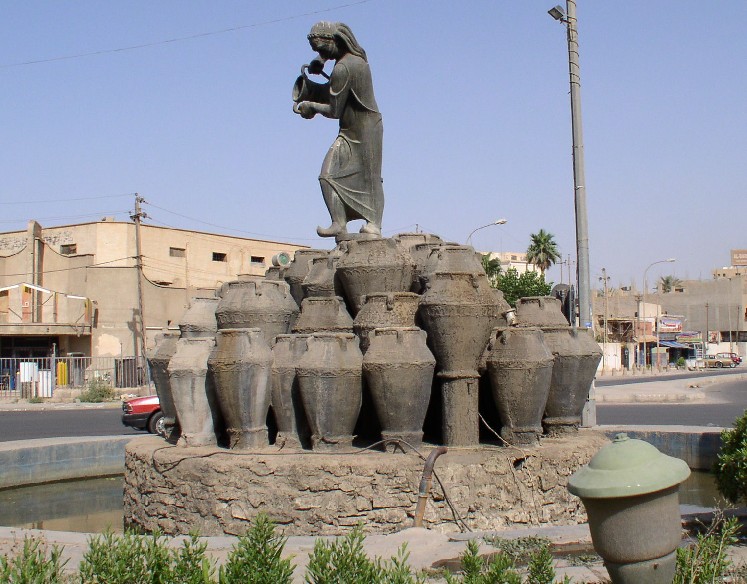
In Baghdad, there is an almost beatific sculpture of a woman pouring from a large pitcher into the urns surrounding her at her feet.  Such a serene, pastoral vision – until you know that she is Ali Baba’s handmaiden and that what she is doing is pouring boiling oil into the jars, which contain hidden men who planned to attack from their hiding places in the night.

I never know quite what to do with all of this.  My ancestors in the faith seem too extreme to me, repudiating, as some did, all forms of physical beauty; beauty seems as much a divine gift to me as is the air we breathe and the food we eat.  It nourishes us somehow.

But mistaking beauty for moral good won’t do either; there’s simply too much evidence to the contrary.

Living in the tension – that, I suspect, is the premier challenge of being human: accepting that very few, if any, of the things of this world are absolutely good or absolutely evil; taking it all in with provisional judgment – judgment willing to be changed with new or different information; seeing the beautiful in the ugly and the ugly in the beautiful – now that’s the job of a lifetime!