Showing posts with label John Calvin. Show all posts

Sunday, June 1, 2014

The Ascension: Going Up?


In Acts 1.1-11, we read that Jesus ‘goes up’ to heaven.  When I hear this, all I can hear is an elevator
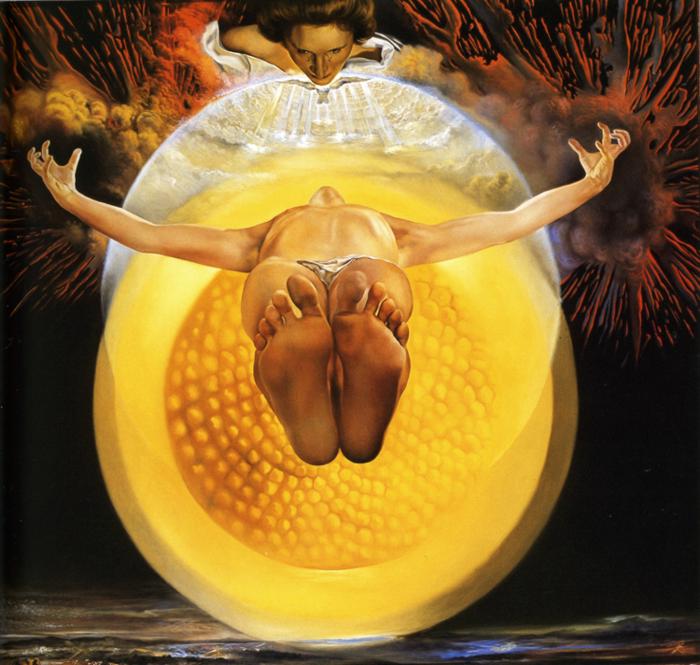
Dali's Ascension - a ground's eye view
operator asking, ‘going up’?  It just seems so . . . ridiculous. This ‘going-upedness’ of Jesus, lifted into the sky on a God-cloud, seems . . . so . . . silly . . . as if Jesus were Superman or better, Lois Lane, being flown into the sunset . . . it . . . is . . . ridiculous . . . isn’t it?

But the author of Ephesians has it more right than I do when he prays that the people of God’s church may ‘see with the eyes of your heart’.  That helps . . . a little.

The eyes of the heart and the words of Barbara Brown Taylor help me to understand a bit better what this ascension thing is all about:  “It was not enough that through him God was born into the body of the world; that was just his Christmas gift to us. His ascension gift was that through him the body of the world was borne (carried) back to God. . . Jesus has not only brought God to us; he has also brought us to God.”

John Calvin says, “Since Christ entered heaven in our flesh, as if in our name . . . in a sense, we already sit with God in the heavenly places in [Christ].” Thus does Jesus open the way to the heavenly kingdom, by which Calvin means that without Jesus, you and I just can’t get ‘there’ from ‘here’.

Using my elevator image, we might say Jesus ‘went up’ in order that we won’t ‘go down’.  By opening the gates of heaven, Jesus closes the gates of hell forever.

Brown Taylor puts it this way, “It was almost as if he had not ascended but exploded, so that all the holiness that was once concentrated in him alone flew everywhere, flew far and wide, so that the seeds of heaven were sown in all the fields of the earth.”

Silly as it sounds . . . We do worship a flying Jesus . . .

But it’s a bit like an airplane . . . no matter how well crafted it is, it can’t fly simply because it ‘decides’ to . . . [This might be a good time to make your own paper airplane and try to fly it to heaven.  That’s what we did in church today, anyhow.]

What is astonishing is that neither could Jesus . . . Jesus didn’t decide to go to heaven . . . Jesus didn’t fly ‘there’ on the power of his own might or even the power of his own decision . . . Jesus didn’t go to heaven . . . Jesus was taken to heaven . . .

Grace is the word we use to understand this simple, crucial truth . . . of our own power, we can do nothing.  Yes, we have work to do.  But if we are not very careful, it is oh so easy to believe that the work, and not God, is our pathway to heaven.

Like paper airplanes, human beings who try to fly themselves to heaven will always fall back to earth.

Think of it as the difference between the grateful and the guarded.  The grateful share what they have . . . it wasn’t theirs to begin with, so what’s the big deal?  The guarded live their lives like characters on apocalyptic television shows, willing to kill to protect their bread from starving others . . .

The guarded always have a plan . . . the grateful simply trust, for they know their plans mean nothing . . . they’ve failed too often not to know.

The guarded know how much work they have done and how much pay they’re entitled to for the work . . . the grateful simply offer thanks for whatever they get, knowing they didn’t earn a bit of it . . .

The guarded think in terms of ‘mine’ and ‘yours’, for they have earned what is theirs and expect that you should do likewise. . . the grateful know there is no earning all the bounty they have received, so they simply say ‘thank you’.

The guarded are often angry at the injustices done to themselves by others . . . the grateful are angry with the injustices done to others . . .

The guarded are productive and hold those who are not in contempt . . . the grateful are not productive and so are free to love others simply because they are, and not because of what they do . . .

The guarded are jealous of the successes of others . . . the grateful rejoice in them . . .

The guarded compete . . . the grateful cooperate . . .

The guarded believe good fences make good neighbors . . . the grateful know good fences make only good fences . . . and that a good neighbor is made from being invited in, not being kept out . . .

The guarded believe the path to heaven is a ladder they must perpetually climb lest they be left behind . . . the grateful know the path to heaven is an elevator and their ticket was bought for them by Jesus a very, very, long time ago.

Going up?

Sunday, October 27, 2013

Sermon Cliff Note: Ecclesia Reformata, Semper Reformanda

SCRIPTURE READING:  Luke 18.9-14 (the Pharisee & the tax collector)

It’s Reformation Sunday.  The Reformation wasn’t all good – Protestants were burned at the stake for their faith, but lest we get too sentimental or judgmental about that, remember that the early Protestants did their own share of burning and killing too.

That said, I would turn our focus to the Reformed churches in particular, for that is what Presbyterians are, part of the family of reformed churches.

The ‘reformed’ bit comes from our motto:  ‘Ecclesia Reformata, Semper Reformanda?’ [Translation: The church reformed, always reforming, but, per Anna Case-Winters, the better translation is The church reformed, always being reformed].

What does it mean to say that we are reformed, always reforming or being reformed?

The church reformed, always reforming according to the word of God and the call of the Spirit is a church that understands, proclaims and lives the realities that:

1. God is a living God, speaking into every time and place.

2. Our understanding of God and God’s ways is always an imperfect thing.  We don’t always get it right.

3. The church is not a static or dead thing: it too lives, in every time and every place.

4. Sometimes reforming means going forward into something new, but just as often, it can mean going back into something quite old – the original church, the original teachings.

Jesus’ parable of the tax collector and the Pharisee is a teaching on prayer, focusing on humility.  We might think of it as a story about being re-formed.

The Pharisee was speaking the truth to God about what he did.  He was a godly man.  And still he didn’t get it right.

The point was never about being better than the next guy.  This perpetual temptation, to always score each other as if life were a football game, is, for John Calvin, the father of the Reformed family of churches, the principal human sin or error, for pride misapprehends the true nature of things.

The true nature of things, as Calvin would have us understand, is that God is the source of everything – everything without and everything within.

Thus it is that any good that we do rests at the feet and originates in the heart of God.

Why does it matter that we get this?

Simply so that we avoid the temptation to believe that it’s about us . . . so that we avoid the toxic thinking, that we are the center of the universe.

Reformed and always being reformed is the recognition that change is a central part of being a Christian – if I am the same person when I leave as when I came, if I am not challenged to grow beyond myself by opening myself to God and God’s ways, then I am but a block of concrete good to no one, not even myself.

This idea isn’t about change for its own sake.

But it is about being open to God’s Spirit moving and working in our lives.

And therein lies the central difference, I suspect, between the Pharisee and the tax collector: both believed in God; both prayed; both came to the place of worship to do it.

But only one came in truth.

Only one came with ears open to a new word.

In reality, the other wasn’t talking with God at all: he was talking only to and for himself.

The one who came to be re-formed knew something the other had forgotten: to stand before the throne of God is to stand in the broken place . . . to see everything from God’s point of view . . . to know one’s self within and without . . . to have nowhere to hide . . . and to own the brokenness, the hurt, the woundedness, the failings, without flinching, without lying, without comparing to others – but to simply stand there, ready at the last, to be re-formed.

John Calvin’s seal was a hand holding a heart aloft.  The explanatory motto for the seal went something My heart to thee, O God, willingly and sincerely.
like this:

When we stand worthily before our God, we rest assured that the worth as well as the offering rest in the heart of God’s own self.

There, we are re-formed . . . again and again and yet again.

And that is a good thing.


Monday, November 5, 2012

Sermon Cliff Note: To the Thirsty I Will Give


To the thirsty I will give water without cost from the spring of the water of life.– Revelation 21.6
I read and ponder: what will be given and exactly who are the thirsty?

What will be given?  The gift of water – the gift of the source as well as the sustainer, of life.

On this All Saints’ Day, we can marvel at the great faith of the saints, famous and obscure, who have gone before us . . . we can puzzle over the faith of Abraham, who took Isaac to the mountain of sacrifice . . . we can rejoice in the faith of Mary, who said yes to God’s invitation into the mystery and suffering of motherhood as much as into its joys . . . we can remember the faith of our own fathers and mothers, whether it be shining with hope or dusty from lack of use . . .

Faith is the knowledge, as John Calvin said, that “Already the door of paradise is open to us and [already] we live in God with [God’s] angels.”  Faith is “a firm and certain knowledge of God’s good will toward us. . . though we are still sad, we do not cease to taste the goodness of God; when we are terrified, we do not cease to hope in God . . .Faith . . . [raises] us up above all we can conceive . . .”

Dr. Brian Blount’s inauguration sermon at Union Richmond, May 7, 2007, titled Are You Ready? engages the story of Lazarus as a story not of miracle, but of faith, “Jesus knows where we are, knows what we can be, and knows what we can do. That is why, while the bereaved in Bethany are hiding beneath the cover of traditional thinking about life and its limitations, Jesus is doing something dangerous. He is teaching life by letting a man die. Are you ready to come out of hiding and meet this Jesus?”

This Jesus, who teaches life by way of death . . .

This Jesus, whose gospel stinks in the mind of the rational as much as the dead body of Lazarus stank in the nostrils of the living . . .

This Jesus, who demands a faith that is not a Hallmark card, that does not pretend that all is well when it is not.

This Jesus, who is for the weak of will, but not the faint of heart.

This Jesus, who is for the doubter but not the scoffer.

This Jesus, a man very much interested in the faith of the here and the now and not so much the hereafter.

This Jesus, who came for all those who have lived and loved, lost and suffered, feared and trembled, and laughed and celebrated . . .

Are we ready to meet this Jesus?

Saturday, August 4, 2012

7 Things To Adore About John Calvin

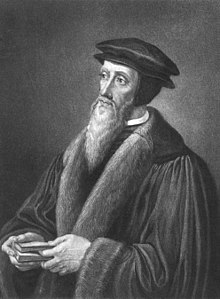
John Calvin, 1554

1. He was a step-dad                    

2. Bitchin’ hat

3. Predestination*

4. He was French

5. Genevan Bible and its treatment of the tyrannical nature of kingship (Calvin didn’t author the Genevan Bible, but its production took place in ‘his’ Geneva)

6. His own recognition that he was a man of his time, a recognition that allowed for the possibility of women in leadership within the church in future because of his view that the biblical admonition that women keep silent in church was a thing ‘indifferent’ (meaning not an essential tenet of the faith)

7. Emphasis on education:  Calvin was a small ‘d’ democrat, insisting that all must have access to education - and that included girls


_________________
*Paving the way for Karl Barth's exposition on predestination and election as God's expression 'for' humanity in the person of Jesus the Christ and the idea that thereby, God can claim all of humanity (and not merely those 'chosen', as it is Jesus himself who is the object as well as the subject of God's choosing).

Saturday, June 2, 2012

Perspective²


In one 360◦ turn in Edinburgh, could you see around and into buildings,  you would see statues of philosopher and father of secular humanism David Hume; father of the United States’ brand of capitalism Adam Smith; the Duke of Queensberry, author of the well-known boxing rules of sportsmanship; and John Knox, Reformation preacher and father of modern presbyterianism as practiced in Scotland and the US in particular.  The same land that in many ways birthed Western modernity’s secular humanism also gave it presbyterian Calvinism.

If you stand inside St. Giles Cathedral, you will see the statue of John Knox.  The iconoclast has literally himself become an icon.

Window at rear of St. Giles
Reads "Gifts, Sweets, Souvenirs"
Standing outside St. Giles at the rear, you will see the St. Giles gift shop and above it, in the glass of the windows, painted signage indicating that gifts may be had.

Reformer Martin Luther rejected the sale of Papal indulgences, a fundraising mechanism for the then-Pope to secure the necessary monies for the completion of the Sistine Chapel.  That, among other things, led to a Reformation and split from the Roman Catholic Church that has yet to be fully (some would say even partially) healed.

Flash forward to our own time, and see a central geography of worship for the Presbyterians that sells trinkets to support care of yet another building, a behemoth of ancient architecture preserved for its beauty.

Of course, no one is threatened with the fires of Hell should they not buy a post card of St. Giles (so far as I know).

Wednesday, December 7, 2011

Not Holier Than God


I was trolling the web, looking for a cute image on the idea of ‘spiritual temperature’ when I came upon the 2008 blog posting by David Wayne.

I love the Bonhoeffer quote from his book, Life Together:
Christian community is like the Christian's sanctification. It is a gift of God which we cannot claim. Only God knows the real state of our fellowship, of our sanctification. What may appear weak and trifling to us may be great and glorious to God. Just as the Christian should not be constantly feeling his spiritual pulse, so, too, the Christian community has not been given to us by God for us to be constantly taking its temperature.
And David’s paraphrase of John Calvin, that “ there are some people who have higher standards of holiness than God. . .” is as funny as it is sharp.  Who says the great reformer didn’t have a sense of humor?

In my own time and place, it is not the vice of complaining that draws my attention; indeed, it isn’t any vice at all that occupies on my mind just now.

Rather, I sit with a community that is in pain . . . there has been no collective catastrophe, but there are so many individual ones, both great and small, that I find myself to be so very spiritually tired. . . not numb . . . not bored . . . not fed up . . . not impatient . . . not judging . . . just sad . . . and tired, soul-weary-tired.

Some of us will survive our current crises, some will not.

This winter is not the season of our discontent; rather, it is the season of our loss.

Counting that loss, however, is part of the problem.  Doubtless, Bonhoeffer had no thought of the seasons of loss in the life of a church when he wrote the challenge to avoid the constant taking of our own temperature, but it is a metaphor that serves well in such times, I think.

Of course we must be self-aware.  Of course, we must provide good care to self and to others.  Of course we must observe our own sabbath rest.

But in the midst of heartache, it does little good to seek to measure it.

In the midst of sorrow, there is little point to counting our own tears.

Such efforts are not only in vain, they are also a way for us, for me, to try to step around what’s happening, to avoid the pain by acting the part of impartial observer, collector of the statistics of sorrow, as if that would somehow minimize the real hurt happening around and within.

God does not count the cost.  But God experiences it.  So too must we.

Today I am sad.  And I am tired.  Sitting with that is necessary.  And measuring it will not make it hurt less or pass sooner.

This is the season of my sorrow.

May I sit with it grace-fully.