Our annual Chocolate-Communion Ice-Cream-Social Kid’s-Carnival celebration of Christmas in July has come and gone. As always, there are lessons to be learned about putting on an event, but my favorite lesson came from a wee boy, my co-conspirator of fun.
At the end of the day, I emptied the cooler of ice into the grass, a couple of passes to get the job done. With the first dump, Kaden came up and just stared down at the ice. I told him he could touch it with his feet.
So he did.
At first gingerly – just a toe – pulled back with a look of utter delight on his face. It’s cold! he exclaimed in sheer wonder.
Yes it is, said I. You can do it again if you want.
And he did.
First a toe. Then a foot. Back and forth he went in the simply joy of feeling the cold on the bottoms of his feet.
Then he got brave and jumped in with both feet.
And down he went.
Tears. Hugs. Arms out for Grandma. Comfort.
I think he’ll remember how fun it was to feel the cold and forget the fall. That’s what I hope, anyhow. Or maybe he’ll remember both and learn from both – how to laugh and how to take care.
Life’s like that, isn’t it?
We learn to navigate the ice and if we’re very lucky, every now and then, we even manage a dance. And fall or no fall, it is so worth it.
Today was my grandson’s first experience with that quintessential sign of summer: the lemonade stand. He hung in there for a couple of hours, during most of which he sat waiting as car after car simply passed by – some waving, some honking, but none stopping for a little boy’s first offering in the world of exchange.
But perseverance won the day and he is $13 richer (half to go to his piggy bank and the other half to Food Bank, or in Rowen’s words, “to the poor people who need food”) for the experience and dedicated to having another go, maybe tomorrow – maybe in the church parking lot.
Watching this wee boy of my heart, I thought about lessons. And they weren’t about capitalism or even about the value of hard work.
The lessons were about people. Lots of folks wished him well, evidenced by their friendly honks and waves. They were appreciated for a time, but after awhile, you just want someone to stop. So to the fellow who pulled up in his truck just to say hi and who offered up 50 cents even though he didn’t want a lemonade, many thanks – you made a wee boy’s day. And the first customers – from the big city in northern Virginia who stopped and turned around, who chatted and took a picture – you are rock stars! And to my neighbor Cotten who stopped as a dedicated lemonade stand sponsor and customer from way back, a special thanks.
I’m not sure what my little guy learned today, but I know what I’ll take away from the experience:
1.From his Gran (yes, me, the preacher lady): “We don’t want your honks; we want your money.”
2.Waiting for a customer can feel like you’re waiting for Godot.
3.The people who frequent lemonade stands are kind.
4.It only takes a little bit to capture a child’s imagination, commitment and heart.
5.It’s like Tom Sawyer’s white-washed fence: once you get going, everyone wants to be a part of it.
6.When you live in a small place, everything and everyone are connected, so your grandson’s money box turns out to have been a gift made and presented to his Gran by the father of one of his lemonade customers, who recognizes the craftsmanship right away.
Lemonade – sweet with just the right amount of tart and cold – the perfect serving on a hot summer’s day on a country road. Hope you’ll stop for a cup next time you’re by this way.
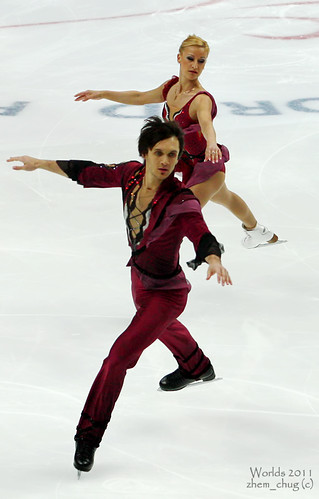
Maxim Trankov and Tatiana Volosozhar performed their short program in team figure skating last night and it
Photo by zhem_chug at FlickrCommons
goes without saying that they were magnificent.
In any display of grand competence, I am always overwhelmed by how the performer makes what is so very difficult look effortless. Last night’s performance was such an example.
Watching them work in tandem minds me of how much more difficult it is to work together than alone. I don’t know how tall they each are, but she only comes to his shoulder, which suggests as much difference in the length of their respective legs, which suggests how very much they must both work – she stretching beyond her limits, he holding back, to match each other skate for skate, turn for turn.
Matching pace, each to the other, is no easy thing in any endeavor: marriage, friendship, teacher-student, dancing, skating, walking side by side – all require an awareness of the other, an ability to slow down or speed up beyond one’s own normal pace of life in order to operate in tandem with another.
It invites the pondering of who do we have to alter our pace for and the recognition that in that altered pace may well lie our best flying.
Sometimes we just have to slow down for someone else. We get that. When our kids are little, we’re spending a whole lot of time in first gear, walking more slowly, matching our pace to theirs, speaking more simply, explaining along the way.
And whatever our life’s work, there will be times when we have to match our pace to another less knowledgeable or experienced, showing them the way, pointing forward so they can see what we already know to be there.
And there will be times when someone else will do that for us.
There is a cost to the self in this matching of pace, of one’s own internal rhythms to another’s.
But when it works, oh, how glorious it is, for there be dancing in our flying and harmony to the universe.
Time passing inspires a bit of reflection on things and people gone by – it’s inevitable, isn’t it?
In my own case, I live in a slow land, so there’s a bit more time for reflecting. And of late, I’ve reconnected with folks from various stages in my own past – e-mail, FB, lunch get-togethers on a recent trip back home and even the forgetting of my fellow high-school classmates (who didn’t invite me to the reunion, forgetting that even though I have moved quite a bit, my mother still lives in the same house I lived in way back in high school) – all these connections draw me back to different stages in my life, from high school through seminary.
Most days, I’m not much of a look-back kind of gal. My kids remember details from our lives together that have long ago slipped my mind.
Me with Judge Handlan - early 1980's
So it’s a rare treat and challenge to look back and see myself in the eyes and hearts of others with whom I was so bound once upon a time.
The question arises: am I who I was? And if not, who have I become?
Some answers are obvious; some obscure; some, I suspect, I’ll never know.
Some life lessons are apparent:
1.Nothing is forever. All those times, those epochs of my life, seemed at the time to be the endless horizon of what my life would be – but horizons are tricky things and every thing does pass away, sometimes with startling suddenness, just as often like the proverbial thief in the night, but slip away they do.
2.Things and people actually do change. We’re not the same – not as each other and not even as ourselves. There’s enough resemblance to connect, but change is integral to the body human.
3.For my own part, I am nicer than I used to be. Much. Which is not to say that I am nice – far from it. But it’s a journey and I’m good with that.
4.I wouldn’t go back even if I could.
5.It’s okay to be forgotten. I’m just not that important. And that too is okay with me.
Some lessons aren’t so obvious:
1.The child I was still inhabits this old-lady skin and she can take me by surprise sometimes – usually in a good way, but not always.
2.High school is nothing like real life. Never was, never will be.
3.We are our families and yet we are not. Mysterious, that.
4.Some people, as well as some things, are better left in the past.
5.The ever-shrinking list of those who were there, those with whom we share the memories, is, all by itself, a cause for sadness, as the ones who can know and understand the scrapbook of a life gets smaller and smaller. Telling is not the same as remembering. Sometimes you really did just have to be there.
Ever my own harshest critic, I wrote on the
back of this pic intended for a friend,
"Don't remember me by this."
When I was 12 or 13, I went to my first dance and to my utter shame and horror even today, when a boy got up the nerve to ask me to dance, I blurted out, “No.” Not “No thank you.” Not “I can’t dance.” Not “Why yes, I’d be glad to.”
Who knows how that artless moment in the life of an awkward teenage girl might have changed the course of her history. I still cringe when I think of it. I’ve never had the nerve to tell the boy become man how sorry and embarrassed about that moment I was even then and I can only hope he has forgotten it.
I set a great store by being asked. Who doesn’t? It’s flattering.
In that moment, I was terrified and my fear did the talking for me, more’s the pity.
But I am a full-grown woman with children and a grandchild now. I’m pretty well past being afraid to dance. Yet I find that I still blush like a school girl to be asked.
And that makes it hard to say no when I know I should.
Thus I’ve had to remember some things of late that I learned on the dance floors of life:
1.I am not an awkward teenage girl any more.
2.I don’t have to say no out of fear, but neither do I have to say yes out of fear either – fear that I won’t be asked again, fear that unless I say yes, I won’t be loved or appreciated.
3.It’s ok to be flattered by being asked, but I still decide with whom I dance and why.
4.Corollary to #3: of course I’ll be asked to dance; why wouldn’t I be? I am a wonderful dancer. My would be dance partner has already decided for themselves that they’d like to have me as a partner. I get to decide whether I’d like to have them as a partner. (You decide what’s best for you; I decide what’s best for me.)
5.The obligation created by being asked to dance is not to say yes; the obligation created is to answer with kindness and dignity and thoughtfulness and integrity.
6.Regretted ‘nos’ of the past cannot dictate the answers of the present.
In this Olympic season, there is celebration of the undefeated. And the character Harvey in the television drama Suits seems to claim an undefeated record as a lawyer. We adore and admire the undefeated among us. But should we?
‘Undefeated’ just means hasn’t failed yet.
Failure comes to us all.
It’s part of life.
And that is not a bad thing.
Think about it.
Who wants to hang out with a bunch of winners all the time?
Especially if everyone else in the room is a winner too?
Yesterday I revisited a common plight when visiting or living in another country: nothing is the same as it was at home – nothing.
If you’re a creative cook, this can make for great adventures. If, however, you’re more like me and require a recipe road-map, this can lead to disaster – a lesson you forget at your peril.
Fortunately for me yesterday, I was cooking for a palate of one, so I can truthfully disclaim that no guests were harmed in the preparing of this dish.
What Sandra's ravioli should look like!
There is a recipe from Sandra Lee's Semi-homemade Cooking television show that I absolutely love to make and to eat – White bean ravioli with brown butter and caper sauce. It’s really quite good. And to reassure you of that certainty, I refrained from taking a picture of what I managed to ‘create’ yesterday. If you want the recipe, just click on the link above and banish all images of the below-described fiasco from your mind - this does not have to be your fate - I promise!
I had the beans I needed, but no blender or food processor, so I tried mashing them first with a fork and then with my hands. It’s not as easy as you would think to get a bean puree by hand. I looked at the clumpy mess I had created, reminded myself that I was dining alone, and proclaimed, Good enough! Mistake #1.
Next I learned that no matter how finely chopped something (even something like cheese) is, finely chopped is not the same as grated. The results are predictable, as your cheese absolutely refuses (who knew cheese was such a wilful beast?) to melt/combine/play nicely with the other ingredients. Mistake #2.
I relearned that at some point, persistence moves from being a virtue to being its own worst-enemy kind of vice. They didn’t have wonton wrappers at the store, so I got some fresh thin lasagne noodles instead. But no matter how thin, unless homemade, a lasagne noodle is soooo much thicker than the wonton wrapper or the ravioli pasta that the restaurants make and use. Thus my spooned in mixture would not be contained in the lovely triangular-shaped pasta purses I had envisioned – the dough simply broke in half when I folded it. That’s when inspiration (translate insanity) struck: I would boil the pasta for a few quick moments to soften it up (and make it wet and slippery and impossible to work with) so that it could be folded. Still it would not stick to itself no matter what I did. So finally I rolled little tubes around the bean mixture, laid them in a glass pan and poured boiling water over them (this was after I kept trying to flash boil them in the water on the stove, only to have the bean mixture slide out of each little triangle, tube and other shape I tried to create).
That worked after a fashion, but what I ended up with on my plate after I had dirtied about every dish in the kitchen was fried beans with some buttered fried pasta atop them.
No worries, I thought to myself – it isn’t how a dish looks; it’s how it tastes. Of course, I was delusional by this point, forgetting everything I have learned from the most basic of cooking shows: people eat first with their eyes. And in this case (as is, I suspect often the case), what it looked like was a good predictor of what it would taste like. Mistake #3
Finally, this isn’t my first kitchen disaster and it won’t be my last. The difference a bit of age has brought to me is that I know that. So after a few bites, I resigned myself to throwing the mess away. Maybe that’s wisdom. Final Lesson #4
_____________________________
Mistakes/Lessons
1.What you wouldn’t serve to/give/present to an honored guest, you should not serve to/give/present to yourself - for you are your own honored guest.
2.Instructions are offered by those with more knowledge than I possess for a reason. They are usually not intended as suggestions and I ignore them at my peril.