Showing posts with label trinity. Show all posts

Monday, June 16, 2014

Alpha & Omega Moments


Who was . . .
God . . .
before all that is or was or ever will be, You were . . .
Dreaming . . . creating . . . being . . . 

Who is . . .
Holy Spirit . . .
with us in every one of our now moments . . .
 
Who is to come . . .
Jesus the Christ . . .
The Risen One . . .
Having been and being yet again and again and again . . .
Coming to us . . .
Coming for us . . . 


___________
Reflecting on Revelation 22.13 - Alpha & Omega moments


Sunday, June 15, 2014

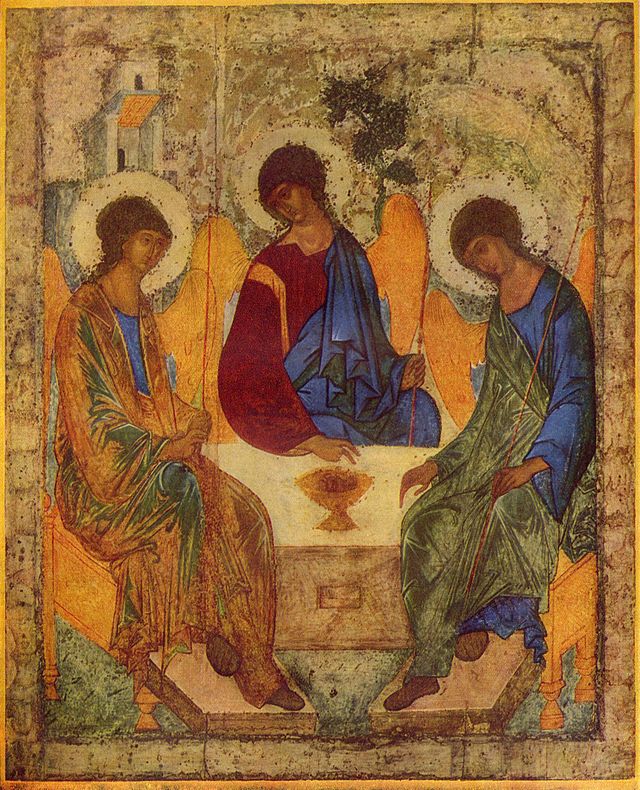
The Church as God’s Icon: Blessed Trinity


In the Orthodox tradition, the church is the icon – the visual sign and symbol – of the Trinity.*  Unity is
the point: from many, one.  We – the church – are the incarnation of the Trinity in the present tense.  Us.  Thus can we not be separate or separated, for the Trinity is not a unity of decision or will; rather, the Trinity is a unity of identity – unity is an integral part of who God is.  And because it is a unity of who God is, it is a unity of who we are.

Consider the Trinity: we understand God the Father, God the Son and God the Holy Spirit to be One, united in all respects.

Polytheistic beings (such as the gods of Greece and Rome) can and do disagree and have conflicts with each other.  Not so God – God as one, Father, Son and Holy Spirit, a perfect unity, does not conflict, does not disagree.  Reform theologian Karl Barth said it this way:  “The Father and the Son and the Holy Spirit are not names for different parts of God, but one name for God.”

And by extension, we the church are as God the Trinity: many and one at once.  Recall Jesus’ prayer in John 17.22 – “that they may be one as we are one”.  Who are the “they” of Jesus’ prayer?  We are.

As God’s icon or sign of God’s own Trinity-self, we are:

1. Invited into peace with God – invited by Jesus, who gives us in the form of his very self, an introduction letter to God.  Paul makes it clear that justification by faith is not so much a doctrine to be understood as the gift of wholeness to be received.  Peace with God is a grace, a gift, we receive, not a prize we earn.  Peace with God by the grace of God is the only solid ground, the only standing place, we have.

2. A looking forward people, looking into the very glory of God’s own self.  Looking back – back to who or what we were before only freezes us in time and turns us into useless pillars of salt.  We are to be, because we are, a forward looking people – looking forward and leaning into God’s own glory, which like the pillar of fire and column of smoke that led the Hebrew people out of Egypt and into the promised land, leads us into God’s own self, which is our promised land.

3. We are a poured forth people – just as Woman Wisdom, God’s Holy Spirit, was poured forth from before the beginning of time, through that same Spirit, God’s love is poured forth into our hearts that we may be daily poured forth into the world.

So church is the icon, the symbol, the sign, of God as Trinity – we many together as One are the sign to the world of the one-ness of the Loving God.  We’re the peace sign to a world at war with itself.  We’re the grace note to a world of discord.  We’re the solid ground, the standing place in a world off kilter.  We’re the glory of God shining into the darkness.  We’re the patient ones in the face of suffering, showing that there is nothing to fear.  We are the love of God poured forth into the heart of a world stretched beyond its patience, near if not beyond its own breaking point.  We are the heart of God laid bare to the world.

That, friends, is who we are. . . blessed Trinity.


__________________
See The Church - an Icon of the Holy Trinity


Saturday, June 14, 2014

It's an And World


So saith Julian*:

Truth sees . . .
Sees what?
All?
Or nothing?
Sees how little it sees?
Knowing itself to be so small,
it cares not how little it knows,
rejoicing in the enough, the sufficiency
of its tiny knowing and calling that good and good enough

Wisdom contemplates . . .
Truth
beauty
longing
knowing
not knowing
fulness
emptiness
the all-ness of The One
the partial-ness of itself
limits and eternity
bounded and boundless
love and hate
truth and lies
will and surrender
the bigness of the small
and the smallness of the big
words written on the page and in the heart
sung by the birds and children and operatic maestros

Love arises . . .
as Truth sees
and Wisdom contemplates
and all is well and very well
indeed
for Love arises
again
and again
and again
and and and


_______________
*Inspired by the writings of Julian of Norwich


Wednesday, June 4, 2014

A Trinity of Things


I love the Celtic prayer habit of three-ing everything.  There’s just something about things in threes that satisfies me like the evenness of twos and fours never can.

Thus do bacon and eggs never satisfy without a side of fried potatoes or at the least, a piece of toast.

And oh, how I wish socks were sold in threes, for I am inevitably set on losing one, leaving the other lone sister abandoned, unwanted, in the dark reserve of the drawer of abandoned things too good to throw away or hurled to the rag pile, this perfectly fine sock with no mate.

And if there be PBJ in my future, I’ll wait until I have a banana for that perfect trio of flavor.

And what are pencil and paper with no story?  Or a hammer and a nail with no hand?  Or a pair of pants with no legs?  Or spaghetti and meatballs with no scooping, sopping garlic bread?  Or peaches and cream without a spoon?  Or Fred and Ginger without the band?  Thunder and lightening without some rain?  Sound and fury without a thing signified?  Sheets and pillowcases without a bed?

A father and a son without a she-flying-the-waters-of-time, wisdom-bearing-carrying, life-breathing-love-giving oh-so-holy spirit?

Ah, yes, I do love the trinity of things.


Sunday, May 26, 2013

Sermon Cliff Note: How God Is Is Who We Are

To understand God as Trinity is to understand ourselves as church.
In the Orthodox tradition, the church is the icon – the visual sign and symbol – of the Trinity.  We – the church – are the incarnation of the Trinity in the present tense.
Trinity is not a unity of decision or will; rather, the Trinity is a unity of identity – unity is an integral part of who God is.  And because it is a unity of who God is, it is a unity of who we are.
But what does it mean to be one?  As Paul points out in 1 Corinthians 12:
For in the one Spirit we were all baptized into one body . . . the body does not consist of one member but of many.  If the foot would say, “Because I am not a hand, I do not belong to the body,” that would not make it any less a part of the body. . . there may be no dissension within the body, but the members may have the same care for one another.  If one member suffers, all suffer together with it; if one member is honored, all rejoice together with it.  Now you are the body of Christ and individually members of it.
Thus, quite literally, to wage ‘war’ against each other is to wage war against ourselves.  In a very real sense, if I kill you, I die.
I am church and so are you, for without you or without me, there is not church, for we are always and only church together.
A poured forth people, we are God’s own icon. . . of the one-ness of the Loving God.  We’re the peace sign to a world at war with itself.  We’re the grace note to a world of discord.  We’re the solid ground, the standing place in a world off kilter.  We’re the glory of God shining into the darkness.  We’re the patient ones in the face of suffering, showing that there is nothing to fear.  We are the love of God poured forth into the heart of a world stretched beyond its patience, near if not beyond its own breaking point.  We are the heart of God laid bare to the world.
That is who we are.

Saturday, March 3, 2012

Affirming My Faith


I believe in a Father who so loves his children to wait in silence for their return in order to give them the best robe, kill the fatted calf and celebrate the feast of reconciliation.  Parent to child – is this how I see God?  Mostly yes.  Mostly I image God as a lap, comforting, welcoming, waiting to be climbed into, lifting up to, lap.  And God-silence is one of my favorite things . . . it is the silence of new-fallen snow in the nighttime. . . silence that is full, not empty – full of promise and possibility, safe haven and love – the silence where nothing need be said because all is understood – the comfortable silence of the life-long known to one another.  I yearn into that God silence.  The feast is just a bonus.

I believe in a Spirit whose power is not revealed in the thunder of the gale nor in the dread of the earthquake but in the still, small voice.  I do believe in the Spirit and the silence, but I revel in and cherish the thunder of the gale and need the dread of earthquakes in my life.  The gale and thunder reverberate down the very molecules of me, ever reminding that safe is not predictable . . . that love is not definable . . . that sometimes God is the storm and that, too, is good.  And earthquakes – how they show me that any ground that I stand on that is not God is uneven at best and perilous dangerous at worst.

From Holy Cliparts
I believe in a Son who broke the power of Silence with the piercing cry "My God, my God, why have you forsaken me?"   This I understand best of all . . . who, this side of heaven, does not?  Anguish is as much of God as joy – how could it not be when so much begs to be cried out against?  How can our hearts not be pierced when God’s own is so wounded?

Dying on the cross he transformed the silence of death into the death of every silence.  Capital ‘S’ silence . . . the fear that there is nothing after all . . . nothing to believe in . . . to rely on . . . to commit to . . . that is the Silence that dies . . . falling into the loving noise of God’s own home welcoming.  And that is very good.

_____________
Affirmation of Faith is from  Massimo Aprile, Italy. In: Rete di Liturgia, 1996, No. 2 © Rete di Liturgia.

Saturday, February 18, 2012

A Far Humbler God


“[In the contryside, I grew up] listening to the counsel of a far humbler God than He who guided the untroubled conscience of the British ruling class.”  –John LeCarre, in his 1989 Introduction to his 1962 novel, A Murder of Quality.

Yesterday’s weekly meeting of ministers preparing, praying, and pontificating (yes, we do that even amongst ourselves), focused on Jesus’ time in the wilderness as told in the Gospel of Mark.

During our discussion phase, dear friend and wise man Bill Cox raised the question: did Jesus know who he was before he was baptized and sent into the wilderness?  Or was Jesus’ own identity revealed to him over time?

And if Jesus was not self-aware that he was and is God, does that mean that he was somehow separated from the Trinity?  Or, perhaps even more radical, did the very Trinity itself become so self-emptied that She/He/They/It (have you ever noticed there’s no good pronoun for the Trinity?) lost or stepped away from identity in those moments in historical time we Christians think of as the life of Jesus?

In other words, what does the wilderness, the place where God is, or at the least, seems, absent, look like when God’s very self goes there?  Can God be absent from God?

It’s a frightening proposition: that God’s entry into time and space was so radical that God’s very self is affected somehow, fragmented even.  We speak of the cost of the cross to God, but seldom think on the cost of being human to God.

Greeks saw the gods in time and space as cavorting sportsters, having fun usually at human expense.  Bill’s question, however, suggests a far graver idea: that perhaps God lost God’s own self in coming to save my and your self.

It is a vision unsettling, this idea of a far humbler God.