Showing posts with label soldier. Show all posts

Thursday, May 29, 2014

I Remember Viet Nam


Yesterday I listened to an NPR story of recovered reel-to-reels of young men headed to, in the midst of, and
some not making it home from Viet Nam.  It is a gut punch to hear their young selves in that crucible time, especially the one who didn’t make it home.

I listen and I remember . . . being a child a teenager and the television news and Walter Cronkite’s voice bringing us the news and images of war never the likes of we had seen and heard before or since, while eating my supper. . . body bags and body counts and children and tall grasses blowing from the winds of helicopters hovering above . . . marches and protests and anger in our streets and our homes . . . I remember I was opposed to the war – Viet Nam is why I became an aspiring pacifist.

I remember my Uncle Richard being there and worrying about him and the few stories he would share when he came home – bombs in baby diapers and jeeps exploding in front of and behind him.

I remember it ending and friends like Walt being spared being sent and numbers taking on desperate meaning as the draft lottery decided who went and who stayed.

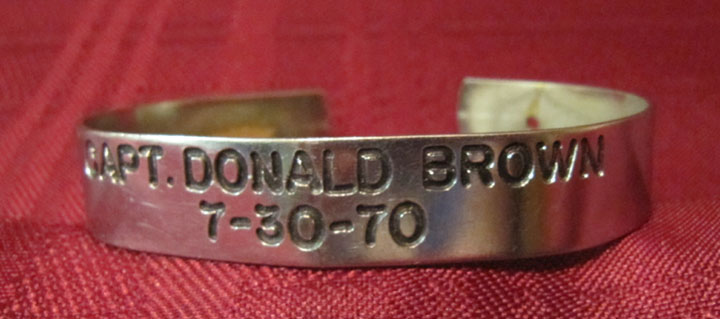
And I remember the POW/MIA bracelets

I wore mine until it broke – snapped in half.

I do not remember the man’s name on the bracelet I wore.  I kept the two broken pieces in my jewelry box for years.  I do not remember when I decided to let it go and leave it behind.  I do remember he was MIA, my soldier.  I was not a person of faith at that time, but I suppose in some way, the thoughts I kept of him formed a prayer of sorts.  I cannot know what happened to him as I cannot even remember his name.  And that troubles me greatly.  How could I have remembered so much and forgotten his name?

Tuesday, November 20, 2012

Thanksgiving Cigarettes


It is March, 2006.  I am sitting on a bench outside a quonset-hut type structure at the Mortuary Unit offices at Balad AFB near Baladiat, Iraq.  I am waiting to learn whether I will be given permission to accompany the remains of my colleague, Tom Fox, home (I was not).

In the waiting hours that stretch into a few days, I sit and smoke cigarettes and listen and talk with the young soldiers of the Unit.

One fellow (from Kentucky, I think) remembers Thanksgiving, 2005.  He was there at Balad.  Secretary Rumsfeld had come to heavily-fortified BIAP (Baghdad International Airport) and had a Thanksgiving meal – turkey and all the trimmings – with a select group of military personnel there.  The meal was shown on television back home.

The young man sitting beside me in the dark laughs the bitter soldier-laugh of one far too young for such ‘wisdom’ and tell about how his mother was so excited that he had gotten to have such a fine meal.  No matter what he told her, no matter how many times he explained it, she could not or would not believe that he and his compatriots had not been given the same treat – that this was a photo-op and he was not included.

I remember that moment when and if ever I am tempted to discount the impact of propaganda: there is a mother’s son somewhere whose mother will not believe that he did not have a wonderful, peaceful Thanksgiving respite, for she will believe the evidence of her eyes over the claims of her son who was there, living the reality the tv never showed.

CPT (Christian Peacemaker Teams) gave me many gifts; one I was not looking for was the unique vantage of standing at the margins of things.  Even when my team and I were center stage in tragedy, a place we neither sought nor desired, we still stood at the edges, from where we bore our witness.

You learn many things from the margins.

One of my reminder lessons is that most soldiers around the world today or any day, will not be feasting on turkey with all the fixings.  Most of them will be eating some version of MRE’s when in field.  The ones from the US are well fed.  But they’re not at a party.  And neither are their enemies.

The obvious lesson: that whenever you see old men in suits in war zones, know that what you are seeing represents not reality but stagecraft.

The deeper lessons reside in the dark behind lit ends of cigarettes.

Tuesday, December 6, 2011

When Is a Soldier Not a Soldier?


When is a soldier not a soldier?  When he or she is a mercenary . . . or part of the growing “private military”, also known as private security contractors (PSC’s).

In Iraq, a soldier is not a soldier when he or she is in country paid indirectly rather than directly by the United States government.  A soldier is a PSC and not a soldier when he or she works for a private contracting firm receiving billions of tax dollars for the privilege.  A solider is a PSC and not a soldier when he or she can act with impunity in violation of local, national and international laws without consequence.

In practical terms, when I have encountered enlisted US military soldiers in Iraq, they were eager to hear a word from home, and apologetic of their limitations in hospitality (such as forcing Iraqis to remain standing in ankle-deep mud in the cold and rain for an ‘audience’ with a higher up, while inviting westerners inside for warmth and comfort. [Side note: we stayed outside with our Iraqi friends]).

When I have encountered private contractors, whether security or otherwise, they have refused eye contact or engagement, have fired upon a vehicle I was riding in (a ‘friendly’ warning shot), have been rude to Iraqis and others, and have generally created a cringingly bad impression of the United States and its citizens, to say nothing of their actions of violence towards the unarmed civilian population whose language they do not speak and whose cultural norms they apparently do not care to understand.

It is widely reported that the United States is leaving Iraq effective December 31 in terms of its military presence.

Which brings us back to the opening question: when is a soldier not a soldier?

The fact is that the United States is not leaving Iraq in terms of its presence of force.  Security contractors will largely take the place of US military personnel.

And whenever government officials of the United States, whether Democrats or Republicans, speak of our forces in Iraq, they studiously avoid mention or inclusion of PSC’s, who, for some time, have actually made up the majority of our on-going presence in Iraq.

Honesty and integrity loathe the misuse of language and false categorization that create this mass denial of reality.

Why is it so important that the American people be led to believe that our occupying presence no longer exists in Iraq?  Why do we so misuse language that it no longer effectively communicates anything of importance?

When did Jesus’ admonition, elegant in its simplicity: Let your yes be yes and your no be no, get forgotten in our collective consciousness?

When did a soldier stop being a soldier?