Friday, May 11, 2012

Locking the Church Doors


Blessed are those who throw the church doors open wide.  –Kathleen Norris

Last Sunday I headed to church in Girvan.  I remembered that it began at an unusually early hour, but I was still late, dawdling the morning away.  I kept dithering about whether to even go or not, as I well knew the doors would most likely be locked when I arrived 5-10 minutes late, depending on my walking pace.

Photo by Dennis Behm at Creative Commons
But I went.  And sure enough, the front doors were locked tight.  I could hear singing inside, so I knocked, hoping to be heard, but alas, I was not.

I went around back and found the door to the choir room and the youth room in the separate building both open, both empty.  I went into the choir room and sat down.  I went back around front and tried the door again, thinking that perhaps it was unlocked but heavy to open – wrong.  I went back to the choir room.  I thought about leaving.  I stayed, knowing that the children would come out after the children’s sermon for Sunday School and this was their only route of escape.

A few minutes later, the Beadle came out with the kids following and with his reassurance that all was well, I scooted in to a side pew and joined the worship.

But as I had wandered about trying to get in to the worship space, I was, as I always am, struck by how difficult it can be to actually get inside a church.

This time, however, I vacillate between Kathleen Norris’ benedictory command to fling the doors open wide and wondering whether it might not be better somehow to have to struggle to gain access.  But even as I ponder, that doesn’t feel right.

I am lucky enough to ‘belong’ in the sense that as a minister, church buildings are innately familiar territory to me – going in back doors might feel a bit intrusive, but I’ve no compunction, really, about doing it.  I’ll wander in the kitchens, stand in the pulpits, look under, over and around things as if I have a right to.  I think we all do, but familiarity of landscape makes it a lot easier for me.

Which brings me full circle in my ruminations that particular Sunday: I was wrong to be late.  But many of us come late to God’s party one way or another.  Now there may come a time when it is too late, as the parable of the bride’s maids suggests.  But that is for God, and not for the likes of me, to decide.

In the meantime, I feel blessed for all the church doors I’ve come across, those closed tight and those open wide; but I have to admit – I see the arms of God in the church more clearly when the doors are flung open into the morning sun.

Thursday, May 10, 2012

A Great Recipe + A Bad-Cooking Day = Disaster


Yesterday I revisited a common plight when visiting or living in another country: nothing is the same as it was at home – nothing.

If you’re a creative cook, this can make for great adventures.  If, however, you’re more like me and require a recipe road-map, this can lead to disaster – a lesson you forget at your peril.

Fortunately for me yesterday, I was cooking for a palate of one, so I can truthfully disclaim that no guests were harmed in the preparing of this dish.

What Sandra's ravioli should look like!
There is a recipe from Sandra Lee's  Semi-homemade Cooking television show that I absolutely love to make and to eat – White bean ravioli with brown butter and caper sauce.  It’s really quite good.  And to reassure you of that certainty, I refrained from taking a picture of what I managed to ‘create’ yesterday.  If you want the recipe, just click on the link above and banish all images of the below-described fiasco from your mind - this does not have to be your fate - I promise!

I had the beans I needed, but no blender or food processor, so I tried mashing them first with a fork and then with my hands.  It’s not as easy as you would think to get a bean puree by hand.  I looked at the clumpy mess I had created, reminded myself that I was dining alone, and proclaimed, Good enough!  Mistake #1.

Next I learned that no matter how finely chopped something (even something like cheese) is, finely chopped is not the same as grated.  The results are predictable, as your cheese absolutely refuses (who knew cheese was such a wilful beast?) to melt/combine/play nicely with the other ingredients.  Mistake #2.

I relearned that at some point, persistence moves from being a virtue to being its own worst-enemy kind of vice.  They didn’t have wonton wrappers at the store, so I got some fresh thin lasagne noodles instead.  But no matter how thin, unless homemade, a lasagne noodle is soooo much thicker than the wonton wrapper or the ravioli pasta that the restaurants make and use.  Thus my spooned in mixture would not be contained in the lovely triangular-shaped pasta purses I had envisioned – the dough simply broke in half when I folded it.  That’s when inspiration (translate insanity) struck: I would boil the pasta for a few quick moments to soften it up (and make it wet and slippery and impossible to work with) so that it could be folded.  Still it would not stick to itself no matter what I did.  So finally I rolled little tubes around the bean mixture, laid them in a glass pan and poured boiling water over them (this was after I kept trying to flash boil them in the water on the stove, only to have the bean mixture slide out of each little triangle, tube and other shape I tried to create).

That worked after a fashion, but what I ended up with on my plate after I had dirtied about every dish in the kitchen was fried beans with some buttered fried pasta atop them.

No worries, I thought to myself – it isn’t how a dish looks; it’s how it tastes.  Of course, I was delusional by this point, forgetting everything I have learned from the most basic of cooking shows: people eat first with their eyes.  And in this case (as is, I suspect often the case), what it looked like was a good predictor of what it would taste like.  Mistake #3

Finally, this isn’t my first kitchen disaster and it won’t be my last.  The difference a bit of age has brought to me is that I know that. So after a few bites, I resigned myself to throwing the mess away.  Maybe that’s wisdom.  Final Lesson #4


_____________________________

Mistakes/Lessons
1. What you wouldn’t serve to/give/present to an honored guest, you should not serve to/give/present to yourself - for you are your own honored guest.

2. Instructions are offered by those with more knowledge than I possess for a reason.  They are usually not intended as suggestions and I ignore them at my peril.

3. Know when to quit.  Think Kenny Rogers here.


4. “Try again, fail again, fail again better.”  –Samuel Beckett, quoted by Chef Tamasin Day-Lewis in Don't Try This at Home: Culinary Catastrophes from the World's Greatest Chefs , Kimberly Witherspoon & Andrew Friedman, Eds.

Wednesday, May 9, 2012

Who Sends Their Children to Die?


Some years back while I was in Iraq, an Iraqi woman, serious and intent, seeking an equally serious and intent response, asked me, “What kind of people are you?”

Somehow I knew what would come next, but she explained to make sure I took her meaning: “What kind of people are you that you send your children here to die?  Who does that?  What kind of people are you?”, her voice rising with each word.

Years later I sit in a borrowed vacation home in Scotland, in one of the most peaceful and safe places perhaps on the entire planet.  Surrounded by beauty and safety, I read novels set in war times.  I don’t know why I do it – this self-inflicted wounding, for that’s what it is.

Sometimes I simply seek understanding through art.  But for all the beauty of the well-told story, they all, whether standing on the side of peace or war . . . they all slide down the slope of inevitability – the biggest lie of all.

And I am sick of it – heart sick and soul weary of this lie we humans proclaim as if it were wisdom, as if it were true: the lie that war and violence are inevitable.

For here’s the thing: that something has been done and has been done often does not make it inevitable.  We are the inevitable piece.  Our participation is what creates the reality.  We choose, and in our choosing, determine whether lions and lambs will or will not co-exist in peace or move on towards destruction.

In the book Resistance by Welsh poet Owen Sheers, a woman of the country whose husband disappears into the night to fight with the resistance cries out in her heart against the notion that Tom had gone to defend his country:  “She was his country and she was in need.”  Tom chose and in the choosing of one thing, abandoned another.

And now I read Remembrance about WWI.  Among the characters is a young man who fervently believes not in pacifism, but in his own certainty that the so-called war to end all wars is wrong – foolish, wasteful, and wrong in its aims and objectives.  And yet he too goes after a period of some resistance.  He goes because the very things he believes are true strike his own family.  He goes to die because others he loves have died – not out of revenge or any change of heart about the rightness of the ‘cause’, but because some internal sense of honor tells him that because these have died so too must he.

It is the worst, the most pernicious, kind of lie, this lie in our fiction as well as in our fact, that a social decision to war has a claim of inevitability upon our hearts, against which we can do nothing but acquiesce.

And it is an outrage.

It is the outrage of the broken widow women at their sinks, the same women who applauded the sending of their sons as well as husbands, to the killing fields.  Do we really so lack in imagination that we can little foresee that what happens to other sons and daughters will happen to ours?  When the telegram comes, how dare we be surprised?  And yet we are and continue to be – deluded, surprised, taken aback by the horrors we so carefully orchestrate that it can hardly be other than thus.

I read and I remember the diaries of my Grandfather from World War I and his two sisters from World War II, particularly the writings of my great aunt Lucy.  I remember her blithe tales of her times in North Africa and Italy, of sun-bathing picnics with officers and teas, dinners and dancing, and I am staggered with the anger I feel towards her.  How dare you, Aunt Lucy?  How dare you lie so even in your own private diaries?  Even when she writes to herself, all she speaks of are light-hearted things, as if she were on her own Grand Tour of Europe.

Here’s the thing: if, and it should (although seldom is) always be the biggest of all ifs – if we are to head to war, ever, then should it not only be after the gravest consideration by us all of the great cost to ourselves and to the others, even and perhaps especially our enemies?  Should not those who have been there before recite with the most somber of tones the enormity of what is to be encountered?  Should we speak not of parades and parties and shining uniforms, but of dirt and grime and death and killing, of those who will never come home and of those who will – but never the same?

How could my ever-so-brave great aunt leave only a legacy of lies?  How could she do that to us who came after?  How could she not see?  Or if she did see, how could she not tell, even herself?

I read and ponder and I walk this ancient land pockmarked with memorials not to the dead, but to their wars.  The one thus far leaving me most puzzled, most troubled, most amused, is perhaps also the most telling of such things:

Near Girvan, in the village of Lendalfoot, along the shore of the Irish Sea, stands a bulky iron anchor monstrosity of a monument, with commemorative words written mostly in Russian – yes, Russian.  What little English there is tells of the life of a Russian ship named Varyag, hailed as a “a symbol of courage and heroism of Russian seamen all over the world.”  Girvan online

The Russian cruiser was blockaded in 1904 by the Japanese at a Korean port.  Refusing to surrender, a battle ensued, the ship was damaged, and her Russian crew scuttled her and escaped back to Russia.  The ship was raised by the Japanese in 1905 and renamed Soya.  In 1916, Russia bought her back and she was renamed Varyag.  In 1917, she was sent to Great Britain for repair, but (here’s my favorite part – saying so little, it says so much), “. . . because of the revolution and civil war in Russia, the legendary ship was set adrift.”  No explanation is offered as to just who set her adrift (I’m guessing the British) or why (I’m guessing they were on the side of the Czar, who was losing the fight).  Again without explanation, it is noted that in 1920 (what happened during the 3 years she was ‘set adrift’?), Varyag was sold for scrap to Germany (sold by whom, one is left to wonder).  And let us note that within less than two years of the end of World War I, someone (I’m guessing Great Britain) is selling off the parts of war ships to the Germans, in what would have to have been a stretch of thinking to be legal under the terms of the Treaty of Versailles, which allowed the German nation only six naval ships.  Again, I’m guessing that the rationale went something like this: these are spare parts and the treaty says nothing about parts, after all.  But not to fear: on the way to Germany for dismantling, Varyag grounded and then sank near Lendalfoot.  And almost 90 years later, a monument is erected to the ship and her crews by the Russians on Scottish soil.

There it is; I’ve seen it with my own eyes: a monument to something rather different than the courage of the seamen who manned her 80+ years ago, I’d say.  Rather than a monument to the seamen of an obscure confrontation in an all-but-forgotten page of history, this monument stands as a wonderful articulation of the history of war and conflict: the Russians and the Japanese fight over a Korean port, each taking from the other and from the foreign soil they invade with their claims, and decades later, one side dares to call that venture epic and heroic.  I wonder how the Koreans tell the story?  Years pass and the armament in the form of a ship is bought back by one side from the other in the previous conflict.  Years pass and a third party refuses to repair the ship because of the shifting political tides within the country which owns her.  Rather than repair her, they set her adrift and then reclaim her to sell her for parts.  It’s such an elegant traipse around the law of the sea, isn’t it?  And of course, her parts are sold by one old enemy to another, with both turning blind eyes to the treaty that would make such a transaction illegal.

And to celebrate all this wonderful history of back-stabbing, war, treachery, and business as usual in the midst of it all, all sides get together and build a monument to it, without the least sign or recognition of irony.

God, how I hate this planet some days.


Siegfried Sassoon, Suicide in the Trenches (1917)

I knew a simple soldier boy
Who grinned at life in empty joy,
Slept soundly through the lonesome dark,
And whistled early with the lark.
In winter trenches, cowed and glum,
With crumps and lice and lack of rum,
He put a bullet through his brain.
No one spoke of him again.
You smug-faced crowds with kindling eye
Who cheer when soldier lads march by,
Sneak home and pray you'll never know
The hell where youth and laughter go.

The Iraqi woman’s question still begs to be answered: what kind of people are we that we would send our young to die in such a place, in such a way, cheering as they go?

Tuesday, May 8, 2012

Scotland Days24-25: Book Towns & Folk Festivals


Road into Wigtown

Only in the UK have I encountered places that define themselves as ‘book towns’: Hay-on-Wye in Wales has to be the best book town ever, but Wigtown near the Scottish borders with England, is a quaint, if distant, second and Saturday, I traveled to Wigtown to check out their spring book festival.  I don’t know how it started for Hay-on-Wye, but Wigtown apparently made a self-conscious decision to become a book town (simply meaning a village with more than one used book store, as best I can tell) in an effort to promote tourism.  Well, it got me there.  And I did buy some books.  So good on Wigtown.

Samba Fusion on the green at Wigtown
The Samba Fusion rhythm playing and dancing on the green was a bonus, especially since the folks doing most of the playing and dancing were old enough to be my parents – their percussive downbeat an ironical contrast to the complaining of the Englishman at the adjacent table in the café where I enjoyed some potato-leek soup and the best ham sandwich I’ve had in a long time.  They would beat, he would complain and then they would beat again, only louder, as if they could hear or sense his displeasure.  It became quite comical, this contest of sound.  But of course, the drums won.  Don’t they always?

The main surprise for me were the comparative numbers of Englishmen and women to Scots: just about everyone I heard had a distinctive English accent.  Then I remembered how very close to the border with England I was.  Going north for a day seems to be a good past time when the weather accommodates the journey.

Ailsa Craig and could that be Ireland behind?
As they had a beautiful drive north, so I had just a beautiful long drive meandering south along the western coast, with fantastic views along the way of the Irish Sea.  It was a clear enough day that I really do believe I spied Ireland across the way behind Ailsa Craig.  It’s only 30 miles or so, so maybe I did.  Or maybe it was low-laying clouds.  Doesn’t matter – whether I saw it or not, I know it’s there.

But the Ireland connection was brought home more firmly the next day.  After church (I was late, the door was locked in typical Scots fashion - more on that another time), I meandered in Girvan to one of the local venues for their annual Folk Festival.

Recitation winner reciting The Twa Dogs
I headed to the story-telling location and was treated to stories and recitations enough to delight for a long time to come.  The recitation that won was a gentleman doing The Twa Dogs by Robert Burns.  He was fabulous, with two hats with dangling ears he’d switch off as he took the part of the high-born dog and then the lowly dog of a poor house, each to espouse the advantages of their respective ways of life.

And I met an Irish Scot, a Protestant Republican.  I leave the politics and legacy of that one to those more politically and culturally astute than I.  But he was a raconteur of the first order in his own right and made for a very enjoyable time as our erstwhile host.

Outside, musicians gathered round the tables of the hotel’s sidewalk café and played and sang – guitars and mandolins and a recorder that broke your heart with each note.  And to my surprise, much of the folk music played was Irish and told the stories of migration to the United States, particularly New York.

This wasn’t one of the venues; it was simply where some musicians sat down and started talking with each other and randomly playing, taking the center by turns, with we non-musicians graciously allowed to sit and stand at the periphery tapping our toes and wiping our eyes.

Whatever the day, when you encounter people making music as you walk by, that, friends, is a blessed day.  And so it was.

Friday, May 4, 2012

Scotland Day22: Greenock


I am delighted to be back in Greenock where I have so many wonderful memories of my time as a student minister.  The filled roll at West Station Café is as good as ever – jokingly, I told the waitress I came all the way from America for it.  I recommend hard-fried egg, tomato, bacon and cheese, the mere description of which makes friend Charlie cringe at its artery-clogging capacity.  But trust me, if you like greasy fried foods, this is not to be missed.

Standing atop the Lyle Hill still manages to take my breath away; it is a sight that never grows old.  A bench bears a commemoration to a man, the memorial reading, “He loved it here . . .”  I can give this place no more fitting descriptor.  The Cross of Lorraine combined with an anchor commemorates the Free French naval forces who fought for their lands from Greenock in World War II.  On this day, it is as if the clouds opened to shine upon the scene and I wonder what exactly God is blessing in this moment.

Friend Stuart and his faithful companion Jura, a wonderful gal of a dog in her old age catch me up on all the happenings since last we met.  Cameron, Rachel and Fraser just grin at my awe at the changes time has brought to them – even three years is an eternity in the life and framework of the young and they are barely recognizable from when last I saw them.

Christine and Charlie regale me with tales of their own travels and when I leave, Christine presses into my hand a wooden angel made as dedication to God by a Catholic man and I am more moved by her gesture than my words can say.

Alison feeds me, houses me, walks me briskly round the Esplanade, and generally nourishes my soul.

There are more friends to see, but they’ll have to await another time.

For now, I stand in front of the tenement building where I lived, occupying the top right flat (auspiciously now for sale) and just soak it all in.

Scotland has always been good to me.

Lucky, blessed, am I.

Thursday, May 3, 2012

Scotland Day21: Why Do Old People Cross the Road . . . Here?


Signage is just another wonderful aspect of culture and its differences met in travel.

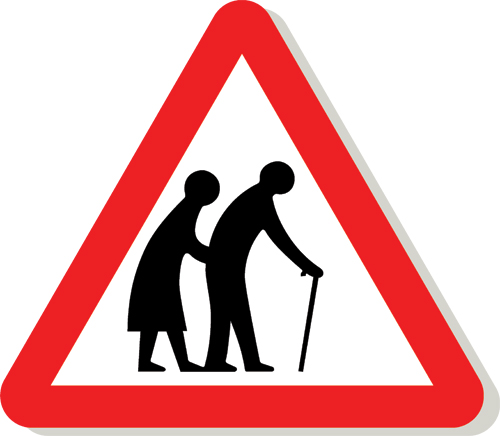
A favorite of mine in Scotland has to be the elderly people crossing signs.

A much younger and much less kind me would have made crude jokes about how thoughtful it was for the locals to provide a place to line up the old folk so we motorists could knock them down in a form of driving sport.  I would have been joking -- of course.

The middle-aged me often wondered how on earth the local authority knew with any certainty that here, right here, is where the old ones will actually attempt to cross the road (much like I wonder the same thing about deer crossing signs along the roadways back home).

The approaching old me is now both grateful and petulant at the same time (a sure sign of old age, I’m guessing): it seems thoughtful that someone would provide a place for me to cross the road, but generally, the crossing is never where I actually want to cross the road, making it more a bother than a blessing.

And if you aren’t from these parts, aren’t familiar with the sign convention for identifying road crossings, all you will see is an odd picture of old people, and here in Scotland, anyway, lest you misunderstand, a written sign below simply saying ‘Elderly people’, which, absent some additional necessary information, would leave you wondering why on earth the Scots choose to alert you to the presence of the elderly.  Do the Scots segregate their old?  Are the elderly in Scotland remarkable, somehow?  Should I as a tourist get out my camera and prepare to take a picture of some spectacular, one-of-a-kind old people?  Why, exactly, are you telling me this?

Which takes me back to one of my own travel axia: Signs are helpful only to people who already know where they’re going and what they’re doing.

Case-in-point: signs are seldom, if ever, placed where the eyes of the uncertain will alight on them, let alone have time to read and comprehend them.  You think I exaggerate?  Consider: in Glasgow (perhaps in the whole of the UK), street name signs are often actually on buildings.  Once you figure that out, you’d think you had it made, but no, for seldom, if ever, are they on the same spot on buildings – some are high up; some are quite low to the ground; some are right at the edge of the building, some are quite far in; some are on the building on the left side of the road; some on the right.

Emerson might be right that consistency is the hobgoblin of the little mind, but it is the savior of the traveler attempting to read the signs.

So on behalf of all the travelers to the UK, I would like to say a hearty thank you to the sign folks for alerting me to the presence of the elderly in my travels and to the elderly who are apparently sufficiently thoughtful to cross the road where they have been told they may.


Wednesday, May 2, 2012

Scotland Day20: From the Sublime to the Ridiculous and Back Again


I visit the Crossraguel Abbey ruins on my way to Girvan on the western coast of Scotland and like any good tourist, I take all the free literature on offer and snap pictures that years from now will make absolutely no sense without a remembered context.

And that’s kind of what the ruins themselves seem like to me: a thing that makes no sense without its history remembered.  Thus do they become sublimely ridiculous and wonderful all at once, their own context having slipped into history long ago.

Abbies are places where people lived out the entirety of their lives, so in addition to worship spaces, there had to be places for beds and places for latrines.  And here remain evidence of all three and more besides.

And two of my own favorite views were views not available at the time the Crossraguel community was active, way back before the Reformation:

The view of the cross against the sky while standing within the choir (what my lot would call the   sanctuary or simply the church), for the simple reason that there would have been a roof impeding the view.  Looking toward the cross, one can actually still see the roof line.  It seems somewhat ironic, in a sad sort of way, that what directs my own eye to God (often an upward thing for me) in this space is possible only because the place is in ruins.  When it was a living community, the cross was not there to direct the gaze upward; rather, it stood higher than surrounding landscape to draw the people in for worship – serving as a literal signpost: here’s the church.  People thus could spot it from miles away.  But they were meant not to be sky-gazing; rather, they were meant to be earth-walking.  And that, surely, is the better purpose.  Isn’t it?

The view from through the waterways serves as a wonderful frame for the visual of this quiet space sitting as it does adjacent to the motorway.  The viaduct structures I look through served as the sewage system.  Literally I stand in the midst of the fairly complex latrine system in order to look through, look beyond.  I wonder whether folks in centuries yet to come will one day stand in the places where my own waste once coursed and ooh and aah at the view.  Maybe they’ll read historical records – things like this blog even – and decide to give that particular pleasure a miss.  Besides, I’m pretty sure our plastic pipes, even emptied of all dross, won’t have the aesthetic appeal of the stone-laid tunnels, gulleys and gulches – more’s the pity.  Isn't a society that views even the courses for the removal of waste as things not only of utility but also of beauty, a society from which we might have much to learn?