Showing posts with label Christian Peacemaker Teams. Show all posts

Monday, October 13, 2014

Being a Pacifist in the Middle of a Blood Bath


Even fellow CPTers (Christian Peacemaker Teams) are writing about how hard it is to reconcile their pacifist ideology with what to do to provide real help to real people in real danger from real violence in light of recent events in Syria and Iraq.

I think the word ‘ideology’ is actually the problem.  And I speak only for myself, which is, I think, at the heart of the issue.

I do not proselytize pacifism.  It is simply who I am.  My views and, I hope, my actions, are shaped by this.  But what you do with that is up to you.

It goes something like this in my head: I am not a Yazidi and I am not stuck on a mountaintop with people surrounding me who wish to kill me.  Thus it is not for me to say what they should do.

My pacifism leads me to live out the reality that for the dangerous places in which I find myself, for myself, violence is not, cannot be, the answer.

That does not mean that I do not have violence in my heart.  I do.  It is precisely because of the violence in my heart that I am a (work-in-progress) pacifist – because I know that my violence towards others has absolutely nothing to do with love, not even love of self, and everything to do with satisfying that peculiar hunger that lives within me.

My pacifist understanding leads me to take the route of non-violence, even in resistance to violence from others.  So my mountaintop dangerous experiences are just that – dangerous.  But my response to them is a response of non-violence, even should that mean my own death, for I am convinced that God values the one who would do me harm as much as God values me.  And knowing this with absolute certainty, I cannot be the instrumentality of their demise.  I simply cannot.

For me, this also means that I would never desire that any person act in any way to preserve my life at the expense of their own or someone else’s.  That is a burden I simply cannot carry.  And I know it asks much, perhaps too much, of others, who may well feel that they have become the instrument of my demise by not acting violently towards this proverbial other, should the situation ever come to pass.

But this is not hypothetical for me.  I mean it.  When I joined CPT, I did the work of counting the cost, including the cost of my own life.

In practical terms, what all this means for me is this:

1. Even if it’s a question of me or him, I choose him.

2. If you have to choose me or him, choose him.

3. That might not be your own choice and I will honor that as best I can in the circumstances – because this is not ideology – this is life and it is messy and my choices are not (necessarily) yours.  What does that mean?

a. it means that I still will not kill another person, even if to save you.  I would put myself between you, but I won’t take their life.  I am not who you want with you as a bodyguard or even as a fellow combatant if violent response is what you require as part of the deal.

b. if you’re asking for the help of someone else who will use violence to your aid, I won’t get in your way, for that is your choice rather than mine to make.

I admit to being surprised by fellow CPTers who are particularly troubled with their pacifism because of the recent actions of ISIS.  They are horrific.  But haven’t the behaviors of violent actors always been horrific?  Did it just get real for the first time for you?  Because it’s been real for me for a very long time.  That doesn’t make me smart or special.  But it does make me clear – if this thing we call pacifism is merely ideology, then it deserves to be thrown out with the trash.  The cost of such a way of life only gets paid when there is violence – unjust, horrible, life-threatening, life-taking, cruel, violence.  The question for me has always been – what is to be my response?  And the answer, at least for me, remains unchanged – I will help, but I will not kill.  Perhaps that makes me useless.  That is not my judgment to make.

But consider this about the recent events in Iraq:

1. These things did not happen in a vacuum.  They never do.  This crucible moment was preceded by countless crucible moments in Iraq before, moments which did not even call for violent solutions, during which we did nothing.  If PM Maliki be the problem, his position is one we established and thus do we reap the whirlwind we created.  I am left to wonder why it is so much harder for us to simply work towards an honest form of government interested in the welfare of its people and so much easier for us just to drop bombs.

2. ISIS has been coming for a long time.  Why the surprise?  Even in immediate terms, the world has known for months about their increasing incursions into Iraq.  And largely, we did nothing.  Where, one might ask, are the UN Peacekeepers?  Where the barriers?  Where the practical steps for evacuation from a coming war zone?  Where the stockpiling of supplies for humanitarian aid?  If this is a crisis, it is one we helped create by our large indifference.

3. Where the world’s outcry when PM Maliki and his folk engaged in similar behavior towards their opponents?  Iraq as a nation has not had one moment of rest since the 1990's and the sanctions imposed not on its leader but on its citizens.  How would one reasonably expect anything but chaos and its attendant horrors with a land that has resources others are rapaciously hungry for and the countries of the world aligned around it to use it as their own version of the O. K. Corral?

4. What have the countries around the world done to offer to take the refugees?  They’re on that mountaintop for a reason.  Fleeing a fearsome enemy, they had nowhere else to go.  And why not?  Why are they themselves not being airlifted out?  Because we, the world, won’t have them.

5. Our prejudices want to have it both ways: we want to condemn Muslims around the world, or certainly in the Middle East, as being barbaric monsters while our condemnation focuses on their victims, most of whom are other Muslims.  Which is it?  Are they barbarians?  Or victims?  Or is the truth much simpler – like all of the rest of us, they’re both?

6. Economic, social, and political upheaval create the perfect storm for the worst of humanity’s behaviors to have free reign.  Everything we have done in Iraq for decades has been towards the certain conclusion that we will and have created a failed state.  We cannot claim surprise at the result.  The cry now for the necessity of violent solutions overlooks each and every step down this path we have taken to its inevitable conclusion.  Perhaps weapons are now our only choice.  But that hasn’t always been true.  And weapons will be a poor solution for the long-term welfare of all Iraq’s peoples.  There is always a what next? phase.  Have we given that any thought?  It would seem not.  Which simply repeats the previous pattern and if we do nothing differently, the same results will certainly attain and only the acronyms will change.  We can do better than that.  The question remains whether we will.

_________________________
I wrote this about 6 - 8 weeks ago and decided not to post it at the time.  Since then, the United States, along with some partners, has sent air attacks raining down on Syria and Iraq, too much for some, too little for others.  And hostage demands and executions have continued.  Today one family has publicly said, while asking that their son be spared, that the price demanded by those holding him is a price they cannot meet.  Actually, they have said it is a price they cannot ‘accommodate’, which is a different matter all together.  I understand what they mean.  At least I think I do.  Prayers continue that the killing madness come to an end.  And that includes bullets and armaments stamped ‘made in the USA’ fired from ISIS hands as well as our own.


Tuesday, August 5, 2014

Hector


The trembling hands . . . 
his trembling hands
exist somehow separate
from him
yet give him away

this man of kind eyes
calm voice
competent presentation

a man composed –
so composed he could be
speaking of the weather

he could be – but he isn’t

But those hands –
their quaking never stops
They give him away

O Lord, where to look?
Everywhere my eyes are drawn
to his trembling hands

like Jesus’ marks
his trembling hands
are the evidence
they give him away
they give us away


________________________
Written in 2005 in Colombia, SA, while on a delegation with Christian Peacemaker Teams (CPT).  Listening to a man named Hector describe the impact of his country's violence on his life and the life of his family, I am struck by his hands, which continuously shake, betraying the seeming calm of his voice, mirroring the violence of his words.

Monday, March 31, 2014

Disappearing the Dead


During my trip with CPT to Colombia in the summer of 2005, we hear about the displaced and the disappeared.  One of the things I notice time and again in lands torn apart by the violence of war is the absence of the men, especially the young ones.  In my prayer journal, I wrote at the time about that absence . . .

Where are all the men?  Dear God, where are all the men?  And what kind of a world have we made when a woman’s prayer of most hope is “let me die first”?  O God, forgive.

Esperanza?  Where is esperanza?  Where is hope?  Donde esta?

Fathers and brothers and husbands and sons killed and killed and killed until there are no more men and women are left to look for and bury their bones.  In this land of widows and orphans, men are literally an endangered species.

With a violent death, is there always frozen a moment, the last ordinary moment, the moment before?  Is it the moment you imagine could change it all if only it were changed?  Left instead of right?  Or is it only the frozen, beautiful moment of before?  The moment just before the moment when ordinary time ends?

Seven years later she still mourns and does not forget that no priest was permitted, no proper words allowed to be spoken, when her murdered husband was buried.  Cut off, under threat herself, she notices the absence; it is a part of the litany of her suffering, their abuse.

They even disappear the dead here.

Tuesday, March 25, 2014

Prodigals Don't Always Leave By Choice


In the early summer of 2005, I traveled to Colombia with CPT.  Among so many others, we meet an older couple whose son was murdered 18 years previous because he went fishing on the wrong day in the wrong place – or so another man with a gun thought at the time.  I wonder if that man still lives and what he thinks of that life he took now.  I wonder if there were other lives taken.  I wonder the cost to him in the taking.  I wonder about wildernesses of our own making, we human-war-making beings.  These are the things I wonder now.

What I wrote, what I prayed at the time, was all about these parents growing old without their boy . . .

Dona Marcelena and Don Juan sit and speak quietly.  Don Juan tells us, “we do not manage the fear; the fear manages us,” describing nights of belly-gripping terror, spent listening to every sound of the forest, every rustling leaf a potential FARC, ELN or para.

O God, forgive us that in their old age, we visit on such folk fear and not peace, sorrow and not joy at a race well run.

They have had 16 children, but even 15 will not make up for the one who is missing from their table.

Prodigals do not always leave by choice.

Thursday, February 28, 2013

A Wee Canto on a Life: Mourning the Death of Abu Hani


I only just now learned that Abu Hani died in December.  He was headed home to Baghdad.  It was a car accident.  A car accident.

Abu Hani was our landlord in Baghdad.  He survived Saddam Hussein, car bombs in his neighborhood, a mortar falling on his apartment building, thieves, and the day-to-day of dodging, weaving and dancing that was and has been life in Iraq for so long.

He and his family survived what we call the first Gulf War, hiding in a barn outside Baghdad.  They survived sanctions.  They survived escaping from Baghdad and the threat of the Jordanians to return Abu Hani to Iraq by force.  That may be my favorite Abu Hani story of all.

Along with millions of Iraqis, he finally fled his beloved Iraq to come to Amman.  His wife Um Hani was already there.  When he arrived, Jordanian officials told the passengers they would have to turn around and fly back to Iraq.

Time passed; Abu Hani argued and stalled long enough to ‘miss’ the return flight and as it got later in the day and into evening, he went to the hamam (the restroom) and changed into his pajamas, rolled out a blanket on the airport chairs and proceeded to make his place for the night.  When the officials challenged him, he calmly told them, “What do you mean I cannot do this?  I live here now.  This is my home.  From now on, I live in the airport because you won’t let me enter and go to my apartment in Amman with my wife.  So this is now my home.  I am very tired; I think I’ll get some rest.”

He rolled over and made as if to go to sleep.

Finally, the officials, mortified by the situation they had created, relented and agreed that Abu Hani could enter, but made him promise to tell none of his friends who had also come.  Of course he swore and of course he told them all.

On election day, Abu Hani took us walking around the neighborhood in Baghdad to various polling places showing everyone’s purple finger.  We sat many evenings around their table, eating, laughing, sharing stories.

He and Um Hani made us welcome.  They prayed for us and worried over us like mother hens.  They kept us safe as much from ourselves as from others.  They bade us welcome at their table in Jordan as well as in their apartment building in Baghdad.

Baghdad killed Abu Hani, finally.  He loved Baghdad.  He was Baghdadi through and through.  And so when the violence would calm, if only for a little bit, he would go back to oversee his investments as well as those of his friends and family.  And he survived.  Until the day when he did not.  And it was a car wreck.  In Jordan.  He was headed home again.  And none of the other passengers were even scratched.  And he is dead.  And it breaks my heart.  

You do not survive in Abu Hani’s world by being a fool.  And Abu Hani was no fool.  He was friend and protector, wisdom giver, proud father and husband, business man and consummate broker, witty and urbane, a Christian for whom the sands of Iraq ran in his blood.  And I mourn his passing with fond memories and a broken heart.

Oh, and I miss his laugh - the laugh of an Iraqi man - a laugh that contains the knowledge of fertile crescents and hanging gardens and wonders of the world and deserts and riches and poverty all beyond imagining – the laughter of one who knows much but tells little.


Sunday, January 27, 2013

Mob . . . Mobbing . . . Mobbed


That a thing in its essence is both a noun and a verb, both the actor and the action, simultaneous – that without the verb, without the action, there is no noun, no ‘it’ – what is one to do with that?

Thus do I read in this morning’s paper about recent events in Egypt.  Some people have been ordered executed for their role in a previous soccer riot which resulted in deaths.  In reaction against the execution order, family, friends, soccer supporters or all of the above, rioted and caused the deaths of 27 additional people.  The irony would be laughable were it not so very tragic.

The word ‘mob’ comes from ‘mobile’ and ‘mobility’ – a thing that moves and the movement itself.     Entomology

In Examining the Mob Mentality, an interview with Tamara Avant, Psychology Program Director at South University in Southern Source, Avant says:

Deindividuation obviously does not occur every time people get together in a group, and there are some group characteristics that increase the likelihood of violence, such as group size and physical anonymity. First, many people believe they cannot be held responsible for violent behavior when part of a mob because they perceive the violent action as the group’s (e.g., “everyone was doing it”) rather than their own behavior. When in a large group, people tend to experience a diffusion of responsibility. Typically, the bigger a mob, the more its members lose self-awareness and become willing to engage in dangerous behavior.  Second, physical anonymity also leads to a person experiencing fewer social inhibitions.  When people feel that their behavior cannot be traced back to them, they are more likely to break social norms and engage in violence. 

Avant points to the presence of certain elements in mob violence:

1. Conscious choice – as in “I won’t get caught”, which suggests not that the mob makes the action happen, but that being in the mob allows cover to do that which we have wanted to do all along.  If the ‘doing’ doesn’t occur otherwise, it is only out of fear of consequences.

2. Related to #1, Avant holds that there is a sense of diffuse responsibility in a crowd that turns into a mob – that is, the individual no longer feels responsible for what he or she is doing.  But again, it would seem not that the mob gives birth to desire, but rather gives cover for it.

3. The greater the emotion, the lesser the restraint.

Anger and rage are feeding fires.  Without the oxygen of provocation (real or perceived) they die.  With it, they thrive, destroying all, including the holder of the anger or rage, in their wake.

Violence begets violence.  It’s so axiomatic I wonder that we continue to wonder at it.

A fire has to be starved of what feeds it to die.

I wonder whether any mob in history ever self-checked and simply went home.  If so, I suspect it began with one person: one person saying count me out.  One person bowing out of the fray, leaving in quiet, noticed perchance by a neighboring rioter, who then put down the brick and followed suit.  And then another. . . and another.

It takes lots of people to make a mob.  I’m guessing it only takes a few to unmake it.

Reinhold Neibuhr, as I remember, opined that the evil actions of the group are inherently different, of a differing class, than the evil of the individual.  Simply put, the evil of the group is of such a greater magnitude than the evil of the individual that there is something inherent in the nature of groups themselves that is evil.  I would tend to agree, but I have experienced mass groups differently.  Not all crowds are mobs.  Not all groups are evil.

Some years back, colleagues and I in CPT, along with our translator, monitored elections in north western Iraq, where Kurds are populous.  The Kurds had been denied the right to vote and many gathered outside the election commission to protest.  We went and spoke with many in the crowd.  They were mostly men.  They were all angry.  They were not a mob, but they could have become one.  Our translator was very nervous that we had placed ourselves in their center, and justifiably so.  And yet we stayed and we listened to their stories.  We wrote down their names.  We reported on their disenfranchisement.

There was no riot that day.  There could have been, but there wasn’t.  I don’t know if our presence played any part in that or not.  Perhaps it was as simple as this: the men and women gathered that day not in anger, but in purpose.  They were angry, but their anger was not their purpose: casting their vote was.  Maybe it’s the purposelessness of anger that is so dangerous.

Anger isn’t the opposite of peace; violence is.  And not all anger is violence.

Transforming anger at injustice into justice is hard work – painful and long and just plain hard.  The results are not often instantaneous.  It’s the work of the generations.  It takes patience.  Yet it bears fruit, this hard work.  The men and women I met that day stood taller than their fellow citizens who simply went home without their purple finger.  They took back their own pride and place.  It was a beginning.

How I wish those rioting in Egypt over a soccer match could have stood with their fellow citizens in the liberating squares, standing taller than sentiment, proud to claim responsibility, to say, We did this.

What makes the difference between a rioting mob and a citizenry gathered to change their world?  Maybe it is in the taking rather than the shedding of responsibility, in the insistence on being counted rather than being invisible.

Maybe.

Tuesday, November 20, 2012

Thanksgiving Cigarettes


It is March, 2006.  I am sitting on a bench outside a quonset-hut type structure at the Mortuary Unit offices at Balad AFB near Baladiat, Iraq.  I am waiting to learn whether I will be given permission to accompany the remains of my colleague, Tom Fox, home (I was not).

In the waiting hours that stretch into a few days, I sit and smoke cigarettes and listen and talk with the young soldiers of the Unit.

One fellow (from Kentucky, I think) remembers Thanksgiving, 2005.  He was there at Balad.  Secretary Rumsfeld had come to heavily-fortified BIAP (Baghdad International Airport) and had a Thanksgiving meal – turkey and all the trimmings – with a select group of military personnel there.  The meal was shown on television back home.

The young man sitting beside me in the dark laughs the bitter soldier-laugh of one far too young for such ‘wisdom’ and tell about how his mother was so excited that he had gotten to have such a fine meal.  No matter what he told her, no matter how many times he explained it, she could not or would not believe that he and his compatriots had not been given the same treat – that this was a photo-op and he was not included.

I remember that moment when and if ever I am tempted to discount the impact of propaganda: there is a mother’s son somewhere whose mother will not believe that he did not have a wonderful, peaceful Thanksgiving respite, for she will believe the evidence of her eyes over the claims of her son who was there, living the reality the tv never showed.

CPT (Christian Peacemaker Teams) gave me many gifts; one I was not looking for was the unique vantage of standing at the margins of things.  Even when my team and I were center stage in tragedy, a place we neither sought nor desired, we still stood at the edges, from where we bore our witness.

You learn many things from the margins.

One of my reminder lessons is that most soldiers around the world today or any day, will not be feasting on turkey with all the fixings.  Most of them will be eating some version of MRE’s when in field.  The ones from the US are well fed.  But they’re not at a party.  And neither are their enemies.

The obvious lesson: that whenever you see old men in suits in war zones, know that what you are seeing represents not reality but stagecraft.

The deeper lessons reside in the dark behind lit ends of cigarettes.

Thursday, September 13, 2012

BethRant5: Ignorant Immolation


I should not publish this.  There is far too much of me in it.  This is my reaction not to the actual events in Egypt and Libya, but to the remarks of Mr. Romney.  My reaction is not born of any political preference (believe that or not).  Rather, my reaction is born of having been in Iraq in 2005-2006 during a time when the country was literally on fire and four of my colleagues were held hostage.  One of them, Tom Fox, would be murdered.  During that time in Baghdad, we, the free ones on team, heard many words from many people.*  And many of those words were fraught with the same kind of judgment, advice, and preferred language echoed by Mr. Romney.  My words below are not elegant.  But please believe me, they are heartfelt.  For I cannot get the image of the Tweet from the US Embassy in Egypt out of my mind: “Of course we condemn breaches of our compound, we're the ones actually living through this.”  Those words were not typed.  Nor were they whispered.  They were screamed.  Sadly, we were too busy talking to hear the plea embedded in them.  I do not speak for the people affected by these most recent attacks; that is a presumption I cannot carry.  What follows is merely my own visceral response.


Sadness . . .
Confusion . . .
Image overload . . .
Puzzlement . . .
Fear – not for self – but for others –
held hostage with only their cell
phones to protect them – shouting
out their Tweets – we mean you no harm . . .
We are not all the same . . . calm down . . .
Please . . .

Anger at the relentless infocycle
that demands a response, an answer,
an explanation, a comment, a stand –
in the place where there is no standing –
only reaching –
Principles are the things you stand on
when the ground is steady under your feet

But when the earthquake comes,
you just grab – onto whatever looks
like it’ll hold you up – even if only
for an instant –
whatever will buy you time –
even if only another moment –

The luxury of distance makes us
cruel . . . and foolish . . . and despised
by those in the earthquake
who would grab our hands if only they could

Sometimes silence is not the only answer,
but the best – especially when our hands
are just too short to grab hold and save

I have stood on that moving ground
and hated the very breath those
at safe distance drew as their
exhalations brought proffered
reason and logic and principles –
as if such things ever mattered
to the dying – or the frightened –

Give me not your logic, I wanted to
scream – give me your help.
Tell me not what to do or not do –
do it for me – but you can’t,
can you?  Then shut up –
for your voice is a distraction
I can ill afford
for if I turn away, even for an instant,
I risk . . . everything . . .
Imagine that I have turned to hear you
and what you have to offer me is a
soap commercial –
I am screaming for help –
and you offer me your principles,
call them universal,
and demand my apology.
I am dying.
And you want apology.
Well, I am sorry to have
inconvenienced you with
my reality . . . here . . .
on ‘the ground’ . . .
What the hell does that
even mean?
Aren’t we all ‘on the ground’?
Aren’t you dying too?
Am I really so very impersonal,
so theoretical, to you, that you
cannot even imagine my death
as your own?

Please, please, please,
if you cannot save me,
just stop – stop talking –
stop.  Stop and pray
or stop and do nothing.
For that would be better
than this.  Please.  Please.


__________________
*Rush Limbaugh called the kidnapping of my colleagues in Christian Peacemaker Teams (CPT) a hoax and then went on to say that if it wasn’t a hoax to get attention, then he hoped my friends’ heads rolled, because that would teach lefties like us a good lesson.  Strangers made comments on an on-line petition calling for our guys’ release expressing the same sentiment – that they hoped my friends were beheaded.  After Tom’s murder and the release of the remaining guys, fellow Christians called us dupes and idiots and ungrateful and worse.  Colleagues within the Christian peace community wrote about our folly.  From a safe distance, far too many, friend and enemy alike, felt great freedom to tell us how we got it wrong.  I’ve never said this before now.  Thanks for that (read the sarcasm, it is intentional).  Fortunately, I cannot recall the physical sensation that I know I felt at the time – gut punched is the best descriptor I’ve got.  Especially when it came to those with whom we thought we were in common cause – that was the worst.

All I have to offer those in the embassies around the world tonight who are fearing for their own safety are my prayers and my most fervent wish and hope that this fever pitch passes, that they may rest safely and well this night and always.  I would give you my hand, but I am too far away.  For that, I am more sorry than you can ever know.

Saturday, September 8, 2012

Bread on the Ground


Thursday I was running late to meet Merwyn DeMello* to prep for our day of meetings with faculty and students at Eastern Mennonite University (EMU).  I was late and I was lost among the myriad of buildings and grounds.**  This is the excuse I offer to God in my regret that I did not stop for the moment it would have taken me to rectify a wrong.

There on a beautiful sidewalk lay an equally beautiful loaf of bread.  I thought about stopping, but I didn’t.

Why would someone stop to pick up a loaf of bread from the sidewalk if she didn’t plan to eat it herself?  And what would she do with it?

Some of you will already know the answer.

Among my Muslim friends and acquaintances, bread is a sort-of holy thing – the very stuff of life – and it is never thrown away or discarded.  All of the leftover bread scraps are gathered together at the end of a meal for use.  If the bread is stale, it will become the base or bed for soups like tashrib or fried in olive oil as a sort of chip for dipping in humus or simply eaten the next morning for breakfast.

And if one has leftover bread when on the move, you simply leave it in an elevated place, for someone who may need it.  It is a literal leaving of food for the poor, a small but integral and integrated part of daily life which remembers the needs of the poor.

This custom of preserving bread reminds me of Jesus’ feeding of the 5,000, where at the end of the meal, the leftovers were gathered (Matthew 14.20).  In the West, we tend to focus on the abundance of Jesus’ providing, marveling that from such a small start, there even were leftovers.  But this misses the point of the custom in that part of the world that nothing be wasted, that all be provided for, for those ‘leftovers’ of bread and fish would have just as surely gone to feed the poor as the bread I saw one day walking the streets of Amman, Jordan.

Thus do I offer sincere apology both to the Lord of my life and to the one who may have had need of the bread that I did not simply stop and take the care to place on a nearby wall.


___________________
*Merwyn is the co-director of Christian Peacemaker Teams (CPT).  We spent the day at EMU engaging with folks there about CPT’s life and work and how the Academy and those ‘in the field’ might intersect in more intentional ways.

**Note to EMU admin: I loved the peace in many languages sign pole, but as a visitor, I would have also loved more signage pointing me to The Commons.

Saturday, January 28, 2012

The Culture Clash of the Literal Mind: The Birth of a Food Terrorist


I have a literal mind.  I barely understand metaphor, symbol, signage, in my own culture.  Plop me down in someone else’s culture and I am lost.  So I read and study and do exactly as I am told.

Like the day I became known as the ‘Food Terrorist’.

Serving with Christian Peacemaker Teams (CPT) in Iraq, I was attending a meal hosted by a friend’s sister.  Somehow around the tablecloth laid out on the ground, I got separated from the rest of the CPT group and ended up being tended by an Iraqi gentleman whose name I never knew.

The table is laden with food, every dish within arms’ reach of every guest.  Bowls of red soup, chicken so tender it pulled away from the carcass which rested on a steaming bed of rice.  Using the flat bread to grasp, emulating my Arabic dinner companions, foregoing the fork thoughtfully provided for we Westerners, and concealing my offending left-handedness as best I could, I commenced eating.

And eating . . . flavor upon flavor in my mouth . . . eating beyond satisfaction – eating for obligation (“Never, never, never, refuse any food that is offered to you”, I had been told) and eating for joy . . . the gentleman beside me filling my plate with accompanying smiles . . . again and again . . . and again . . .

I do not understand his words, but the gestures and the smile are universal . . . here – try this . . . and this . . . and this . . . and I do.

And it is bliss.

But then I notice . . . the quiet . . . mid-bite, I look around and see the stunned faces, Arabic and Western alike – none can believe how much I can eat.

It is at that moment that my new friend pronounces me a Food Terrorist.

Laughter fills the silence.

The meal has ended.

Monday, November 28, 2011

Advent: A Time of Hope, Not Wishes

“Advent is the time of hope, not wishes. Christians truly believe that Jesus is working through our work to bring about liberation and allow us to live in dignity and peace. And we do not wait idly, we wait expectantly, and we continue the struggle in the meantime.”
–“The Holy Margins” by Julie Myers, CPT

Advent is a time of hope, not wishes.  Julie writes her reflection from Christian Peacemaker Team’s (CPT) Colombia home, recalling the continuing work of the people of Colombia to reclaim their land and their dignity, at great personal risk.

I cannot imagine a better understanding of this thing we call hope: keen desire mixed with fervent effort.

Hope is not fatalism, simply awaiting what will come.  Nor is hope, as Julie points out, merely wish or desire, for blended in with the desire of hope is the expectation of it.

Hope is reality working against the odds.

So today, during this week of hope during the Advent season, I ask myself:  for what do I hope?

I live in such plenty that it is often difficult to experience any sense of lack or desire.  It is often as if all my desires have been met.

But this is the lure and the lie of material comfort: the mirage that all is well and nothing is left to be desired.

For what do I hope?

Big things like world peace . . . plenty of food on every table . . . reconciliation among and between us all . . . shelter for every head . . . creation cherished . . . children safe and loved . . .

But those things are more like wishes than hopes.

I hope, I desire fervently, I work for, I expect . . .

that someone’s Thanksgiving was a little brighter, a little less lonely, a little more fed, because my community gave of itself food for the table . . .

that a few children will have a happier Christmas and will find hope for themselves because someone brought them some toys and tokens to show that they matter and there are people who care . . .

that mine will be a reconciling voice at the table of family and friends . . .

that the generations in my family will flourish, knowing they rest upon a foundation of love and care from the generations before them . . .

These are my hopes . . . my desires . . . the things I work for and fervently desire . . .

I wonder . . . what are your hopes?

Saturday, November 12, 2011

I Want My Own Personal Celebrity


Belonging to Christian Peacemaker Teams (CPT), I have been trained in the art of accompaniment, literally walking with someone from one place to another in a way designed to assure our mutual safety and well-being.

Yesterday, the news reported that the environmental protestors had scored a success, in that the White House delayed any possibility for granting permission to a Canadian company to transport shale oil through a large portion of the United States, for at least a year.

But the report concluded with almost an after thought: a couple of named celebrities attended the protests.  When I hear their names, I laughed to myself, for the unbidden thought that somehow, the celebrities were being credited for ‘saving the day’ for the environmental movement.

I have mixed feelings about the environmental issues (for another time, perhaps), but I am quite taken with the idea of each of us having our own personal accompanying celebrities.

After all, why should they get all the glitter and attention?  And since most of us can’t command that kind of focus just by being ourselves, wouldn’t it be nice to have our own celebrities to go with us to events important to us?

Clever - all 3 morphed into 1!
What George/Brad/Johnny
would look like
I’m pretty sure George Clooney, Brad Pitt and Johnny Depp are already booked well into the future, but there might come a day when even such ‘A list’ stars might actually enjoy going with me about my days.

And think how much easier it’ll be to raise funds for medical expenses for those in our community without health insurance.  Surely a call from George or Brad or Johnny would bring the bucks flowing in.  No more pot luck suppers; no more raising the money $5 and $10 and $20 at a time!  Now there’s a thought!

But come to think of it, I actually like those pot lucks.  I like hanging in the kitchen with Flo and Pearl and the other ladies.  I like coming together with my neighbors to do something both nice and helpful for one of us in need, knowing that they’ll do the same for me when I’m in need.  And I like the food too.

Come to think of it, I already have my own personal celebrities.  You may not know their names, but that’s ok.  I’m betting you already have your own celebrities too.

Thursday, October 27, 2011

On Wall Street, Occupations and Such: When is Enough Enough?


Last week in Chicago for Christian Peacemaker Teams’ (CPT) 25th anniversary Peace Congress, some friends and I joined the Occupy Chicago protest outside Bank of America and in front of the Chicago Board of Trade.

Drums, not bullets or rocks, were the medium of expression for anger and determination.

Community building happened before our eyes as a general assembly convened for business sublime and ordinary.

What might have been street kids mingled with college grads, grandmas and grandpas and everyone in between.

And the signs were a crash course in economics, with quotes from such folk as Adam Smith blazoning messages of the need for change.

It was peaceful, convivial, respectful of passers by, cheerful and focused.

The political structures of the day seem at a loss as to what to ‘do’ with the Occupy movement.  Politics and politicians are largely irrelevant in what I saw.

I can’t express the credo for this movement; but the question I come away with is this: When is enough enough?

When we arrived, my friends and I, we milled around a bit, observing, listening.  We had come without signs, but noticed a pile of them, available to all.  Looking through them, I found the perfect one for me: Stop telling the truth.  I am trying to be normal.

I don’t know what the author intended, but what I took away was this:

(1) as a follower of Jesus, speaking Truth and truth is my obligation as well as my privilege.  It often isn’t comfortable or welcome, the business of speaking Truth and truth.  What it is is a calling; the calling of every Christian.  Living truth, following The Truth, we may not, we cannot, remain silent in the face of lies, especially the great ones; and

(2) When we live our lives trying to pretend that everything and everyone is okay when it and they are clearly not, the Truth and the truth are very uncomfortable.  Not thinking about, not acting upon, the call to and for justice is a luxury Americans in general and Christians in particular do not have.

So when is enough enough?  It is a personal question and all I can offer is my own personal answer in all its particularities.

In material terms, when do I have enough?  Enough stuff?  Enough wealth?  The answer is a very long time ago I accumulated all I would ever need and more besides.  I give my 10% to my church and still have more than I need.  In a lifetime of 56 years thus far, I have already expended far more than my personal share of the world’s resources.

This is my confession and my challenge.  I cannot undo what has already been done.  But I can change. . . change patterns of consumption . . . the desire for things . . . the enculturated feeling within that enough is never enough . . . I can use less and share more . . . I can stop pretending that all is normal . . . I can listen and learn . . . I can stop supporting structures that oppress the generations. . . and I can lend my voice, my presence.

I can.  The question is will I?                    

Friday, October 21, 2011

How the Light Gets In


Ring the bells that still can ring 
Forget your perfect offering 
There is a crack in everything 
That's how the light gets in. 
                                          Chorus from Anthem by Leonard Cohen

I sit in a workshop at CPT’s Peace Congress in Chicago.  I’m not sure what it’s about, but clay will be involved.  And I am more than ready for a bit of play in my spiritual life.

Photo by Tim Nafziger courtesy of CPT
The facilitator hands us each a ball of clay, inviting us to shape it however we like.  As we press and mold and shape, she speaks. . . gently . . . quietly . . . she speaks of loss, for there is much loss in the room . . .

And she speaks of allowing the cracks into our creations . . . quoting Leonard Cohen’s Anthem, she reminds us of letting the light in . . . of seeking and finding the spaces and gullies and gulches in our faith . . . of looking there . . . in the broken places . . . for God’s shining . . .

I glance around . . . all have created small pots of beauty and symmetry . . . all save me . . . my creation is a broken thing . . . finger gouges mark it within and without . . . cracks and holes where my hands have punched through, at first unaware, mark this misshapen thing that I begin to see as me . . . broken and bent, chock full of holes, uneven, barely standing . . . and yet somehow letting in the light . . .

I start to press the clay back into a ball and begin again, aiming for beauty this time, when something stays my hands . . . no . . . this is true . . . and so I keep it . . . and a couple of Sundays from now, I will stand at the communion table and pour the wine into the misshapen clay . . . and the wine will pour out . . . like Jesus, poured not in, but out, for us . . . and the light will come in.

Saturday, October 15, 2011

Drawing Our Lives

Photo by Tim Nafziger, CPT
Rev. Dr. Shanta Premawardhana steps to the podium to bring the message on the second day of CPT's 25th Anniversary Peace Congress in Chicago.  As the worship had begun earlier in the morning, Pastor Shawna Bowman entered the empty space before the podium, knelt before the blank black page taped to the floor and began to draw.

By the time Dr. Shanta came forward, a border had been largely filled by Shawna and my eyes left her for a time, engaged in Dr. Shanta's words.

Theology, he reminded us, is not an abstraction.  It cannot be.  And we help determine the context in which each of our theologies will develop by the simple act of choosing:  who will be at table with you today?

Dr. Shanta was reminding us that the people of the margins are seldom invited to the tables of folks like me.  Perhaps it was the sting of that truth; I don't know.  But it was at that moment that my eyes reverted to Shawna's drawing.  It seemed somehow safer.

My line of sight is drawn by Shawna's actions to the far right side of her work.  There are figures running up the page, perpendicular to the floor.  I'm looking at her creation sideways.  As I look at Shawna's hands, I am captivated . . . she is literally drawing on the margins Dr. Shanta is describing. . . while he invites us to notice who is absent from the table, Shawna is drawing . . . curling, whorling, swirling black on black strokes . . . there, on the margins . . . on the margins of the page as in the margins of our lives . . . there, God is still speaking.

As Dr. Shanta continues to speak of the margin space, Shawna adds . . . more whorls and swirls, but now in vivid color . . . suddenly, the margins are alive . . . the place where movement is happening . . .

It's been there all along . . .

And the age-old invitation comes back . . . Let them with eyes to see see . . .

I am so grateful for the eyes of Shawna and Dr. Shanta and so many, many, others, living out there, at the margins, living and dancing and bringing life-giving color to those like me in the comfortable middle of things. . . that space where colors fade into complacency.

Blessings on us all.


Monday, October 10, 2011

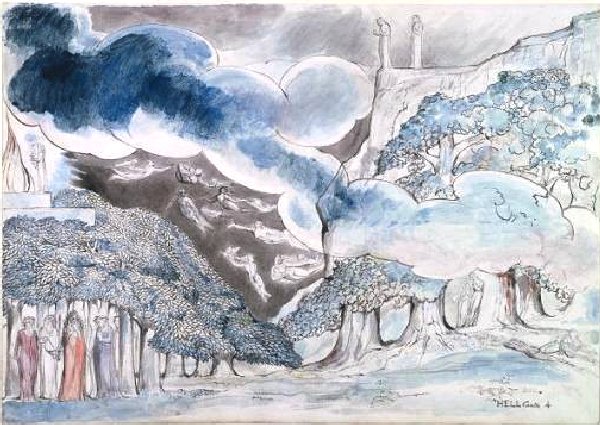
Limbo


William Blake [Public domain], via Wikimedia Commons

Limbo is not a concept in Protestantism; yet often do we live there, at least this side of heaven.

As a Christian, the notion of ‘call’, of God leading and directing us to a particular path, of waiting to hear God clearly, of discerning that it is God’s voice and not my own or the voice of others, is steeped deep in my bones.

I have been called before to work in Iraq with Christian Peacemaker Teams (CPT) and have been to Iraq with CPT for roughly two-month stints from 2005-2010.  I did not go this year, mostly because I have been ambivalent about whether I am still called.

How do we know when God calls?  Even more, how do we know when God stops calling?  I wish I knew.

What follows is a random part of my own thought-process when I met an Iraqi woman this summer at the PC(USA) Big Tent event in Indianapolis.

***
Fi kelbee, anni Iraqiya.

It’s a phrase I haven’t said in a long time . . .

“In my heart, I am an Iraqi.”

As I meet Martha at the Big Tent gathering, she is introduced for her work with refugees in California.  The man who introduced us surprisingly says to Martha (about me), “She’s Iraqi.”

Martha, a Middle Eastern woman, looks at me with frank surprise.  I grin and say, “Anni Iraqiya, fi kelbee." [“I am an Iraqi, in my heart.”]

We both laugh, exchange pleasantries and basic information, and move on.

Yet the phrase hangs with me.

Am I?

Is it still true that I feel this affinity for the people of Iraq?  I think so.  But what am I going to do about it?

I haven’t been since the winter of 2010.

“What have you done for me lately” isn’t just asked by sports figures looking for the better deal (watch the movie Jerry MacGuire if you don’t get the reference).

It is a fair question for people caught in all sorts of webs to ask of those who would help them or walk alongside them as they endeavor to help themselves.

Kurdish Iraqis not allowed to vote in 2009
“What have you done for me lately?”

No one is asking me this question, at least not in person, face to face.

But I still hear the question ringing in my ears.

Will I go back?  I do not know.

What am I waiting for?  I do not know.

Do I feel the pull?  I do.

Am I exhausted by the implied rejection of the work I do in Iraq from family, friends and congregants?  I am.

Is it their ‘fault’ I haven’t gone back?  No.

What am I waiting for?

I do not know.

***

God’s voice has never boomed from the sky for me, but I have never before had such a sense of unknowing.

Limbo.  It’s a place I don’t like living in much.

Saturday, July 2, 2011

I'm So Glad


Weeks ago, somebody spoke to me about suffering in a way that gut punched me - bringing back, as it did, memories of Tom Fox . . . of his murder in Iraq . . .

I called dear friend Anita, who was there through it all.  She reminded me of something important: when it comes to suffering the pain of loss, it’s not something we ‘get over’, at least not in the sense of it no longer being true.

The fact is, all that happens to and around us affects us – always.  The ‘it’ of the thing becomes a part of all our continuous present moments.

I won’t ever be over Tom’s death, his murder.

Tom’s passing from this life is a part of my story too, simply because I knew him.

Recently, I began reading James Loney’s book Captivity.  Jim was kidnaped along with Tom and two others: Norm and Harmeet.  The book is compelling reading.  I have dreaded picking it up.  The only thing that got me to is that if Jim could live it and write it, the least I could do is read it.  And I am.  Often I put it down, doubled over with the pain of remembering.  But I am reading it.

This past week, I have been in Indianapolis for the Presbyterian Big Tent gathering.

One of the gifts of being here is the continual and random encounters with people I have known but not seen face-to-face in a long time, most of them from my time at PTS (Princeton Theological Seminary).

Over and over again, we say the same thing to each other: “I am so glad you’re in my life.”

When I hear it, I understand perfectly.  I feel exactly the same way.

All of the ‘its’ that become a part of the fabric of our lives certainly include the tough and painful times: the deaths of those we know and care about, the suffering of another whose life intersects with our own, our very own personal suffering.  And those suffering moments do, as my friend Anita maintains, become a part not only of our past, but also of our continuing present.

What is so easy to lose sight of, however, is so too the good ‘its’.  And the joy of friendships past is indeed a present reality.

Molly, Bridgett, Kiran, and so many others, I am so very glad you’re in my life.

Thursday, June 30, 2011

From the Big Tent: Networking with Len


Here I am, at the Big Tent, the gathering of a multitude of ministries within the Presbyterian Church, sitting in a meeting for the Iraq Peace Network.  We’ve moved from hearing directly from an Iraqi partner to hearing more about the work we’re doing in the U.S. and the mechanisms by which we will do it.

One of the buzz words is ‘networking’.  Well, it is in our name.

How do we network?  How do we network better?  What does our networking ‘bring to the table’?

I have nothing to offer.

But here is what I do know; and I think it might be all I do know about networking.  Maybe it is enough.

When I began to learn about Christian Peacemaker Teams (CPT), the peace group I go to Iraq with, I was attending Princeton, a Presbyterian seminary.  I was a member of a Presbyterian church back home in West Virginia.  I belonged to a group at seminary called Princeton Seminarians for Peace.  I was ‘under care’ of the Presbytery of West Virginia.

I thought I was pretty well hooked into my church.

Until one day when I was preparing to go to Iraq for the first time and the phone rang.

There was a man on the other end of the line, who identified himself as Len Bjorkman.  Len introduced himself as being a part of the Presbyterian Peace Fellowship.  I was surprised.  I didn’t know there was such a thing.

Then he gob-smacked me, “The reason I’m calling is that I heard you’re going to Iraq with CPT.  And I just wanted to touch base with you and introduce myself and see how you were doing.”

Outside of CPT, Len is the only fellow Christian who reached out to me as I prepared to go to Iraq for the first time.  Until that phone call where Len introduced himself to me, it never occurred to me that other people might be interested in what I was doing; might pray for me even though they didn’t know me; might care about what might happen to me.

Len wasn’t done with surprises: after we talked for a time, he asked me who would be checking in with my mom.  This is after we had established that I was living with her at the time.  Len, with a pastor’s keen ear, identified the person closest to me and asked about who would be taking care of her.  And while I would be gone, every now and again, Len called my mom.

Len Bjorkman is a born networker, which is just another way of saying that Len and his wife Judy think about people and reach out to them and make connections between what they’re doing and what others might be doing; and they work hard to connect all those dots.

I have visited with Len and Judy in their home, done a speaking tour that Len organized, done a few workshops/conversations at General Assembly at Len’s behest, helped Len usher an overture (fancy name for a certain kind of motion) about Iraq through a committee process, and come to the Big Tent early for the Iraqi Peace Network, all because this kind man has bid me come.

Want to know how to network?  Call someone who might have something to offer and introduce yourself.  Call Len.

Tuesday, June 14, 2011

A Mountain Cheesemaker


Should you be mislead in your search for the perfect cheese recipe, let me assure you, your search continues . . .

Whatever this is, it is most definitely not a treatise on that perfect Gruyere . . .

Allow me to introduce myself . . .

My name is Beth

I live in the mountains

I have never, and I do mean never, made cheese . . .

But I am a huge fan of Monty Python

Love Life of Brian

And fancy myself one of the ‘cheesemakers’ Jesus blessed therein [translate: blessed are the peacemakers]

Admit it - like me, you really wish Jesus had blessed the cheesemakers instead - it would have made life so much easier if all I had to do was go out and learn to make a fine cheddar - with all its challenges, that’s got to be so much easier than making peace . . .

And in the end, the cheesemakers have a fine wheel of something very tasty to show for all their effort, while all I have is more fighting and discord and disagreement and disharmony and dysfunction and and and any other dis– you can think of . . .

Not that I’m complaining, mind you – well, maybe a little. . . but I continue to be surprised that the efforts at peacemaking so often result in more discord, that the attempt to secure justice, at least for a time, increases injustice.

For every action, there is an equal and opposite reaction.  This Newtonian law of momentum holds that “all forces are interactions between two different bodies.” [fn]

It would seem that Newton’s third law holds true in the world of the exchange of ideas as well.  It’s the only explanation I’ve got (nod to social scientists, who I’m sure can do better) as to why various propositions for peaceful resolution meet such anger and violence and resistance.

Virtually all humans claim to desire, even to long for, peace.  Yet proposals for peaceful change are often, if not usually, met with anger.

Resistance to change and the cost of that change to the individual or its society as a whole can offer only a partial explanation.  For the fact is that every war results in change and enormous cost.  Yet few wars provoke the violent response in the citizenry that calls for peace do.

Hypothesis: humans are on a trajectory of war and violence.  Ways of being peace would alter the trajectory.  Resistance is the predictable result.  Newton was more right than he knew.

Yet, if this is true, why does the trajectory of war and violence not yield an ‘equal and opposite reaction’ of peaceseeking?  Perhaps it does.  Perhaps by its very nature, the impulse to peace is quieter, more low to the ground, than the impulse to war, so that the ‘reaction’ of peace goes by unnoticed, even, sometimes, by those who seek it most fervently.

The Christian answer in these United States today to war and violence often includes statements offered so matter-of-factly that they are proffered as axiomatic: I’m not Jesus.  I’m not that good a person.  Jesus didn’t have to contend with nukes.  Even Jesus was violent (referring to the money-changers incident, but forgetting, somehow, the cross).  They’re evil.  They need killing.  What else can we do?

It is settling for so much less than the gospel of the Risen Christ, these reasons to stay on the course we’ve set for ourselves.

Perhaps peace is the dream of God.  But if there are any dreams in the universe that have a chance of coming true, surely they’re the dreams of God.

To all the peacemaking cheesemakers or cheesemaking peacemakers seeking your blessing, I say, blessed are you.

______
[fn]  C Hellingman (1992). "Newton’s third law revisited". Phys. Educ. 27 (2): 112–115. Bibcode 1992PhyEd..27..112H, per Wikipedia article on Newton’s Laws of Motion.