Showing posts with label violence. Show all posts

Monday, October 13, 2014

Being a Pacifist in the Middle of a Blood Bath


Even fellow CPTers (Christian Peacemaker Teams) are writing about how hard it is to reconcile their pacifist ideology with what to do to provide real help to real people in real danger from real violence in light of recent events in Syria and Iraq.

I think the word ‘ideology’ is actually the problem.  And I speak only for myself, which is, I think, at the heart of the issue.

I do not proselytize pacifism.  It is simply who I am.  My views and, I hope, my actions, are shaped by this.  But what you do with that is up to you.

It goes something like this in my head: I am not a Yazidi and I am not stuck on a mountaintop with people surrounding me who wish to kill me.  Thus it is not for me to say what they should do.

My pacifism leads me to live out the reality that for the dangerous places in which I find myself, for myself, violence is not, cannot be, the answer.

That does not mean that I do not have violence in my heart.  I do.  It is precisely because of the violence in my heart that I am a (work-in-progress) pacifist – because I know that my violence towards others has absolutely nothing to do with love, not even love of self, and everything to do with satisfying that peculiar hunger that lives within me.

My pacifist understanding leads me to take the route of non-violence, even in resistance to violence from others.  So my mountaintop dangerous experiences are just that – dangerous.  But my response to them is a response of non-violence, even should that mean my own death, for I am convinced that God values the one who would do me harm as much as God values me.  And knowing this with absolute certainty, I cannot be the instrumentality of their demise.  I simply cannot.

For me, this also means that I would never desire that any person act in any way to preserve my life at the expense of their own or someone else’s.  That is a burden I simply cannot carry.  And I know it asks much, perhaps too much, of others, who may well feel that they have become the instrument of my demise by not acting violently towards this proverbial other, should the situation ever come to pass.

But this is not hypothetical for me.  I mean it.  When I joined CPT, I did the work of counting the cost, including the cost of my own life.

In practical terms, what all this means for me is this:

1. Even if it’s a question of me or him, I choose him.

2. If you have to choose me or him, choose him.

3. That might not be your own choice and I will honor that as best I can in the circumstances – because this is not ideology – this is life and it is messy and my choices are not (necessarily) yours.  What does that mean?

a. it means that I still will not kill another person, even if to save you.  I would put myself between you, but I won’t take their life.  I am not who you want with you as a bodyguard or even as a fellow combatant if violent response is what you require as part of the deal.

b. if you’re asking for the help of someone else who will use violence to your aid, I won’t get in your way, for that is your choice rather than mine to make.

I admit to being surprised by fellow CPTers who are particularly troubled with their pacifism because of the recent actions of ISIS.  They are horrific.  But haven’t the behaviors of violent actors always been horrific?  Did it just get real for the first time for you?  Because it’s been real for me for a very long time.  That doesn’t make me smart or special.  But it does make me clear – if this thing we call pacifism is merely ideology, then it deserves to be thrown out with the trash.  The cost of such a way of life only gets paid when there is violence – unjust, horrible, life-threatening, life-taking, cruel, violence.  The question for me has always been – what is to be my response?  And the answer, at least for me, remains unchanged – I will help, but I will not kill.  Perhaps that makes me useless.  That is not my judgment to make.

But consider this about the recent events in Iraq:

1. These things did not happen in a vacuum.  They never do.  This crucible moment was preceded by countless crucible moments in Iraq before, moments which did not even call for violent solutions, during which we did nothing.  If PM Maliki be the problem, his position is one we established and thus do we reap the whirlwind we created.  I am left to wonder why it is so much harder for us to simply work towards an honest form of government interested in the welfare of its people and so much easier for us just to drop bombs.

2. ISIS has been coming for a long time.  Why the surprise?  Even in immediate terms, the world has known for months about their increasing incursions into Iraq.  And largely, we did nothing.  Where, one might ask, are the UN Peacekeepers?  Where the barriers?  Where the practical steps for evacuation from a coming war zone?  Where the stockpiling of supplies for humanitarian aid?  If this is a crisis, it is one we helped create by our large indifference.

3. Where the world’s outcry when PM Maliki and his folk engaged in similar behavior towards their opponents?  Iraq as a nation has not had one moment of rest since the 1990's and the sanctions imposed not on its leader but on its citizens.  How would one reasonably expect anything but chaos and its attendant horrors with a land that has resources others are rapaciously hungry for and the countries of the world aligned around it to use it as their own version of the O. K. Corral?

4. What have the countries around the world done to offer to take the refugees?  They’re on that mountaintop for a reason.  Fleeing a fearsome enemy, they had nowhere else to go.  And why not?  Why are they themselves not being airlifted out?  Because we, the world, won’t have them.

5. Our prejudices want to have it both ways: we want to condemn Muslims around the world, or certainly in the Middle East, as being barbaric monsters while our condemnation focuses on their victims, most of whom are other Muslims.  Which is it?  Are they barbarians?  Or victims?  Or is the truth much simpler – like all of the rest of us, they’re both?

6. Economic, social, and political upheaval create the perfect storm for the worst of humanity’s behaviors to have free reign.  Everything we have done in Iraq for decades has been towards the certain conclusion that we will and have created a failed state.  We cannot claim surprise at the result.  The cry now for the necessity of violent solutions overlooks each and every step down this path we have taken to its inevitable conclusion.  Perhaps weapons are now our only choice.  But that hasn’t always been true.  And weapons will be a poor solution for the long-term welfare of all Iraq’s peoples.  There is always a what next? phase.  Have we given that any thought?  It would seem not.  Which simply repeats the previous pattern and if we do nothing differently, the same results will certainly attain and only the acronyms will change.  We can do better than that.  The question remains whether we will.

_________________________
I wrote this about 6 - 8 weeks ago and decided not to post it at the time.  Since then, the United States, along with some partners, has sent air attacks raining down on Syria and Iraq, too much for some, too little for others.  And hostage demands and executions have continued.  Today one family has publicly said, while asking that their son be spared, that the price demanded by those holding him is a price they cannot meet.  Actually, they have said it is a price they cannot ‘accommodate’, which is a different matter all together.  I understand what they mean.  At least I think I do.  Prayers continue that the killing madness come to an end.  And that includes bullets and armaments stamped ‘made in the USA’ fired from ISIS hands as well as our own.


Friday, September 19, 2014

Blood-Dripping Tears: A Florida Lament


blood-dripping tears
quench the ground’s
lust for such things
as all is silence - for
death is silent and
only the dead waited
those with eyes to see - 
their dying already
a done thing - waiting
only for living tears to
begin their commencing
turning into salt and light
in the cosmic way of things
even as earth-bound critters
solidify into something
hard and angry, for who
cannot be angry beholding
such horror? 

God


_____________________
Written in response to the news of a grandfather killing his daughter and all her children – his grand-children, in Florida, wondering and worrying about those who found their bodies – their reactions, their internalizations, for how can they not carry hard places with such images residing alongside the memories of favorite meals, Christmas with family, and all that is good?  Only, I think, with, through, alongside, God.

Friday, September 12, 2014

The Fierce Tenderness of a Mother's Love


“Darkness cannot drive out hate: only love can do that.”  I believe that.

The best way I know how to describe that kind of love is as a mother. What we need in the public square right now, in our places of worship and places of learning, in our Tweets, blogs and Facebook posts and in our supermarket parking lots, is a kind of love that looks something like a mother's love.

  The kind of love I'm talking about is tender, and it's fierce:      
   

  It means paying attention, knowing what time it is and what the weather's like out there.  It means naming danger when it threatens, and meeting it with savvy and with courage.  It means teaching the difference between right and wrong.  It means being responsible for our words and our actions, and calling on others – like those public figures with their violent images – to take responsibility for their actions.

  It means showing up, being present, caring, not expecting somebody else to handle it.

It means compassion, knowing that we are all in this together.

  And of course it means getting your heart broken, which opens you to hold the pain as well as the beauty of being fully human.

  So with our hearts broken open right now, I hope we can meet the challenge of these violent times with the power of love, fierce, tender love. . .

Tuesday, August 5, 2014

Hector


The trembling hands . . . 
his trembling hands
exist somehow separate
from him
yet give him away

this man of kind eyes
calm voice
competent presentation

a man composed –
so composed he could be
speaking of the weather

he could be – but he isn’t

But those hands –
their quaking never stops
They give him away

O Lord, where to look?
Everywhere my eyes are drawn
to his trembling hands

like Jesus’ marks
his trembling hands
are the evidence
they give him away
they give us away


________________________
Written in 2005 in Colombia, SA, while on a delegation with Christian Peacemaker Teams (CPT).  Listening to a man named Hector describe the impact of his country's violence on his life and the life of his family, I am struck by his hands, which continuously shake, betraying the seeming calm of his voice, mirroring the violence of his words.

Thursday, April 10, 2014

It.Is.Enough


I read of a stabbing boy
and am stabbed in the
heart of my eyes – soul-
weary of trying to
understand – wanting
only to yell S.T.O.P.
Enough, already!
Yes, something is
wrong – really wrong –
when someone, anyone,
decides today will be
the day of knife stabbing
gun wielding shooting
life taking crap over
way to problem solve
through their own
particular brand of pain

on another day, I will
care again, be concerned –
again –
wade through the societal piece –
again –
but today, enough
really is enough
and I don’t particularly
want to care – all I want
should anyone care to know
is for this to stop

I doubt any of the weapon
carrier believers that today
will somehow be different –
be their day – will be reading
but on the off chance and with
no thought to changing
minds or hearts but if you
were wondering what
everyone else is thinking
about you – and it isn’t fear –
that’s reserved solely to
those right in front of your
weapons – well, here goes –
get over ‘it’ – what ever your
it may be – just get over it –
everyone else did and does –
yeah – we’ve got shit in our
lives too - we’re real too –we’re
invisible to many too – we’re
tired too – we’re struggling too –
we’re hurt and hurting too –
we have angst too – and no,
we’re not better than you –
we just decided a long time
ago that it was our problem
and did the best we could with
it – and the best we can does
not include taking knives
and guns and trying to shoot
and stab our way out of our
pain – simply because it
just doesn’t work – and oh
yeah – those other people –
they. are. people. too.

you are not a hero
not
nor are you a villain
you’re just ordinary
about to do something
really stupid
from which there is no
coming back
and here’s the thing –
you want to come back –
it’s obvious – your very
actions scream that you
want to come back –
people who don’t
want to come back
don’t take other people
with them on the journey

and you will not be famous
a handful of people will
know your name, but they
will not know you
that doesn’t happen by
headlines
knowing you happens by
a lifetime of spending
time with
that’s it
not very mysterious
but boy is it hard
and all you’re doing
with your snap
stupid gun-slinging
knife toting is
showing you don’t
have it to go the distance
because it’s hard

spoiled poor baby
living in the land
of too much that
isn’t enough
with nowhere to
go – how about
down to the local
mission or shelter
to lend a hand to
someone who really
has had it bad or hard
life-slinging bad hard
or over to the nursing
home to do the hard
work of sitting with
someone who will
never recognize you
never say thank you
and just do something
nice for them with
no reward
because there is a
whole world of real
suffering – you’re just
a poor imitation of
the real thing
and you really piss
me off

Tuesday, March 25, 2014

Prodigals Don't Always Leave By Choice


In the early summer of 2005, I traveled to Colombia with CPT.  Among so many others, we meet an older couple whose son was murdered 18 years previous because he went fishing on the wrong day in the wrong place – or so another man with a gun thought at the time.  I wonder if that man still lives and what he thinks of that life he took now.  I wonder if there were other lives taken.  I wonder the cost to him in the taking.  I wonder about wildernesses of our own making, we human-war-making beings.  These are the things I wonder now.

What I wrote, what I prayed at the time, was all about these parents growing old without their boy . . .

Dona Marcelena and Don Juan sit and speak quietly.  Don Juan tells us, “we do not manage the fear; the fear manages us,” describing nights of belly-gripping terror, spent listening to every sound of the forest, every rustling leaf a potential FARC, ELN or para.

O God, forgive us that in their old age, we visit on such folk fear and not peace, sorrow and not joy at a race well run.

They have had 16 children, but even 15 will not make up for the one who is missing from their table.

Prodigals do not always leave by choice.

Thursday, March 13, 2014

Guns & Violence & Problem Solving


So here’s the thing about guns and problem-solving – guns don’t solve problems; people do.

Sound familiar?

And here’s another thought that arises from bumper-sticker philosophy: if people kill people (rather than guns, as the bumper sticker so catchily proclaims), then it stands to reason that people are the problem, which means, does it not, that it is people that are not to be entrusted with guns?

Violence and gun-toting problem solving I have encountered in my lifetime has involved . . .

A man, now dead presumably of old age, who got so angry by the fact of a right-of-way granted by his father to his neighbors (who were also relatives) that he took to shooting at said neighbors (including a 60-year-old woman carrying her groceries into her house), gas meter readers, pizza-delivery folk, and anyone who dared to exercise their lawful right to ingress and egress.  Before he died, said gentleman yielded up virtually all his earthly wealth to said neighbors.  I wonder if those shots were worth it to him?  His cousin will never know if she’s alive because he missed on purpose or was just a bad aim.

Then there was the old drunk who lived next door to my neighbor.  While we painted her house, my then 3-year-old son played in the grass with his ball.  I had warned him to stay out of the man’s yard, but he was only three and when his ball crossed the invisible line of ‘mine and not yours’, my son ran after it, at which point the angry neighbor called my son a racial slur.  One of the men of our party reacted angrily and the escalating words prompted threats of the exchange of gun fire.

Then there was the man threatening to kill his wife in the middle of the street in front of my house one night, threatening to pursue her onto my porch where she hid behind me as I stood my ground with no weapon save a telephone to get him to back down.

Or the man in a divorce case who bore down on me in the hallway, just having lost his latest bid in court, his fist raised with threatening words on his lips as I slowly took off my glasses (so they wouldn’t be broken – they were pretty expensive for me back in those days) and simply waited my fate.  At the last minute, he dropped his fist and stormed away.

Then there were the young soldiers at the many checkpoints in Iraq.  The ones I remember stood before us, myself and a colleague and three Iraqi college professors seeking redress for the mistaken bombing of their university.  We were ankle-deep in mud.  It was cold.  We waited there for hours.  The boy-men soldiers were clearly uncomfortable treating me, the only one from the US in our party, so discourteously that they invited me in to their hut for warmth, but refused to allow anyone else to enter, so we all stood out in the cold, the only protest we had available to us for the refusal to hear these men.  And in the freezing hours of waiting, I heard about one young soldier’s pending divorce and the new baby he had never seen, having nothing to offer him save my caring ears.  And I heard their apologies – they had no choice but to hold us at gunpoint, you see.  They wouldn’t have shot us, at least so I think.  But to force the situation was to place them in harm’s way from their commanders.  So we simply waited, silent witness to the cold.  Eventually we gained entry and were heard and an agreement was reached.  Success.  Until a day later when the officer who had reached agreement with our friends reneged.  Apparently he could do by phone what he could not do face-to-face.  But that too was a violence.  And there were guns behind it.  Lots of guns.

What was the difference between the man who shot at his own family members and all the rest?  Time.  Time to better reflect.  So it was that the drunken gentleman had a wife who intervened, inserting herself between him and his desired shotgun.  And the man in the hallway, had he been armed, probably would have shot me and then thought about it.  But because he had the length of the hallway and only silence from me in which to think about what he was doing, he had the chance to reconsider his choices.  And the husband chasing his wife?  A gun in his hand would have eliminated the need to cross the street himself and stand face to face with us and reconsider.  And even the young soldiers faced no opposition.  All we offered in protest was our calm presence.  There were lots of folks killed at checkpoints just like that one and many of them meant no harm at all.  But those boy soldiers lacked the time to reflect on their actions and instead shot first.

What do guns take away that knives and fists and raised voices and other weapons do not?

Time.  Time to think.

And therein lies all the difference to the outcome in the world.

So if you want to know why I am in favor of controlling human access to weapons of such destruction, for me, it’s all about time.  And I am willing to give up quite a lot to buy the would-be shooters among us a little time to reconsider.  Because it might just make a difference.  I know it has for me.

Friday, December 6, 2013

Just-A-Man Mandela

Nelson
Tata to a nation
as you stand at yet
another gate, I wonder
what holds sway in your
remembering – decades in
a prison cell circumscribed by
those who would define you – were
they wrong? – by the violence you played
with in ever more desperate measures to claim
even the possibility of freedom for your own
or the women – the many women – what
is it about men of charismatic mein
that the women become your
drug of choice?  Your
children– will you
miss them as
they will
surely
miss you?
Do you ponder
the many meetings
and speeches and losses
and victories?  Do you forget
as we have the violence and recall
only the peace – for it was prodigious
the reconciling calls to a forgiving together
kind of living that you and others dared dream into
something approaching reality in the land that
so held your heart and soul in its wrenching
claim upon your destiny?  We so want
our saints to be perfect, so without
the many sins that hold sway in
our own lives – the humdrum
ordinariness of the wrong
won’t do for you
Mandela


Wednesday, September 25, 2013

Remembering the Alamo

A battle.  People dead.

“Sacred”.

Why?

Why “sacred”?

This is the question which haunts me as we circle the displays, the intention behind not at all rhetorical – why is being dead “sacred”?

I am moved to ask a volunteer, who tells me that the language in the bill in the Texas legislature in the early 1900's referred to the sacred deaths of those defending the Alamo.  The reason?  Because they died for Texas.

Texas is not alone in appropriating the language of the divine for its secular cause of the hour.

Sacred is defined as “worthy of religious worship; very holy”.  Merriam Webster

Secondary definitions include the notion of something worthy of respect.  But this conflating of the sacred and the profane (shedding of blood ) – in its elevation of the profane –  actually reduces the sacred, or perhaps better, twists the sacred into something unrecognizable.

At another location within the exhibit there are a series of plaques commemorating the “heroes” of the Alamo.  Missing from the list of names are those  who actually survived the siege.  When I asked another volunteer, she handily explained that the heroes were those who died.

I understand the distinction, but not the reason for it.  Why is it, at least implicitly, more heroic to have died and thus less heroic to have lived?

To die for country is not to die for God.

To live for God is not to betray country.

To live is often the most heroic thing a person will ever do.

To die is sometimes the most cowardly.

Living is more sacred than dying.

And being dead is not sacred – not holy – at all.  Whether we rise in resurrection as my faith has it or not, dead is beyond the cares and causes of this world.  It is not holy; it simply is.

What will I remember of the Alamo?

One more effort to invest with meaning the senseless violence we human beings engage in from time to time to have our way.  The ground crying out with the spilling of blood.

Nothing sacred about it.

But that’s just me.

Friday, September 6, 2013

I Will Never Leave Nor Forsake You

Hebrews 13.5: I will never leave nor forsake you.

So I read in preparing for prayer over Syria last night, this God promise the writer of Hebrews sets forth – the context far different as he (presumably) writes about leaving aside the fears and desires created by a lack of material goods.  Or is it?

Was he writing to people starving to death?  To people running for their lives?  To people aching with the fear of never having enough?  to people whose fears had good cause?  I suspect so – there is no need to preach freedom from worry to the rich, the safe, is there?

So maybe this is a word of the Lord for the people of Syria today, this God promise of safe haven and deliverance.  But what can it mean in the midst of real violence, real destruction, real lack?

I cannot presume to say.  Yet the promise stays with me and becomes my prayer for these strangers who are my kin so far away.

Then, perhaps subconsciously harkening back to where the promise is first uttered (in Deuteronomy 31), I think of Moses, his arms uplifted, held in place by Aaron and Hur at his side when he grew weary.

But I mixed my images, holding the Moses image together with the demand that his people be released from captivity.  I forgot the context.  God didn’t, but I did.  Deuteronomy 31's divine promise of eternal presence is in aid of the conquering of the promised land and Aaron and Hur hold Moses’ arms up because his upraised arms assure battle victory to the Israelites.

I cannot escape the imagery of war no matter where I turn.  The irony is lost on me, but perhaps God appreciates the joke as I use these images of battle victory to pray for a turning of hearts and minds away from violence and towards just peace.

There are real combatants on battle fields all over the world today.  Maybe it does make sense to offer prayer for both sides to all these conflicts, prayer that they recall the divine promise to never leave nor forsake. . . maybe were all to remember this God promise, the lasting victory whose name is peace would become real . . . maybe it becomes impossible to lift weapons when, eyes downcast, it is remembered that the ground stood upon is not holy because of the blood shed there, but rather is holy because of the God standing there . . . maybe the feared, implied threat of divine abandonment is so real that it is necessary that we pray that none be left or forsaken . . .

Lord, whatever You do, do not leave them . . . do not leave us.

In Your mercy, hear this prayer.

Tuesday, April 23, 2013

Swords and Plowshares


The sword ends half way down the hilt
the pointed end of the plow sticks out
solder joins the two – more sword
and plowshare joined at the hip
than one turned into the other

and somehow this image stays intact,
more real, than the melding other
of biblical proportions . . .

and so it is that the hands squeezing
around my neck do not so much
melt as meld into love and peace

peace - a concept bound and defined
by its opposite – no violence, we’ve
no need, no desiring, for this thing
we call peace . . .

What do I do with that?
I remember the violence
and I remember that I survived it.
And that, at least, for now, is good.

Saturday, April 20, 2013

Vigils & Bombs


It felt bad – real bad – last night to be watching moment-by-moment developments in Watertown.  If I lived there, I’d need to know.  But as it was, I truly felt like a voyeur.  And I had to remind myself that these were events about real people unfolding in real time.

With that reminder, I was able to do the one constructive thing I had to offer – pray.  And so I prayed – for the young man probably still a boy in many ways . . . for the police . . . for the folks living there ejected from their homes or ‘sheltering in place’ (such a benign-sounding phrase for being held hostage to a situation not of their own making) . . . for a peaceful end to such a horrific beginning . . .

Thus did my watching move away from atavistic curiosity to vigil.

And thus did I give thought to those all over the world living with such dangers every day.  Having spent some time in Baghdad, I considered the difference of bombings that happen daily versus those that happen so rarely.

As a civilian in Baghdad where bombings are a regular and often daily occurrence, you stop briefly to
determine where, in relation to you, the bombing happened.  When the first one goes off, if it’s close, you retreat because experience has taught you that another is coming soon.  In the immediate aftermath, you only go closer to help the wounded if you’re already so close that you know you can’t run far enough fast enough.

And if it’s some distance away, you simply resume what you were doing before the blast after checking to find out where it was and calling those you know in that area to make sure they’re okay.  And if you’re a praying person, you offer up a prayer as you go about your life.

Like anything else, violence quite easily becomes a norm to which we adapt.  That isn’t to say it doesn’t change us – it does.  But the needs and desires of day-to-day life simply work themselves around the reality, much like a tree engrafts a rock into its root system.

The only problem is I’m not sure which is the rock and which is the tree.

So today I pray for all the peoples of the world: Lord, enable and empower we human beings to work, to strive, to dedicate ourselves to make violence such a rare thing that no one need adapt themselves to its reality, its demands, its reactions.  May fear find no place in our lives.  May vengeance be left to You.  May all children grow into the reality You dream of for us all.  May it begin with me.

Sunday, January 27, 2013

Mob . . . Mobbing . . . Mobbed


That a thing in its essence is both a noun and a verb, both the actor and the action, simultaneous – that without the verb, without the action, there is no noun, no ‘it’ – what is one to do with that?

Thus do I read in this morning’s paper about recent events in Egypt.  Some people have been ordered executed for their role in a previous soccer riot which resulted in deaths.  In reaction against the execution order, family, friends, soccer supporters or all of the above, rioted and caused the deaths of 27 additional people.  The irony would be laughable were it not so very tragic.

The word ‘mob’ comes from ‘mobile’ and ‘mobility’ – a thing that moves and the movement itself.     Entomology

In Examining the Mob Mentality, an interview with Tamara Avant, Psychology Program Director at South University in Southern Source, Avant says:

Deindividuation obviously does not occur every time people get together in a group, and there are some group characteristics that increase the likelihood of violence, such as group size and physical anonymity. First, many people believe they cannot be held responsible for violent behavior when part of a mob because they perceive the violent action as the group’s (e.g., “everyone was doing it”) rather than their own behavior. When in a large group, people tend to experience a diffusion of responsibility. Typically, the bigger a mob, the more its members lose self-awareness and become willing to engage in dangerous behavior.  Second, physical anonymity also leads to a person experiencing fewer social inhibitions.  When people feel that their behavior cannot be traced back to them, they are more likely to break social norms and engage in violence. 

Avant points to the presence of certain elements in mob violence:

1. Conscious choice – as in “I won’t get caught”, which suggests not that the mob makes the action happen, but that being in the mob allows cover to do that which we have wanted to do all along.  If the ‘doing’ doesn’t occur otherwise, it is only out of fear of consequences.

2. Related to #1, Avant holds that there is a sense of diffuse responsibility in a crowd that turns into a mob – that is, the individual no longer feels responsible for what he or she is doing.  But again, it would seem not that the mob gives birth to desire, but rather gives cover for it.

3. The greater the emotion, the lesser the restraint.

Anger and rage are feeding fires.  Without the oxygen of provocation (real or perceived) they die.  With it, they thrive, destroying all, including the holder of the anger or rage, in their wake.

Violence begets violence.  It’s so axiomatic I wonder that we continue to wonder at it.

A fire has to be starved of what feeds it to die.

I wonder whether any mob in history ever self-checked and simply went home.  If so, I suspect it began with one person: one person saying count me out.  One person bowing out of the fray, leaving in quiet, noticed perchance by a neighboring rioter, who then put down the brick and followed suit.  And then another. . . and another.

It takes lots of people to make a mob.  I’m guessing it only takes a few to unmake it.

Reinhold Neibuhr, as I remember, opined that the evil actions of the group are inherently different, of a differing class, than the evil of the individual.  Simply put, the evil of the group is of such a greater magnitude than the evil of the individual that there is something inherent in the nature of groups themselves that is evil.  I would tend to agree, but I have experienced mass groups differently.  Not all crowds are mobs.  Not all groups are evil.

Some years back, colleagues and I in CPT, along with our translator, monitored elections in north western Iraq, where Kurds are populous.  The Kurds had been denied the right to vote and many gathered outside the election commission to protest.  We went and spoke with many in the crowd.  They were mostly men.  They were all angry.  They were not a mob, but they could have become one.  Our translator was very nervous that we had placed ourselves in their center, and justifiably so.  And yet we stayed and we listened to their stories.  We wrote down their names.  We reported on their disenfranchisement.

There was no riot that day.  There could have been, but there wasn’t.  I don’t know if our presence played any part in that or not.  Perhaps it was as simple as this: the men and women gathered that day not in anger, but in purpose.  They were angry, but their anger was not their purpose: casting their vote was.  Maybe it’s the purposelessness of anger that is so dangerous.

Anger isn’t the opposite of peace; violence is.  And not all anger is violence.

Transforming anger at injustice into justice is hard work – painful and long and just plain hard.  The results are not often instantaneous.  It’s the work of the generations.  It takes patience.  Yet it bears fruit, this hard work.  The men and women I met that day stood taller than their fellow citizens who simply went home without their purple finger.  They took back their own pride and place.  It was a beginning.

How I wish those rioting in Egypt over a soccer match could have stood with their fellow citizens in the liberating squares, standing taller than sentiment, proud to claim responsibility, to say, We did this.

What makes the difference between a rioting mob and a citizenry gathered to change their world?  Maybe it is in the taking rather than the shedding of responsibility, in the insistence on being counted rather than being invisible.

Maybe.

Friday, January 4, 2013

2012: A Very Bad Year


Hurricane Sandy . . . Newtown . . . Aurora . . . Israel bombs Gaza . . . car bombs kill and kill and kill in Iraq . . . Syria . . . Gaza bombs Israel . . . no Pullitzer awarded for fiction . . . Mexican drug wars result in horrific killings . . . Benghazi . . . Israel bombs Gaza . . . bus and train crashes, floods and earthquakes, kill thousands . . . cholera and yellow fever and ebola strike the poor . . . drought spreads . . . one gang rape in India and one Pakistani girl shot stand as exemplars for the horror of our violence . . . History Orb

Turning the page on a calendar will not change anything . . . will not lead to a new chapter of existence . . .

But it does give pause . . . a time, a space, for reflection.

Is this who we are?

In the microcosm, how easily I can name the violence done me; 2012 is no exception.  But can I chronicle nearly so well the violence I do others?  Or does that violence disappear into the fog of self-justification?

We search for reasons as if that changes the thing.  But perspective is just another name for forgetting.  If we can ‘understand’, then we can differentiate – that could not happen to me, to mine.

But it could.  It does.

So to 2012, I bid good-bye.  To all the reasons proffered, I say never mind.  To all the justifications, I say no go.

You did it.  I did it.  We did it.  Now we live with it.

For you see, when it comes to the whys, well, that’s easy: because we could.

The real question is how to avoid the doing. . . the hurting . . . the wounding . . . the tearing of the fabric of all that is good and holy and just and right and true and worthy . . .

We didn’t call names because we were wounded; we called names because we could.

We didn’t kill because it was necessary; we killed because we could.

We didn’t fail to protect because of anything other than because we didn’t want to.

What good is a will if it is only bent to the self?

What good is a will that leans only towards destruction?

So here goes for my own personal 2013 resolution:

This year, I resolve to do no harm.  Period.

Likely I will fail.  But in the resolving there is good to be found, progress to be made.  And fewer bloody carcasses left behind.

Saturday, December 15, 2012

Dear Mr. Huckabee


Dear Mr. Huckabee,

As a fellow pastor, here are my problems with your analysis of the question posed to you by Nick Cavuto:

How could God let this happen?

1. Your response was to a question Mr. Cavuto did not ask.  You answered the question “why is there so much violence in our schools”.  While this may be an interesting and important conversation, it was not the question Mr. Cavuto asked.  And here’s the thing: in the immediate aftermath, his was the question that needed and needs answering.  But you wandered off course, doing real harm because those who were listening for an answer to that question were left with nothing.

2. You’re a pastor.  And you were speaking as a representative (evangelist/ambassador) for Christ yesterday, not as (or not merely as) a television commentator.  You were asked the question because of your presumed expertise on the mind and heart of God.  By failing to meet the hard questions head on, the Christ you (and I) represent on earth appears to be a dodger of the tough stuff as well.

3. Crises are not times for answers, especially pat ones.  Even if you’re right (and I do not believe you are), no one can (nor should) hear logic and analysis in such times.  What they, what we, seek; nay, what we require, is comfort.

4. “I don’t know” is an acceptable and honest answer.  Allowing the demands of prime time to push you into a sound-bite response is dishonorable to the body.

Why you’re wrong in what you said.  Here’s the quote:

We ask why there’s violence in our schools, but we have systematically removed God from our schools. Should we be so surprised that schools would become a place of carnage? Because we’ve made it a place where we don’t want to talk about eternity, life, what responsibility means, accountability. That we’re not just going to have to be accountable to the police if they catch us, but one day we stand before a holy God in judgment. If we don’t believe that, then we don’t fear that,” said Huckabee.  He added, “Maybe we ought to let (God) in on the front end and we wouldn’t have to call him to show up when it’s all said and done at the back end. Fox News Insider
1. You’re factually wrong in the claimed link between the alleged removal of God from school and this attack.  The shooter was not a school child as in Columbine.  Nor was he an employee or former employee of the school.  He invaded the school as a very unwelcome intruder into its routine and tranquility and presumptive safe haven status.

2. Maybe you have some insider knowledge as a professional journalist, but the information reported yesterday when you were making your remarks included nothing about the young man who did this in terms of his own faith (or lack thereof).  He may have been raised in church.  He may have attended a church school.  At the time of your remarks, that simply was not known.  You made assumptions about him.  They may prove in time to be correct; they may not.

3. Theologically, I am troubled with the premise that the claimed absence of God from any sphere of life creates trouble because we forget the eternal consequences of our actions.  Is this really what we have on offer to the world – a seat in hell if we’re bad?  Isn’t the message of grace in the here and now the gift of changed-ness?  Of being more than we were before?  Of being transformed by God’s grace into someone and something we never before thought possible?  And isn’t the worldly challenge one we have to grapple with – the very real truth that Christians are too often indistinguishable from others in their/our behaviors?  That we too do heinous evil?  That we too fall short?  That our fruit is often rotten?

4. You cannot be the man you are and claim the erasure of faith and faith discussions from the public square, for you are Exhibit A for the case that this simply is not true.  You are a very public figure, paid to offer up just such opinions on the public airwaves.  You are arguing against a straw man.

5. I would say this to all sides: when a tragedy occurs and your first response links the tragedy to your own views of what’s wrong with the world, it probably says more about you than it does the world.  You regret the decision to eliminate verbal prayer from schools; thus this event must be linked to that absence.  Others decry the absence of gun control; thus this event must be linked to that absence (and given that the instrumentality was in fact a gun, they have the better argument – although Michael Moore’s documentary Bowling for Columbine makes a good case that something else is at work in the national psyche of the US by contrasting our gun behavior to that of Canadians, who have similar access to such weaponry, but nothing near our levels of gun deaths).  For my own part, I do not know what the causes were.  I’m not sure that the young man who apparently did this deed even knew himself; that level of awareness generally requires more clarity of thought and judgment than his acts would indicate he possessed – but I am speculating.  The fact is I really do not know.  None of us do.  And we may never know why.

Finally, to Mr. Cavuto’s question, which deserves honest reflection and response.

How could God let this happen?

I do not know the mind and heart of God sufficiently to claim special insight into divine motivations.  So the best answer I have is I don’t know.

But this is not a question demanding of an answer grounded in reason and logic.  This is the cry of the human heart that will not be comforted.  This is Rachel weeping for her children who are no more.

And the answer I have – indeed, it is the only answer I have – to that question, that keening cry, is God’s comfort and the sure and certain knowledge that God weeps with us and that the temple curtain was rent yet again in God’s own cosmic mourning, for these were God’s children before they were ours.

But if the why question demands more attention, this is all I’ve got.  William Slone Coffin once said (I paraphrase), “when you ask God why he let something happen, have you ever considered that God is asking you the same question?”

The first time I read that, I felt as if I were gut-punched.  The truth of it slammed me against the place there is no running from: God does send help – all the time – God sends us.  And we fail.  We fail each other.  We fail ourselves.  We fail God.

My own anger yesterday was directed not at God but at us – the collective us – humanity.

In terms of God’s own responsibility, when some time has passed, those seeking the answer might read Elie Wiesel’s writings on the rabbinic trial of God in the concentration camp.  Finding God guilty of crimes against humanity, the rabbis adjourned and went for their evening prayers.  These were real people experiencing real suffering of epic proportions.  This seeming paradox was the only answer they had.

The fact is that all people of faith will wrestle with the question of how evil and tragedy can occur in a world created by a God claimed to be loving and protective of the divine creation.  And the fact is that there is no answer grounded in logic and reason that will suffice.  How could it?  What possible answer could there be in human understanding that would satisfy a grieving parent?  For my own part, as a person of faith, every answer I can imagine always leaves me responding, “But you’re God!  You can do better than that!”

And in my own heart, God responds, “But you’re humanity.  So can you.”

We’ve failed each other, it seems.

Where we go from there, who can say?

Sunday, November 18, 2012

Acclimatization


ac·cli·mate  to adapt to a new temperature, altitude, climate, environment, or situation.  Intransitive form: to become acclimated.  Merriam-Webster Dictionary

To acclimate is to become accustomed to change.  To become acclimated is to have external forces act upon in an acclimating way.  The easiest method for acclimation is repetition.  Thus do people living in war zones manage to go to the grocery store and do all the other things of ordinary life, knowing that any time, a bomb could fall from the sky.  Taking that as a given is acclimation.

The beginning of living in war isn’t like that at all.  At first, physical response kicks in, adrenaline surges, and fight or flight reactions go into high gear.  But with enough repetition, the one acted upon becomes accustomed or acclimated to the environment of violence so that it becomes a natural backdrop to existence.

Think not?  Consider, then, events in Israel-Palestine today – right now.  Today, right now, tensions are on the rise at an alarming rate.  From a distance, it can seem puzzling, even for that imbroglio: on-going low-level violence has become the business-as-usual order of things.  The people have become acclimatized to the daily violence.  That is not to say that they find it acceptable; it is to say that they have adjusted their lives to that reality, many, most likely, without any conscious thought.

But in the mind(s) of someone or someones in Israel this week, that has changed.  Sadly, on neither side has it changed in the direction of de-escalation.  It seems that acclimatization has set the floor at low-level daily violence, with the only perceived place to go being up, up, and up, towards ever more violence.

And with the choice of name for the current operation:  Operation Pillar of Cloud (also known as Cloud Column or Pillar of Defense) – an  obvious reference to the Exodus, where God led the Israelites out of Egypt as a cloud of smoke by day and a pillar of fire by night, Israel National News, a religious element is introduced.  The danger, of course, is the notion of divine mandate.

Thus the question begs to be asked: what kind of a world must some folks inhabit where daily violence is so routine that it’s the norm and any deviation towards peace is beyond imagining.  Perhaps the real question is how people can be acclimatized towards peace rather than violence.

War is not just something that we humans do; it is also something that is done to us.  And like everything else, it becomes habit, normative, when practiced frequently enough.

In this way, a cease fire can be understood as something much more than breathing room.  Cease fire can become a tiny crack in the acclimatization towards war and its own small acclimatizing step in the necessarily repetitive process of peace.

Maybe in a very small way we around the world can help.  Maybe today, even just today, we can stop talking about who’s at fault and who’s violence is the more justified.  Maybe, even just for today, we around the world can speak only words of peace and hope and love to, with, for, around, and about Israel and Palestine.

Maybe, just for today, we could acclimatize ourselves towards a peaceable kingdom.

Peace, salaam, shalom.

Thursday, November 8, 2012

Panning Rise of the Guardians


Santa Clause May Not be a Pacifist, but the Easter Bunny Is!   (Actually, I think Santa Claus is too.)              

There’s a new movie set to be released Thanksgiving week called Rise of the Guardians.  It features an animated Santa Claus, Easter Bunny, Tooth Fairy, Sandman, and Jack Frost as the ‘guardians’ of the happiness of the children of the world.

At the risk of entering the saga in the role of Scrooge, I admit that (a) while I love adventure flicks, (b) the previews of this movie bother me greatly.

I am not above some gratuitous violence in a movie, but this is a children’s movie and it uses children’s icons.

Icons are just that: symbols of something.

Santa Claus, derived from a variety of historical and imaginary figures, has his origins in Saint Nicholas, with the gift-giving tradition arising from stories about his many and secret gifts to the poor.

The Easter Bunny probably arises from pagan observances incorporated into Christian practices in celebration of Easter and the resurrection, the rabbit or the hare and the egg long having been symbols of life itself.

In Rise of the Guardian, Santa Claus is a sword-wielding warrior (modeled by the author on James Bond) and the Easter Bunny throws egg bombs and a “mean boomerang” in the battle against evil.

The problem is this: the icons of Santa and the Easter Bunny, distinctly Christian for centuries, are symbols of the nativity, the herald of peace among people, peace being specifically understood to include justice and care for the poor; and Easter is the defeat of death and the victory of life, achieved not by violence, but by sacrifice.

Mythologies teach us something.  There are important lessons brought by these icons:  care for the poor, the blessing of giving, the understanding of Jesus' advent as a gift for all humanity, God cares for children, humility as a way of life, life itself as divine gift, the certainty of the resurrection promise, to name but a few.  The James Bond lesson that the ends justify the means is a problem.

The Christian tradition recounts the battle of good and evil and the triumph of good.  These icons bear witness to that story.  It is the story of life, of courage, and of sacrifice as the ‘tools’ Jesus uses to bring about the triumph of good.

A sword-carrying Santa and a bomb-throwing Easter Bunny?

Not Good News.

Saturday, September 15, 2012

And So It Goes: Violence, Vengeance, Anger, and Aiming at the Wrong Target

Mosque in Harrisonburg after Friday's vandalsim

The local mosque in Harrisonburg, Virginia, was defaced on Friday, as Muslims in many other parts of the world demonstrated against the film whose name I do not know, dishonoring the Prophet Mohammed, with outbreaks of violence reported.  And we all know what happened earlier in the week in Cairo and Benghazi.

Defacing a mosque might seem ‘small’ in light of these other events, but they all bring to light the inherent problem with enacted anger and the desire for vengeance in the form of violence: it never hits the ‘rightful’ target (if there be such a thing).

Thus do folks around the world give vent to their spleen by attacking people who had nothing to do with the film and may not even have known of its existence and, as many of the targeted folks have made clear, disagree with its contents.

And in counter-attack, unknown people closer to home for me attack a building and thereby the people who worship there, none of whom have anything to do with the demonstrations and violence around the world.  The Muslim community in Harrisonburg simply has the misfortune of being handy by virtue of proximity.

So to the Muslim community around the world engaging in violent demonstrations, I would say that most Americans have not even heard of this film, most will not view it, of the ones who view it, most will find its contents disgusting and disturbing, and none of those you are attacking had anything to do with the film or its publication.  If there be an enemy, you’re aiming at the wrong one.

And to my fellow American citizens (presumably most of whom self-identify as Christian) who are speaking anger and rage at all Muslims, who are engaging in vandalism and violence (yes, our words can be as violent as our fists), take a breath and take a moment to watch the counter-demonstrations in Libya, where thousands of Muslims have gathered to protest against the violence to our embassy officials there, holding signs in a language many do not speak (English) in order to show their solidarity and support with us.  And remember that like Christians, Muslims around the world number in the millions, if not billions.  Yesterday, most of ‘them’ behaved like most of ‘us’ – by going to work, to worship, loving their families, praying for peace.

The outbreak of violence anywhere has the potential to bring out either the best – or the worst – in each of us.  The vandalism against the mosque in Harrisonburg is an example of the worst.

In response to the vandalism, the Muslim community there has invited the Harrisonburg community to an Open House at the Mosque from 4.30 - 6.00 p.m. for gathering and celebration of the best of that community.  Visit We Are All Harrisonburg on FaceBook or the Mosque's web site at IASV.org for more details.

Our Muslim brothers and sisters in Harrisonburg are modeling to rest of us the spirit of the best of us in response to this violence.  If you’re in the area, I hope you will attend.  If you cannot, I hope and pray you will send them messages of love, encouragement and support.

Sunday, May 13, 2012

Things Are Not Always as They Seem


Yesterday’s visit to Culzean Castle was a feast for the senses.  It was a beautiful west-of-Scotland spring day: sun shining, wind blowing, clouds quickly scattered.  And the grounds of Culzean Castle are lovely.  The well-tended gardens, the swan pond, the nicely-kept walks through the woods all reveal treasures.  The smell of wild garlic wafted on the air; flowers in bloom, known and unknown, were a feast for the eyes.  Birdsong filled the air.  You could walk and walk in the darkness of the woods and forget that you were right on the sea, only to come across another opening and have it there before you.

At one point, we came onto some grounds well into our walkabout that opened to the sea and as we approached, I noticed a series of regular humps of ground, like the scalloped edges of an Irish-lace tablecloth.  Eagerly I walked forward to see what they could possibly be, only to discover a small canon set in each of the scallops.  I literally cried aloud in dismay and disappointment.

But what did I expect?  The main function of a castle from any age, after all, is that of the fortress.  It is truly terrible how often and how well the form and function of violence meld into an aesthetic of beauty.

Some of the early Reformers so eschewed beauty because of this very concern – that beauty can be such a seductress, tempting the beholder to believe that the beautiful is, by its very nature, the good – so often not the case.

Perhaps we are the problem, in that we ascribe to beauty both more and less than it actually has to offer.  A beautiful landscape is a beautiful landscape – or is it?  Knowing its history, its context, can change our very perception of its beauty (or lack thereof).

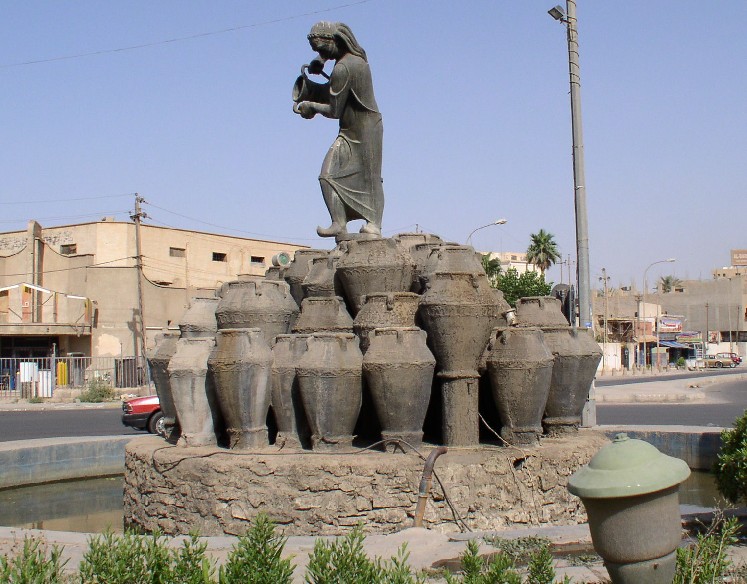
In Baghdad, there is an almost beatific sculpture of a woman pouring from a large pitcher into the urns surrounding her at her feet.  Such a serene, pastoral vision – until you know that she is Ali Baba’s handmaiden and that what she is doing is pouring boiling oil into the jars, which contain hidden men who planned to attack from their hiding places in the night.

I never know quite what to do with all of this.  My ancestors in the faith seem too extreme to me, repudiating, as some did, all forms of physical beauty; beauty seems as much a divine gift to me as is the air we breathe and the food we eat.  It nourishes us somehow.

But mistaking beauty for moral good won’t do either; there’s simply too much evidence to the contrary.

Living in the tension – that, I suspect, is the premier challenge of being human: accepting that very few, if any, of the things of this world are absolutely good or absolutely evil; taking it all in with provisional judgment – judgment willing to be changed with new or different information; seeing the beautiful in the ugly and the ugly in the beautiful – now that’s the job of a lifetime!

Wednesday, September 7, 2011

If I’m Lying, I’m Dying: Jacob & Esau & the Cost of Violence: A Conversation Between Me and Myself


Can we say that violence (always) begins with deception?    

I bracket the always, ever wary of the universal claim.


Then I backpedal, just a bit. . . 

Maybe we can say that deception is, perhaps, the most-often unrecognized and perpetrated act of violence by we humans.

Maybe?  Perhaps?  Could I qualify it into meaninglessness any more?

Deception tears us apart from within.

Now we're getting somewhere.

And deception is the handmaid of (physical) violence -- the lies we (must) tell ourselves to justify the violence we do, those particular forms of deception, are, by their very nature . . .

     unending . . .

          shocking in their daring . . .

               infinite in their scope . . .

                    abyss-filling in their capacity destroying . . .

Jacob and Esau serve as paradigms . . . but their reality is achingly human . . . achingly broken . . . achingly true . . .

***

The shooting and the dying continue unabated (Gunman Used AK47 in IHOP Shooting) and we tell ourselves that the profits made from the weapons of destruction have no bearing on the destruction . . . no place in the conversation . . . no impact on our ‘rights’ to be bearers of such destruction . . .(Gun Violence in NYC)

We need not be an infinite string of Jacobs and Esaus locked in eternal combat . . . like the brothers, we too can find the pathway to peace . . . beginning with forgiveness, reconciliation, and putting down our arms, our 'right to be right' . . . and embracing each other in the love and Spirit of God.

We can.