Showing posts with label Russia. Show all posts

Thursday, September 11, 2014

It is No Accident 2.0


It is no accident that President Obama’s speech calling for war
          by another name was given on September 10 – the eve 
          of an anniversary of horror in the United States.

Last September 10, President Obama gave his address about Syria and its chemical weapons.  This year, the President again addressed a crisis of the Middle East on September 10, at the same time that he was saying, “ISIL is not “Islamic.” No religion condones the killing of innocents, and the vast majority of ISIL’s victims have been Muslim.”

At the same time that he decried, by implication, any broad-brush condemnation of Islam, President Obama engaged in appealing to the tendency to broad-brush condemnation of all things Muslim by the very date of his speech, timed so thoughtfully to coincide with but not usurp the commemoration of, September 11, 2001.

It was and is manipulative in the extreme.  And it is a calculated effort to stir the American people to again see unknown and unnamed forces from the Middle East as terrifying hordes about to descend upon our borders.

If the cause be just, there is no need or requirement for propaganda or manipulation.  Thus does the very use of such techniques in order to ‘convince’ us of the President’s ‘case’ suggest that it is a weak case at best.


It is no accident that President Obama mentioned Russia 
          in his speech.

“ It is America that has rallied the world against Russian aggression, and in support of the Ukrainian peoples’ right to determine their own destiny,” the President asserted as part of a laundry list of examples of supposed American moral superiority and claimed unique positioning in history as justification for his plan against ISIS (a.k.a. ISIL).

It is no accident that the President mentioned Russia, ally to Syria and global actor in its own right.  Russia perceives itself as having vested interests in the Middle East as well as we do.  Turkey, a NATO member, lies uncomfortably close geographically to Russia from its point of view.

Russia and the United States remain all too willing in the present global climate to continue to fire shots across each other’s proverbial bow and this was yet another from our side of the imaginary trench.

This, I read, as President Obama telling Russia to stay out of it.  Why Russia would listen to us any more than we listen to them I cannot think.


It is no accident that President Obama referred to “Kurdish” in
          addition to “Iraqi” forces – as something separate 
          and distinct.

All due respect to my many Kurdish friends, there is, at least technically, no such thing as “Kurdish forces”.  The President presumably refers to the Peshmerga, the fighting forces originating in the north of Iraq where the Kurds historically reside.

The Peshmerga have remained intact and visible since the US invasion of Iraq in 2003, but in more recent years, have largely been absorbed into the Iraqi army in its various permutations, although they do see themselves largely as a separate entity from the rest of the Iraqi army.

But since August, various countries around the world have been arming the Peshmerga.

President Obama said these things last evening:  “These strikes (air strikes against ISIS to date) have . . . given space for Iraqi and Kurdish forces to reclaim key territory.”  and “[These American forces] are needed to support Iraqi and Kurdish forces . . .”

President Obama recognized Kurdish fighting forces as something separate and apart from Iraqi fighting forces, in effect recognizing the Kurdish semi-autonomous region of Iraq as its own separate country.

This gels nicely with the desires of the Kurds themselves.  But it will not end well for them.  Turkey has a substantial Kurdish population that desires to form a Kurdish nation.  The PKK, the Turkish-Kurdish resistance, has been labeled a terrorist organization by Turkey and by the United States.

Iran’s sister organization, PJAK, with similar intentions and tactics to PKK, is actually supplied arms by the United States in order to disrupt that regime.

President Obama glibly names the Kurds as a separate entity in a speech televised around the world, giving hope and quarter to the aims and desires of the Kurdish peoples who have long desired to have their own nation-state.  But he doesn’t mean it.  When Turkey complains, as it has in the past and surely will again, about the impact on its own internal politics with its Kurdish population, Washington will, as it has before, capitulate, for the simple reason that to not capitulate will unite Syria, Iraq, Iran and Turkey in common cause against the Kurds, which Washington will perceive that it can ill afford (remember Turkey’s strategic importance relative to Russia).

But the Kurds aren’t fools.  They’ve been down this road many times with the West.  Only time will tell what will become of their resolve, but make no mistake, this current violence is an opportunity for the Kurds.  Maybe it’s one they deserve.  I am in no position to judge; but I do know that it will be costly for all involved.

It always is when so many motives with so little power are on the table.


It is no accident that President Obama asserted his ‘authority’ to 
          act as he already has and clearly plans to continue to do, 
          congressional imprimatur or no.

In a December 20, 2007 interview with the Boston Globe, then Senator Obama said, “The President does not have power under the Constitution to unilaterally authorize a military attack in a situation that does not involve stopping an actual or imminent threat to the nation.”

The only thing that has changed between then and now is that Mr. Obama himself is the one wielding the power.

The President’s assertion last night that he has the authority to act as he already has and plans to continue to do, with the expanded and ominous threat to invade another sovereign nation (Syria) to achieve his stated goals, with or without congressional approval, merely continues the actions of presidents in the aftermath of World War II (the last declared war under the provisions of the constitution that the United States has engaged in).

There is no virtue in announcing ones intention to violate the laws of one’s own nation.  But there is clarity.

And it might be good political strategy for the president to throw down on Congress in this manner, but it isn’t good governance.


It is no accident that President Obama referenced no direct 
          threat to the United States, but raised all of our 
          collective bogey men to stir our fear of what might come.
So ISIL poses a threat to the people of Iraq and Syria, and the broader Middle East – including American citizens, personnel and facilities. If left unchecked, these terrorists could pose a growing threat beyond that region – including to the United States. While we have not yet detected specific plotting against our homeland, ISIL leaders have threatened America and our allies. Our intelligence community believes that thousands of foreigners – including Europeans and some Americans – have joined them in Syria and Iraq. Trained and battle-hardened, these fighters could try to return to their home countries and carry out deadly attacks.  -- President Obama's speech of last night

The language the President used was careful but revealing: the only Americans threatened are those living and working in those areas where ISIS/ISIL are located.

But they “could” threaten us.  And although there is no knowledge of any specific plots of attack, there could be.  And those of ISIS/ISIL who are from Europe or the United States “could” come home and attack us.  Just like on September 11.  Except not.

President Bush specifically abandoned any pretense at just war theory in his invasion of Iraq in 2003 and President Obama has never looked back from that dramatic shift in policy.

Everyone who doesn’t like us is a threat to us.  And we to them.  But every threat is not a justification for war or invasion.  And the distinction between ground and air attack is a distinction without a difference in terms of whether it is constitutional or proper.

The distinction between ground and air is simply to assure the American people that its children will not die in the numbers that the children of our enemies will.  In others words, it’s a tactical point rather than a legal or procedural one.  And I, for one, am not particularly interested in debating tactics.

I am interested in a national debate on whether to do this at all.  By simply doing it and then asking permission, our President has taken that privilege and responsibility of citizenship away from us.

And we are the poorer for it.

The shame, however, is ours as much as his, for we have let him do it.


Thursday, August 28, 2014

Dear Mr. Putin: Some Thoughts on Russia and Ukraine


I had an experience some years ago that might be instructive for you.

As a lawyer, I represented some folks in a property dispute, along with another lawyer.  It was a family thing, which, as I am sure you know, can be some of the worst fights.

Our clients lived at the top of the hill, surrounded by the large farm of their cousin, whose father had long ago granted them a legal right-of-way over the farm for their driveway.

When the father died, his son, by then quite old himself, got it in his head that either (a) there was no right-of-way or (b) his cousins had somehow cheated his father out of the right-of-way, so there should be no right-of-way.  And he acted accordingly.

In his case, ‘accordingly’ meant that he took all kinds of increasingly hostile actions to prevent these folk, or anyone else for that matter, from going up and down the driveway.

He put jackrocks in the driveway to flatten their tires when they drove upon it.  He knocked their mail boxes over with a sledgehammer.  He graded the drive with his tractor so that an ordinary car could not traverse it.  He threatened meter readers and pizza delivery men.  He blocked the drive, which also provided access to the family cemetery on the day of the funeral for his cousins’ mother.  He dug up gas lines, leaving them with no heat in the dead of winter.  And then he started shooting at them.

That was their last straw, when they sought out the help of lawyers.  We got a court order.  He ignored it.  We got a trial date.  He laughed at it.  When the other lawyer went to survey the latest damage, he took his tractor and pushed the car over the side of the hill.

We went to trial.  He mocked it all while pretending to be law abiding.  And we took every cent he had, simply because he continued to show himself to be uninterested in anything except his own narrow view that he was right and the rest of the world was wrong.

He died some years later angry and bitter and still, I am confident, sure that he had been grievously wronged.

Interestingly, the cousins, our clients, during all of this gentleman’s shenanigans, never retaliated in kind.

What do you in your current situation have in common with these folks?

1. They were all related.

2. He insisted on rewriting history to suit his view of things because he found the present to be unacceptable.

3. He used force to try to get the outcome he wanted.

4. He felt betrayed by everyone around him.

5. He acted badly in order to try to get his way.

6. The court of public opinion rejected him.

Sound familiar?

So what?  And so what’s instructive in this small dispute between some country cousins in a far away land?

A few things, I might suggest:

1. Winning the battle is never the same as winning the war.  If more folks understood this simple fact, there might actually be fewer wars.  Something to think about.

2. Strong men can often build themselves a box from which they find it impossible to escape.  This man certainly did – he was so committed to his ‘cause’, that he left himself no way out save to go down fighting.  It is a foolish mistake.

3. A few inches or even many acres or hectares of ground, most of the time, just aren’t worth the fight.  Lines on maps will be drawn and redrawn into the swirls of time.  In the long haul, no one will even remember where the lines were.  They will remember the harm done to the people.  And that isn’t much of a legacy.

4. Because the rest of the world is so unstable now, you might calculate that the rest of the world will bemoan your actions but ultimately do nothing, as the man with the farm calculated (wrongly about his cousins).  This is a grave miscalculation on your part, for it never works that way and the truth is, you know that.  You’d actually have better luck if the rest of the world was stable, for in stable times, no one is much interested in someone else’s fight.  In unstable times, however, everyone’s battles take on larger and more epic proportions, becomimg more rather than less threatening, inciting more rather than less response.  I don’t know about you, but ‘Starter of World War III’ is not what I would want for my epitaph.

5. Nobody took anything from you in the first place.  The Soviet Union existed and now it does not.  Its satellite states were just that.  We had our civil war; you have had your own versions of that.  If the eastern Ukraine is truly Russian rather than Ukranian, in time it would simply come back.  It happens all over the world.

6. Patience is not merely a virtue; when it comes to the scales of history, it is actually something that is rewarded.  If you take eastern Ukraine by force, it will never truly be yours.  Unrest, subversion, sabotage, armed resistance, will all continue.  Who needs the headache?

7. Paranoia often arises out of the (usually mistaken) belief that everyone else thinks as you do.  The cousins had no interest in taking over the old man’s farm.  But he could never allow himself to believe that; consequently, a driveway became a threat to his entire existence – but only in his own mind.  Just so, from this distance, it seems highly unlikely that Europe, with all its own problems, has any interest in invading, taking over, annexing, or in any other way encroaching on Russia.  Annoying your neighbor is not the same thing as being a threat to your neighbor.  Just a thought.

I am no expert on the affairs of Russia or the former Soviet Union.  I do not know the intricacies of Ukraine’s relationship to your country.  I am given the luxury by birth of remaining far too ignorant of the complexities of your part of the world.

But I can tell you that from this distance, you are looking like a thug and a bully and a very scared little boy.  I can tell you that you are picking a fight with the world at a very bad time.  I can tell you that instability is contagious.  So keep encroaching, invading, destablilizing Ukraine at your own peril.  And I can tell you that adventuring seldom goes well either for the victor or the defeated.  The law of unintended consequences is alive and well and if you haven’t been paying attention to Afghanistan, Iraq, Israel-Palestine, Colombia, Syria, and all the other places of civil war and wars of encroachment around the world, you are more a fool than you have any right to be.

And whatever we in the West may think of you, until now, we have never thought you a fool.


Wednesday, February 12, 2014

The Flight of the Harmonious Stride

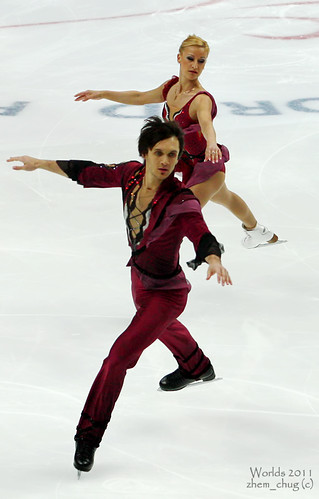
Maxim Trankov and Tatiana Volosozhar performed their short program in team figure skating last night and it
Photo by zhem_chug at FlickrCommons
goes without saying that they were magnificent.

In any display of grand competence, I am always overwhelmed by how the performer makes what is so very difficult look effortless.  Last night’s performance was such an example.

Watching them work in tandem minds me of how much more difficult it is to work together than alone.  I don’t know how tall they each are, but she only comes to his shoulder, which suggests as much difference in the length of their respective legs, which suggests how very much they must both work – she stretching beyond her limits, he holding back, to match each other skate for skate, turn for turn.

Matching pace, each to the other, is no easy thing in any endeavor: marriage, friendship, teacher-student, dancing, skating, walking side by side – all require an awareness of the other, an ability to slow down or speed up beyond one’s own normal pace of life in order to operate in tandem with another.

It invites the pondering of who do we have to alter our pace for and the recognition that in that altered pace may well lie our best flying.

Sometimes we just have to slow down for someone else.  We get that.  When our kids are little, we’re spending a whole lot of time in first gear, walking more slowly, matching our pace to theirs, speaking more simply, explaining along the way.

And whatever our life’s work, there will be times when we have to match our pace to another less knowledgeable or experienced, showing them the way, pointing forward so they can see what we already know to be there.

And there will be times when someone else will do that for us.

There is a cost to the self in this matching of pace, of one’s own internal rhythms to another’s.

But when it works, oh, how glorious it is, for there be dancing in our flying and harmony to the universe.


Tuesday, September 10, 2013

Syria: When Eddie Prayed

So Eddie prayed
and today the Russians
become 
(very tentative)
allies of thought
with the likes of 
John Kerry and
Hilary Clinton
and 
(perhaps)
Assad himself

seems there might just
be an alternative –
a peace way –
of coming to resolution

and all can claim victory
even the US can claim
(as Mrs. C already has)
that it was the very threat
of force that brought
about the possibility
of peaceful resolution

so you say, Hilary
and for this day
that’s good enough

but not really – for
the warp and woof of
cause and effect are
not so clear as even one
single thread in a
tapestry of events

it will do for today
this claim of victory
if it gets us there
it'll do

oh, 
but how do you know
it was not the threat
of force
but Eddie’s prayers in 
the night?

Wednesday, September 4, 2013

Syria: To Bomb or Not To Bomb

The President says it’s punitive.
The people hear that it will save lives.

The President says it’s to protect Israel.
The people hear that it’s to protect Syrians.

The President says it’s to challenge Iran.
The people hear it’s to challenge Assad.

The President says it’s not about regime change.
Senator McCain hears it’s about regime change.

It is my own view that one of the biggest problems we citizens of the United States have when it comes to political interactions is that we do not listen to our leaders.  We do not hear what they say; we hear what we want them to say.

The second largest problem is that when it comes to contemplated military action, our Congress as a whole debates not whether to but how to.  And as Congress goes, so goes the press by and large.

Thus we are right now in a situation regarding Syria of taking the fact of a strike against that nation as a virtual given, arguing only over the details, when in fact, the whether to at all question is actually the important question of the day.

And thus we are right now in a situation regarding Syria where President Obama is actually being very clear; unfortunately, his citizens are not listening to him.

1. It’s punitive.  Let us take the President at his word: his reason to seek military action against Syria’s government is punitive.  He has actually used the word ‘punitive’.  There are several problems with such an approach:

a. it’s a do-what-I-say-and-not-what-I-do approach to world affairs; and as any (good) parent knows, it’s an approach doomed to fail, for those following and even those not seeming to be paying attention will inevitably do not as we say but as we do.  We supported the use of chemical weapons by Iraq against Iran in the 1980's, to the point of remaining silent in the face of Saddam’s turning those same weapons against his own citizens, the Kurds of the north.  We used white phosphorous on the civilian population of Fallujah.  We will not sign treaties that seek to ban cluster bombs and certain types of land mines.  And even when we do act to oppose such weaponry, we are strangely silent about the manufacturers and holding them accountable.  To claim the moral high ground, it’s axiomatic that one must actually be standing on the moral high ground at the time.

b. If it’s punishment we’re after, there are a whole host of remedies in the international arena.  The International Criminal Court provides a venue for the prosecution of crimes against humanity and what we term war crimes.  The United Nations has vehicles for other remedies, including sanctions, the sending of peacekeepers and inspectors.  In fact, the UN did send inspectors.  Their report has not yet been produced.  Their testing is not yet complete.  To circumvent the United Nations yet again is to effectively say to the world that the United States does not even believe in the possibility of international law and action.  The lone wolf mythology we cling to is costly beyond our ability to imagine, I fear.  And punishment is a poor substitute for a just peace, especially a punishment that seeks to say that killing in a particular way is wrong by killing in a different way, but killing nonetheless.

2. It’s about Israel, not Syria.  The fear about chemical weapons is as much, if not more, about our concern for the people of Israel than it is for the people of Syria.  It is commonly accepted (although not publicly stated) that the source of information/ intelligence about this most recent attack is Israel.  Given its geographical proximity and their historical hostility, Israel is right to be concerned.  Whether Israel’s concerns and ours align in this particular instance is something that should be discussed.  It’s not.  The President has named the concern.  But no one else seems interested in discussing, weighing and evaluating it.  And remember point #1 – this is about punishment.  The President has said so.  There is no goal to save Syrian lives.  There is no reason put forth that the contemplated action by the US will reduce violence in Syria.  Many believe it will have the opposite effect of escalating an already violent conflict.  When acting pre-emptively on behalf of a party such as Israel, we have to at least admit that we’re willing to sacrifice Syrians to do it.

3. Challenging Iran.  Secretary of State John Kerry stated that one reason to strike against Syria is to send a message to Iran, North Korea and others that chemical weapons may not be used with impunity.  Setting aside the cruel irony of the US telling Iran that it will not tolerate chemical weaponry when it was the US that enabled Saddam to use chemical weapons against Iran in the 1980's war (by providing Saddam with critical intelligence on where and when to launch his attack (Democracy Now), are we really going to kill Syrians in order to teach Iran a lesson?  Are we, in so doing, going to ignore the mutual-defense pact between Syria and Iran?  Are we really going to provoke Iran and its allies, drawing them into (or further into) this conflict?  Did we learn nothing about how global conflicts begin from World War I?  Are we really interested in restarting the practice of proxy wars we retired with the Cold War?  Are we really ignoring Russia and China in all this?  Are we really so immature as to believe that to explore alternatives to military air strikes is ‘doing nothing’?  Is our press so ineffectual as to ignore these vital questions?

4. It’s not about regime change.  President Obama (who will be making the decisions, no matter with whom he consults) has been very clear: he is not seeking regime change.  Senator McCain is not listening and insists that regime change is what must occur.  The problem I see is that following the course of either man does nothing to reduce or eliminate the bloodbath that is Syria today.  We the people would do well to remember that we’re not in this to save the Syrians.  This is not the good guys versus bad guys stuff of movies.  This is exactly what our President is saying it is: killing some Syrians, destroying some territory, to show the Syrian leadership that doing what we’ve said not to do will cost him because we said it would.  It’s a penalty.  No more, no less.

What might we do instead if we’re really interested in helping Syrians?

1. If you’re a praying person, pray.  One of the most important lessons I’ve learned about prayer (wish I could recall the source) is that God does not reverse the past.  What has happened already has happened already and it will not be undone.  Prayer, effective prayer, deals with the present and the future.  For those of us in the United States particularly, we might pray for wisdom, patience, forbearance, and mercy on the part of our leadership.   We might pray that our own eyes be opened to new pathways of peace and the strength, courage and dedication of resources to make them happen.  Weaponry as a problem-solving technique has become too easy in our time.  Military solutions are our go-to position all too often, ironic given its largely ineffectiveness at meeting our stated goals of peace.  This praying isn’t about patriotism.  It isn’t about having our own way.  It isn’t about undoing the past.  It’s about being empowered by the God of all to do right in the world and by the world.  The work of doing right is hard.  It takes lots of time and effort and money.  And it doesn’t often get a parade at the end.  And sometimes it gets a cross.  For a Christian at least, that shouldn’t be a surprise.  So let us praying people pray like we mean it and live like we believe it.

2. Invest in peace and the ways of peace.  We might marshal our impressive resources in the cause of just peace -- for at no time in our nation's history have we dedicated the resources for peace preparedness that we do to war preparedness. What might we do now?

a. we might pony up really big money to make refugee camps and other sites genuine places of safe haven.  On an individual basis, we might donate money to UNHCR (United Nations High Commission on Refugees) to provide for the masses of Syrian refugees (shout out to Jon Stewart on the Daily Show for highlighting this issue and way to help on September 3's show).

b. We might mobilize massive numbers of trained peacemakers, mediators and folks trained in the ways not merely of conflict resolution but also of building a civil society based upon universal humanitarian goals. We mobilize our military - why not our non-military?   And there are Syrians who are trying desperately to build and rebuild their own civil society.

c. We might ask our elected leadership to stop any support for the rebels in Syria unless and until they attend peace talks in Geneva.  We might ask other nations supporting the Assad regime (Russia and Iran) to do the same.

d. We might start punishing those who produce chemical weapons in international tribunals.

e. When it comes to the dedication of troops, we might use the United Nations - peacekeepers from the UN actually have a pretty good track record - a fact that gets overlooked. (and yes, I remember Rwanda).

f. We might wait for the UN inspection team to come back with its report/findings. I am no fan of Mr. Putin, but he actually asked a pretty good question - why would Assad use chemical weapons exactly when the UN inspection team was in country? Assad might be a monster, but is he really that much of an idiot?

g. If the goal is punishment,  we might treat this as a crime.  If so,

(1) proof beyond a reasonable doubt is required. Shouldn't we have the same level of proof for the killing of many as we do of the killing of one? and

(2) there are already processes in place in the international community for that. So charge Assad with crimes against humanity and prosecute him for them.

(3) If, on the other hand, the goal is to stop or reduce the numbers of civilians from being killed, we have to remember that this is a civil war and all sides are armed to varying degrees and all sides are using violence to impose their will both upon the civilians as well as the opposition. The only thing I know to change that dynamic (other than a clear winner, which rarely happens) is negotiated peace. The bottom line for me is that the answer to grab our guns just hasn't been effective, ever, at reducing or eliminating the numbers of the dead -- it's only been effective at giving one side or the other clear victory after the bloodbath.  Isn't it well past time to commit , really commit, to the ways of peace?

(4) A side note worth remembering: the other day NPR interviewed 2 sisters in Syria - they were of opposite opinions. Family. One favored the rebels and hated the Assad regime for its cruelties. The other feared the rebels, particularly as a woman, certain that her own life would not be worth much if they were to prevail. When I jump into someone else's fight, I'd better have a good idea about all that's at stake. Ask the Iraqis.

When I take up a gun, a bomb, or any instrumentality of violence, I am not stopping people dying. What I'm doing is simply changing the cast of characters who will die.

And logically, if I am 'letting' people die by not bombing Syria, am I then responsible if the bombing results not in less deaths but more, if Assad increases rather than decreases his attacks on the civilian population?

We can't predict with certainty the outcomes of actions because we're not in control of the universe of possibilities. That doesn't mean we do nothing. But it does mean that we dare not act surprised when our efforts to 'help' backfire with more violence that we participated in escalating.  ( See Slate report on the increase in civilian deaths in which other countries intervene in armed conflict.)

But I remain stuck in pondering whether it really is the best we humans can do when children are dying to drop more bombs that risk killing more children? Why can't we create safe havens for them to run to? Why can't we teach their parents a better way? Why can't we spend the money on things that actually work? I wish I knew.

__________________
Other posts I've written about Syria:  There's a War a CominJumping Rope in the SandCandidate Questions on Foreign Policy, and Grading the Debate.


Thursday, October 4, 2012

Grading the Debate


Grading the Debate
My Scoring of the 1st 2012 Presidential Debate
With an important post-script about Syria & Turkey

I score President Obama the winner over Governor Romney by a score of 26-10.

How did I arrive at a score?  I flowed the debate, as best I could.  Even though this was not actually a debate in any sense of the word, I scored it as if it were and to that end, I took each candidate at their word (leaving my own pre-knowledge outside the room and leaving fact checking to others).

Clash is the debate concept that each debater meets the issue(s) raised by their opponent directly and responds, with evidence rather than with mere assertion.  Mostly what I ended up scoring was clash or the lack of clash.  This approach was in order to capture, as best I was able, the content of what each candidate had to say in relation to what the other said, which is the essence of debate.  If there weren't an opponent in the room, there would be no debate.

Round 1 - The economy and jobs: Obama claimed to have created 5 million new jobs, to have saved the automobile industry, that housing is on the rise, and that money saved from the two wars the US has been involved in will be used to ‘rebuild America’, and a plan to close tax loopholes regarding overseas investments, none of which Romney responded to.  5 points Obama.  Both agreed on a need to invest in skill building of the work force and education.  Obama specifically referenced Race to the Top educational reform, the plan to invest in 100,000 additional math and science teachers and to keep tuition affordable, none of which Romeny addressed.  1 point Obama.  Obama referenced developing new energies, increasing American energy production and increased oil and natural gas production, which Romney countered with the fact that energy prices have increased under Obama, public energy leases have been cut in half under Obama and increased development has occurred on private lands, to which Obama did not respond.  1 point Romney.  Romney’s tax savings plan was attacked by Obama with specific figures ($5 trillion in tax cuts, $2 trillion in increased military spending, e.g.), saying that these could not be offset by eliminating tax deductions.  Romney countered with the assertion that it isn’t true, to which Obama responded that the math is clear and it can’t be done without other cuts or tax increases to the middle class.  1 point Obama.  Assuming a nexus between taxes and job creation (as both seemed to do, at least part of the time), Obama claimed to have lowered taxes 18 times to the benefit of small businesses, to which Romney did not respond.  1 point Obama.  On Obama’s proposal to raise taxes for those with an income above $250,000, there was clash about what is a small business, how much employment the top tier of small businesses generate, and finally, Romney’s claim that the top tier of 3% of small business owners employ 1/4 of the work force and enactment of Obama’s tax increase would result in a loss of 700,000 jobs, to which Obama did not respond.  1 point Romney.  On the big picture, there was a bit of a tie: Romney’s claim that in the last 4 years, 24 million people have been out of work; and Obama’s claim that under the Clinton/Democrat model, there was record prosperity and under the Bush/Republican plan, there was record financial crisis - 1 point each.

Round 2 - The economy and the deficit: Obama urges the elimination of corporate subsidies to the oil industry, which Romney countered with the fact that the same subsidies were extended by Obama to alternative energy companies, to which Obama did not respond.  1 point Romney.  Obama urged eliminating deductions for corporations such as for corporate jets, to which Romney did not respond.  1 point Obama.  Obama claimed a record on deficit reduction of eliminating 77 government programs, 18 educational programs, saving tens of billions in eliminating Medicare fraud and 15 billion in waste, taking 1 trillion out of the budget, a 4 trillion deficit reduction plan, a plan to increase revenues by $1 for every $2.50 in spending cuts, to none of which specifics Romney responded.  1 point Obama.

Round 3 - The economy and entitlements: Noting a problem with the usage of the word ‘entitlements’, Obama said that Romney’s voucher plan is estimated to cost each person covered an average of $6,000 per year, to which Romney did not respond.  1 point Obama.  Romney proposes shifting to needs-based coverage, to which Obama did not respond.  1 point Romney.  Romney overall attacks the expense of provision of these benefits, to which Obama responded that Medicare has less administrative costs than private insurance, which also adds in the expense of its profit for doing business.  1 point Obama.  Obama cited AARP claiming that Obamacare extends the life of Medicare by 8 years, to which Romney did not respond.  1 point Obama.  Obama said that repeal of Obamacare would cost on average an additional $600 per year in prescription drugs, increase in co-pays, and benefitting only the insurance companies, to which Romney did not respond.  1 point Obama.

Round 3a - The economy and government regulation: Romney said that while some regulation is necessary, it can also become excessive and actually do unintended harm, citing Dodd-Frank banking regulations as an example.  Obama did not respond directly to Romney’s challenge about excessive or over-regulation.  1 point Romney.  Obama specifically linked the recent economic crisis to an absence of regulation, with which Romney either agreed or did not expressly refute.  1 point Obama.  Romney said Dodd-Frank hurts the economy with provisions like protecting banks deemed ‘too big to fail’, to which Obama responded that the banks had paid back the monies loaned to them by the government with interest.  1 point Obama.  Romney said that he would keep ‘some’ of the provisions of Dodd-Frank (used as an example of government regulation).  Obama charged that Romney had previously said he would repeal Dodd-Frank, to which Romney did not respond.  1 point Obama.

Round 4 - Health Care Romney asserts that Obama cuts Medicare to pay for Obama care and that Obamacare will kill jobs because businesses are less likely to hire workers because of the additional burdens it imposes, to which Obama did not respond.  2 points Romney.  Romney charged that a private unelected board would be making medical decisions for patients under Obamacare, to which Obama responded that the board did not deal with individuals but with industry best practice standards, to which Romney did not respond.  1 point Obama.  Obama claims that repeal of Obama care will result in 50 million people without health insurance, to which Romney did not respond.  1 point Obama.  Both claimed the provision of health care to be an important goal, but when challenged by Obama to reveal what his plan is, Romney did not respond save to say he would have one.  1 point Obama.  On the Obamacare model and its workability, Obama asserted that it is the same model as that enacted by Romney while governor of Mass. Romney shifted the argument to say that Obamacare did not have bi-partisan support, to which Obama responded that it was a Republican idea using the same plan as that in Mass, with actually the same advisors helping craft it.  1 point Obama.  Romney asserted that according to the CBO, Obamacare would result in 20 million people losing their health insurance, to which Obama did not directly respond.  1 point Romney.  Obama claimed that the rate of growth of health insurance premiums has slowed, to which Romney did not respond.  1 point Obama.  Romney asserted that the (federal) government is a bad bet as an organization or institution for saving money, to which Obama did not respond at this point, although Obama had earlier made the case that Medicare administrative costs are lower than private insurance, which when added to profits private companies received, results in savings to the consumer.  No point to either candidate.  Obama challenged Romney’s plan as failing to provide for coverage of pre-existing conditions.  Romney denied that was true.  Obama responded with an explanation of Romney’s plan (which sounded like COBRA), which would not provide universal coverage of pre-existing conditions, to which Romney did not further respond.  1 point Obama.  Romney’s health care policy foundation is his statement, “the private market and individual responsibility always work best”, to which Obama challenged him to explain how he would enact to provide health care and why keep it a secret, to which Romney did not respond.  1 point Obama.

Round 5 - The Role of Government - what is government’s ‘mission’?  After outlining their general principles about the role of government, the debate focused on education and the question of whether providing education or improving the quality thereof is a role of the federal government.  It is to that portion that I addressed my judgments, making no score on the two men’s statements of principles.  Obama alleged that Romney would cut the education budget by 20%; Romney said he wouldn’t.  No points.  Romney offered his school voucher proposal, to which Obama did not respond.  1 point Romney.  Romney attacked Obama on things like investments in green technologies and an implied attack of corruption (saying that Obama gave federal green monies to campaign contributors).  This was off topic, as Romney never tied it to education.  No points.  Obama cited his program of linking community colleges with industry, providing training for students, who are guaranteed a job at the end of the program as an example of the role the government can play in education, to which Romney did not resopnd.  1 point Obama.  Obama also cited his program which eliminates banks as ‘middlemen’ in student loans, saving students on the cost of repaying their loans, to which Romney did not respond.  1 point Obama.

Round 6 - Governing and gridlock Both men spoke about their aspirations and approaches.  No points.

On the substance of any debate, which is comprised of the often boring details and minutia of an issue, the winner was clear on my flow chart.  Mr. Romney tended to speak in broad terms.  That does not mean what he had to say was either unimportant or untrue.  It does mean that when it comes to debate, there was often little upon which to judge his performance.

Some general observations about the style aspects and other random thoughts

1. Pundits asked for a substantive debate.  Even observing that Gov. Romney spoke more generally, both men in fact gave a substantive debate, outlining their worldviews when it comes to governing and at least some of their particular ideas about how we go about achieving their vision for the United States.  The sadly ironic thing is that it was that very provision of substance that results in many claiming Mr. Obama ‘lost’ the debate on style points, which simply demonstrates that we apparently have absolutely no interest in how we are going to be governed and are only concerned about whether we like the person, or think the person is most like us, or some other such ephemera.

2. Here’s my take on who you should vote for, for whatever it’s worth: if you believe that government should get out of your way, be the least intrusive as possible in your journey towards your dream, leave it entirely to you to choose, whether you choose badly or well, vote for a Republican.  If you believe government should help you and provide for the common good, even if not your own particular good, then vote for a Democrat.  It is a philosophical difference.  It does not mean that one is necessarily morally superior to the other.  And the fact is that most of us believe government should land somewhere in the middle of these two poles.

3. Both men ran roughshod over the moderator.  Mr. Romney was more obvious, interrupting Mr.Lehrer often, even talking over him.  Most seemed to have found that appealing, as Mr. Romney was assertive, like a president should be.  I thought it was just rude.  But Mr. Obama ignored Mr. Lehrer as well; he was just more subtle.  One female commentator noted last night that maybe it’s a gender difference, but she didn’t like it.  I agree.  If you’ve agreed to a format beforehand, honor it.  If you haven’t, don’t tell us you have.

4. I just googled ‘judging the presidential debate by content rather than style’ and got 65 million+ hits, but not one of them was about the debate that actually happened last night.  Not one.  That, I think, is an incredibly sad commentary on us as a people.

Finally, in my blog yesterday, I had a couple of questions I wanted answered.  Mr. Romney answered the questions I had for him:
Mr. Romney, if you wish to eliminate or substantially change the approach of progressive taxation, as your talking points suggest, upon what basis do you claim that this shift actually results in an increase in prosperity for everyone?  And as a subset of that question, if you have to sacrifice one of your taxation goals in order to achieve a balance to the budget, which goal is the most expendable from your point of view?
As I understand his position, Mr. Romney believes that lowered taxes on the wealthy (the job creators, as he describes them) generally frees up more capital for them to invest, which creates more jobs.  He did not say those words.  What he said was, “taxes slow growth”.  I extrapolate the rest, but I think I understand his position.  The second aspect was much more clear: what would Mr. Romney sacrifice to achieve a balance to the budget?  Everything – when it comes to government spending.  Everything except military spending.  And social security.  And education.  And Medicare for those currently receiving it.  But Mr. Romney made it very clear that under no circumstances would he increase taxes.

My question for Mr. Obama was answered as well.
Mr. Obama, given that as president, you are required to work with Congress, how do you propose to enact your economic programs (or any of your programs, for that matter) in the face of organized, concerted congressional opposition?  It is not enough to merely blame Congress.  What do you plan to do about it?
He said that he would take all ideas on board when it comes to solving our problems as a nation, whatever the source.  He said that he would take care to well-describe his plan so that there was understanding about what it is and what it is not.  And he said that occasionally, he would say no, to both friend and foes.

I believe them both.

Now to the hard work of citizenship and deciding where that takes us as a nation and what I intend to do about it when I enter the voting booth.

An important post-script

Yesterday as these two men were preparing to meet and debate, one of them had some other things on his mind, no doubt.

Yesterday Syria (or someone from Syria’s opposition groups) bombed Turkey.  This isn’t the first time.  But it is the first time that Turks were killed.  Five people, including a mother and her three children were killed.  Turkey responded by bombing Syria.  NATO weighed in as did Secretary of State Hilary Clinton.

And Turkey’s military asks its parliament today for the authority to act against Syria.  Early indicators are that this is more symbolic than an actual precursor to outright war between the two nations and thus far, Syria has taken a conciliatory and apologetic approach with Turkey, promising to investigate how this could have happened.

But the border between the two countries is a tense place as Syria’s civil war continues and rebels move into Turkey for cover.

And lest we forget, Syria counts among her allies Iran, Russia and China.

World wars don’t always or often begin in the obvious place.  They begin with a skirmish there, an insult here, a death or two, revenge killings, drawing in of allies, and escalation.

Thus far it seems that in the aftermath, both Turkey and Syria are seeking ways to avoid war with each other – a good thing.  But allies are also being pulled in.

If you do nothing else today about world politics, pray for Syria and Turkey, pray for world leaders, that cooler heads prevail and that escalation is avoided.  In the U.S., pray that the man who you think didn’t have such a great debate last night be filled with wisdom and vision and the courage to resist violence as a problem-solving technique.  Pray like the world depends on it.

Tuesday, July 10, 2012

To Russia, with Love


There are apps that track even what towns folks are reading a blog from, but I don’t subscribe to them.  But Blogger.com does tell me the countries readers are from (forgive the dangling prepositions – I’m from West Virginia [it’s an old joke]).

What has been fascinating to me as I track statistics on readership is the increasing number of readers from Russia particularly (shout out to Malaysia, India, France, Germany and Latvia, the other non-English speaking countries also with regular readership).  But since I went to Scotland, Russian readers have become my second largest audience group, following the United States.

I am both puzzled and delighted.  I wonder about you, the Russian reader.  Are you practicing your English skills?  Are you fellow Christians?  Folks interested in nature who enjoy my thoughts on rural life?  Do you enjoy my jabs at the political foibles in my own native land?  Or was it Scotland that drew you as it draws me?

We truly are entangled (in the best possible way, I think) in a world-wide web – of communication and increased understanding, of learning and knowledge, of sharing and caring, of giving and receiving.

Just like any community, the web has its share of the weird, the odd, the ugly and the dangerous.  But for the most part, I have found friendliness and welcome with a world of folks I will most likely never meet in real time.

So to the friends all over the world, but especially to my Russian buddies, a special welcome today.  May you be blessed with all the wonders and joys life has to offer, now and ever more.

Wednesday, May 9, 2012

Who Sends Their Children to Die?


Some years back while I was in Iraq, an Iraqi woman, serious and intent, seeking an equally serious and intent response, asked me, “What kind of people are you?”

Somehow I knew what would come next, but she explained to make sure I took her meaning: “What kind of people are you that you send your children here to die?  Who does that?  What kind of people are you?”, her voice rising with each word.

Years later I sit in a borrowed vacation home in Scotland, in one of the most peaceful and safe places perhaps on the entire planet.  Surrounded by beauty and safety, I read novels set in war times.  I don’t know why I do it – this self-inflicted wounding, for that’s what it is.

Sometimes I simply seek understanding through art.  But for all the beauty of the well-told story, they all, whether standing on the side of peace or war . . . they all slide down the slope of inevitability – the biggest lie of all.

And I am sick of it – heart sick and soul weary of this lie we humans proclaim as if it were wisdom, as if it were true: the lie that war and violence are inevitable.

For here’s the thing: that something has been done and has been done often does not make it inevitable.  We are the inevitable piece.  Our participation is what creates the reality.  We choose, and in our choosing, determine whether lions and lambs will or will not co-exist in peace or move on towards destruction.

In the book Resistance by Welsh poet Owen Sheers, a woman of the country whose husband disappears into the night to fight with the resistance cries out in her heart against the notion that Tom had gone to defend his country:  “She was his country and she was in need.”  Tom chose and in the choosing of one thing, abandoned another.

And now I read Remembrance about WWI.  Among the characters is a young man who fervently believes not in pacifism, but in his own certainty that the so-called war to end all wars is wrong – foolish, wasteful, and wrong in its aims and objectives.  And yet he too goes after a period of some resistance.  He goes because the very things he believes are true strike his own family.  He goes to die because others he loves have died – not out of revenge or any change of heart about the rightness of the ‘cause’, but because some internal sense of honor tells him that because these have died so too must he.

It is the worst, the most pernicious, kind of lie, this lie in our fiction as well as in our fact, that a social decision to war has a claim of inevitability upon our hearts, against which we can do nothing but acquiesce.

And it is an outrage.

It is the outrage of the broken widow women at their sinks, the same women who applauded the sending of their sons as well as husbands, to the killing fields.  Do we really so lack in imagination that we can little foresee that what happens to other sons and daughters will happen to ours?  When the telegram comes, how dare we be surprised?  And yet we are and continue to be – deluded, surprised, taken aback by the horrors we so carefully orchestrate that it can hardly be other than thus.

I read and I remember the diaries of my Grandfather from World War I and his two sisters from World War II, particularly the writings of my great aunt Lucy.  I remember her blithe tales of her times in North Africa and Italy, of sun-bathing picnics with officers and teas, dinners and dancing, and I am staggered with the anger I feel towards her.  How dare you, Aunt Lucy?  How dare you lie so even in your own private diaries?  Even when she writes to herself, all she speaks of are light-hearted things, as if she were on her own Grand Tour of Europe.

Here’s the thing: if, and it should (although seldom is) always be the biggest of all ifs – if we are to head to war, ever, then should it not only be after the gravest consideration by us all of the great cost to ourselves and to the others, even and perhaps especially our enemies?  Should not those who have been there before recite with the most somber of tones the enormity of what is to be encountered?  Should we speak not of parades and parties and shining uniforms, but of dirt and grime and death and killing, of those who will never come home and of those who will – but never the same?

How could my ever-so-brave great aunt leave only a legacy of lies?  How could she do that to us who came after?  How could she not see?  Or if she did see, how could she not tell, even herself?

I read and ponder and I walk this ancient land pockmarked with memorials not to the dead, but to their wars.  The one thus far leaving me most puzzled, most troubled, most amused, is perhaps also the most telling of such things:

Near Girvan, in the village of Lendalfoot, along the shore of the Irish Sea, stands a bulky iron anchor monstrosity of a monument, with commemorative words written mostly in Russian – yes, Russian.  What little English there is tells of the life of a Russian ship named Varyag, hailed as a “a symbol of courage and heroism of Russian seamen all over the world.”  Girvan online

The Russian cruiser was blockaded in 1904 by the Japanese at a Korean port.  Refusing to surrender, a battle ensued, the ship was damaged, and her Russian crew scuttled her and escaped back to Russia.  The ship was raised by the Japanese in 1905 and renamed Soya.  In 1916, Russia bought her back and she was renamed Varyag.  In 1917, she was sent to Great Britain for repair, but (here’s my favorite part – saying so little, it says so much), “. . . because of the revolution and civil war in Russia, the legendary ship was set adrift.”  No explanation is offered as to just who set her adrift (I’m guessing the British) or why (I’m guessing they were on the side of the Czar, who was losing the fight).  Again without explanation, it is noted that in 1920 (what happened during the 3 years she was ‘set adrift’?), Varyag was sold for scrap to Germany (sold by whom, one is left to wonder).  And let us note that within less than two years of the end of World War I, someone (I’m guessing Great Britain) is selling off the parts of war ships to the Germans, in what would have to have been a stretch of thinking to be legal under the terms of the Treaty of Versailles, which allowed the German nation only six naval ships.  Again, I’m guessing that the rationale went something like this: these are spare parts and the treaty says nothing about parts, after all.  But not to fear: on the way to Germany for dismantling, Varyag grounded and then sank near Lendalfoot.  And almost 90 years later, a monument is erected to the ship and her crews by the Russians on Scottish soil.

There it is; I’ve seen it with my own eyes: a monument to something rather different than the courage of the seamen who manned her 80+ years ago, I’d say.  Rather than a monument to the seamen of an obscure confrontation in an all-but-forgotten page of history, this monument stands as a wonderful articulation of the history of war and conflict: the Russians and the Japanese fight over a Korean port, each taking from the other and from the foreign soil they invade with their claims, and decades later, one side dares to call that venture epic and heroic.  I wonder how the Koreans tell the story?  Years pass and the armament in the form of a ship is bought back by one side from the other in the previous conflict.  Years pass and a third party refuses to repair the ship because of the shifting political tides within the country which owns her.  Rather than repair her, they set her adrift and then reclaim her to sell her for parts.  It’s such an elegant traipse around the law of the sea, isn’t it?  And of course, her parts are sold by one old enemy to another, with both turning blind eyes to the treaty that would make such a transaction illegal.

And to celebrate all this wonderful history of back-stabbing, war, treachery, and business as usual in the midst of it all, all sides get together and build a monument to it, without the least sign or recognition of irony.

God, how I hate this planet some days.


Siegfried Sassoon, Suicide in the Trenches (1917)

I knew a simple soldier boy
Who grinned at life in empty joy,
Slept soundly through the lonesome dark,
And whistled early with the lark.
In winter trenches, cowed and glum,
With crumps and lice and lack of rum,
He put a bullet through his brain.
No one spoke of him again.
You smug-faced crowds with kindling eye
Who cheer when soldier lads march by,
Sneak home and pray you'll never know
The hell where youth and laughter go.

The Iraqi woman’s question still begs to be answered: what kind of people are we that we would send our young to die in such a place, in such a way, cheering as they go?