Showing posts with label mourning. Show all posts

Thursday, September 4, 2014

Rachels Mourning


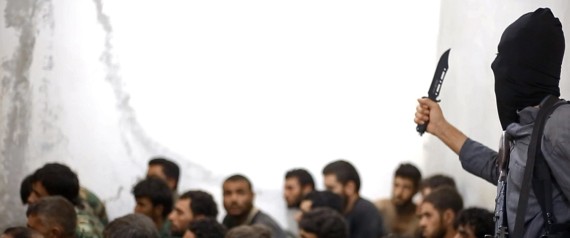
Posted by the Raqqa Media Center of the Islamic State group,
a Syrian opposition group, broadcast by AP
I see the picture this morning of a young masked man wielding a knife in the air over the heads of   captives and I am moved by his bare arm, his wrist, at his evident youth and ponder his own mother, somewhere and wonder if she recognizes that wrist and imagine what she might want to say to him, this beloved flesh of her own flesh and recall the mourning of Rachel, who will not be comforted, for the loss of all her sons and daughters, a horror wrapped in a tragedy that seems to know no end.


***

Your wrist is so small,
so clear
so young
so blemish free –
in your hand
the knife looks
like a toy
the kind you might
have gotten in a
Cracker Jack box
if Cracker Jacks
still had prizes
of any size to them

and that black stocking cap?
it’s too early for Halloween
don’t you know that?
and I know it’s got to be hot
under there – it’s 100 degrees outside

so wee man, why don’t you
put down your toys – you know
I don’t like it when you play
kill-the-whatevers
and I don’t care if the whole
neighborhood is in on the game
I am your mother and I do not
like it and if all your friends
would jump off a bridge, would
you jump too?  Well?  Would you?

and then my true worry begins
as I look to this imaginary child
of mine and realize he probably
would – jump too – and then
where will we be?

So, no, you cannot go back
outside after lunch – there will
be no jumping off bridges for
you today little boy - do you
hear me?  I am your mother!
Get back in this house right now!
It’s not safe out there for you.
And now I must fear it’s not
safe out there for them either.

Don’t you dare look at me like
that with that stupid mask on –
I am not afraid of you –
you look ridiculous
and I am not having it –
do you hear me?
Don’t you dare pretend
you don’t.  Look at me!

When did you become this machine
of rage?  When did doing unto others
before they even get the chance of
thinking of doing unto you become
our family’s creed?  When did this
happen?  While I wasn’t looking?
Well, I am your mother and I
do not like it one bit.  This is
most definitely not how I
raised you, so you get back in this
house right now!  I mean it!

Don’t you understand?
They will kill you.
Maybe not today.
Maybe not even tomorrow.
But they will kill you for this.
And I will become the mother
of a terrorist and the neighbors
will look on me with horror,
spawner of Satan that they will
believe me to be – that, or pity
and I cannot tell you which
is worse – you bring me shame
and I cannot endure it, so if
you’re going to kill them, you’d
better begin with me, for it is
me you are killing – the one who
gave you birth, gave you life

Where is my little boy?
The one I tucked in to bed
with laughter and stories
and one more glass of mai
and ‘oommee, I’m scared  – 
there’s a monster under
my bed’ and I wonder when
you went from being scared
of monsters to becoming one

and I cry out to the God that
you are not a monster, you are
my boy and I beg the God to
spare you your foolishness
and even as I mutter my
desperate prayer with its
obligatory  inshallah, I do
not mean it – in my heart
of hearts, for I cannot conceive
that any of this would be the God’s
will – for you, for me, for them,
for any of us – you must end this
for it is not yet too late – it will
be soon, but not yet, so please,

[I know the world has hurt
you and I have not kept you
safe from it and they see you
as a monster which tempts
you to become what they see
and it is not right and I know
you think you have no hope
and this is the only way and
it is just, so you’ve been told
by the men who know better
as they keep their own safe
distance from the bombs and
guns while they send you –
a child – and I know you feel
inside yourself you are a man
and yearn to do something for
your people, yourself and I
know the hurt and the shame
you carry within you, but son,
I also know this is not you –
who so tenderly loves the fresh
shoots of the garden in spring-
time and the baby lambs as
they nuzzle your cheek and
your little sister who needs
you to protect her and show
her our ways and this is not
you – their words not yours
– their lies given as dreams
not for you – I know you are
hurt and think the pain and
the injustice will never leave
your heart unless you do this
thing but I am your mother and
I carry the wisdom of ages inside
me and I know too that when you
kill their children, it will not
bring ours back and you will
sorrow but then it will be too
late and you will be one of them
the thing you never meant to
be – the thing that killed your own
for the wisdom of ages knows that
when you kill them, you kill
your self, you kill us, and your
hurt will not go away – it will
explode into the stars and it will
never go away because you will
become the hurt]

I beg you, my son, put down
the toys of war you have picked
up and come back in the house
and I will fix you an iftar worthy
of a king – or a little boy come
home for good – please, my
precious prodigal, do not do
this thing – I, your mother, am
begging you with my tears –
Do.  Not.  Do.  This.  Thing.


Wednesday, August 13, 2014

Why Does It Hurt So Much That Robin Williams Died?


Robin Williams is a stranger to most of us.  So was Philip Seymour Hoffman.  And Heath Ledger.  And sadly, so many other people of fame who have died in some way associated with alcoholism or addiction.

Why does it matter so much to us when they die?  Strangers die unremarked in all kinds of ways every day.

Maybe (speaking only for myself) it matters so much because if they can’t do it – if ‘they’, who have so very much by way of resources and access to resources, can’t do ‘it’, who can?  What hope does the little guy, the average joe, the ordinary person, who may not have that kind of access in these United States, at least, have?


Of course, success may actually be part of the problem for the rich and famous – that same success that gives them ease of access to treatment and care gives them access to the thing that will kill them.


Obviously, the cost of addiction is not (or not only) an issue of class or economics.  


But when Robin Williams dies, I am not just mourning for him.  I am mourning for everyone else who struggles his struggle and wondering what chance they have if he couldn’t do it.


Of course, I know better.  Of course I know that all those who struggle have a chance.  And that so much depends on so many variables.  And that help is really only a phone call away.  But I also know that for some, it is sometimes just too much and Superman won’t arrive in the nick of time.  


And knowing all this, I mourn.


Sunday, January 19, 2014

MLK & Happy Mourning

Considering Matthew 5.4:  Blessed are they who mourn, for they shall be comforted.

We might translate this passage in various ways:

Blessed the mourning ones among us, for they shall  receive comfort and their mourning shall not have been in vain – consolation, the full realization that what they mourned has passed away, shall be their knowledge, their joy.

Privileged are the broken hearted among us:  they shall know the consolation of change.

Blissful mourners:  in your mourning lie the seeds of change, which will be your consolation.

O the blessedness of the mourning ones!  Consolation is yours!

Comfort, consolation, here has the sense of God as companion, for the Greek word means coming alongside.  So we might say:

Privileged mourning ones!  God walking beside you – comfort!

***

In the hymn Great is Thy Faithfulness, the chorus’ 2nd line: morning by morning, new mercies I see, came to me today not in terms of the morning dawn of each new day but as the sorrowful, grieving mourning, “mourning by mourning, new mercies I see” – as one sorrow takes us to the next and the next and the next . . .

Tomorrow is MLK day, when we remember the work and sacrifice of Dr. King.  He began working for his own people: the people of color in Montgomery, Alabama . . . but he was moved from there to a movement that embraced the entirety of the South and then into the north . . . and from there to the vagaries and violence of the war in Viet Nam and from there to the conditions of poverty throughout our land . . . from there to standing alongside the sanitation workers on strike in Memphis, where he would be killed so we cannot know where he would have gone from there . . .

But virtually his entire ministry was encompassed by a movement from mourning to mourning, from cause for sorrow to cause for sorrow, yet moving in the sure and certain and true conviction that consolation was always present . . . not fully realized, but always present.  

This consolation is easy to understand (when you’ve experienced it) but right difficult to explain:  it’s the knowledge of the grieving mother that she will see her son again in the sweet by and by . . . of the soldier standing on the field of battle surrounded by the fallen dead at the moment when the victory is won . . . of the moment when a lawyer pleads with an opponent to understand that this is wrong and sees a glimmer of understanding in their eyes . . . change hasn’t yet happened, but it is coming and mourning and promise stand together, hand in hand.

The mourners among us are the ones who see things as they are and know they do not have to be thus . . . sorrow is their response.

Blessed are they, for they do not mourn in vain.

This is not merely the sorrow of inevitable loss, such as death.

This is the soul-invading Spirit sorrow at a world gone awry.

This the praying, beseeching, pleading sorrow of a saint on his knees before his God. . . the sorrow for the hunger of children she’ll never meet . . . the broken tears shed for a world that cannot, that will not, imagine another, better way.

Put another way, Jesus might have said . . . consider yourselves lucky for the pain-in-the-neck cry babies among you . . . the ones always reminding you about Somalia and Syria and Israel-Palestine and Congo and Iran and Iraq . . . the ones whose tears never end and who insist that things not only should, but can, change . . . lucky you to have such people living among you – for they will make you better and in the making, God will comfort them.

On the night before he died, Dr. King spoke of hypothetically being given the chance by God to choose in which time he would live and in his choosing, said this, I would turn to the Almighty, and say, "If you allow me to live just a few years in the second half of the twentieth century, I will be happy." Now that's . . . strange . . . the world is all messed up . . . Trouble is in the land. . . . But I know, somehow, that only when it is dark enough, can you see the stars. And I see God working in this period of the twentieth century in a away that men, in some strange way, are responding — something is happening in our world. . .

Using the parable of the Good Samaritan, Dr. King made the point that the question is not: if I help this man, what will happen to me?  Rather, the question is always, if I do not help this man, what will happen to him?  

Dr. King concluded the last speech he would ever give famously and prophetically saying, Like anybody, I would like to live a long life. Longevity has its place. But I'm not concerned about that now. I just want to do God's will. And He's allowed me to go up to the mountain. And I've looked over. And I've seen the promised land. I may not get there with you. But I want you to know tonight, that we, as a people, will get to the promised land. And I'm happy, tonight. I'm not worried about anything. I'm not fearing any man. Mine eyes have seen the glory of the coming of the Lord.  

The mourning ones among us, like the rest of us, live as long as they live.  They eat and drink, they laugh and make jokes.  They watch tv and read the papers and go to church . . . or not.  They raise their families.  And they watch and see and read the signs of the times.

And in their reading live their tears, which God has blessed for the benefit of us all.

For them, there is special blessing – the blessing of knowing the right question to ask (what will happen to them?) . . . the blessing of a heart able to break over the things that should break a heart . . . the blessing of seeing the land of promise and like Moses and Dr. King and so many others, that is enough and more than enough.

God walks alongside the mourning ones among us, whispering the comfort that will be theirs: O blessed are they!


Tuesday, November 19, 2013

Words No Words

A student is killed in an ‘altercation’ with a security official on Liberty University’s campus.  Not so far away, a local politician is stabbed and his son is dead.

Details, salacious details, are sure to follow.

Analyses, over-the-counter diagnoses, pieties and impieties will be spoken.

Tear Drop Window, Monument
Valley - photo at Luminous Landscape
Here, in this now, before the storm following the storm of personal tragedy writ large, I sit and wonder with a  friend about all the little things . . . the little problems we call to mind to remind ourselves that our lives aren’t so bad . . . the little things that for some become the big things . . . mounting and mounting until the explosion comes – the small explosions of angry words and harsh judgments or the bigger ones . . . none of them can be taken back, can they?

The writer of that book was wrong I think – that book that told us not to sweat the small stuff and that it’s all small stuff – yeah – I think he might be wrong – I think it might all actually be big stuff.

I have no answers, only questions – and tears.

What do we do to keep the pressures from mounting?

How do we help each other not let the little things pile up?

What does it take to change a course that in hindsight can seem inevitable?

I wish I knew.

Lord, oh Lord, how I wish I knew.

Thursday, February 28, 2013

A Wee Canto on a Life: Mourning the Death of Abu Hani


I only just now learned that Abu Hani died in December.  He was headed home to Baghdad.  It was a car accident.  A car accident.

Abu Hani was our landlord in Baghdad.  He survived Saddam Hussein, car bombs in his neighborhood, a mortar falling on his apartment building, thieves, and the day-to-day of dodging, weaving and dancing that was and has been life in Iraq for so long.

He and his family survived what we call the first Gulf War, hiding in a barn outside Baghdad.  They survived sanctions.  They survived escaping from Baghdad and the threat of the Jordanians to return Abu Hani to Iraq by force.  That may be my favorite Abu Hani story of all.

Along with millions of Iraqis, he finally fled his beloved Iraq to come to Amman.  His wife Um Hani was already there.  When he arrived, Jordanian officials told the passengers they would have to turn around and fly back to Iraq.

Time passed; Abu Hani argued and stalled long enough to ‘miss’ the return flight and as it got later in the day and into evening, he went to the hamam (the restroom) and changed into his pajamas, rolled out a blanket on the airport chairs and proceeded to make his place for the night.  When the officials challenged him, he calmly told them, “What do you mean I cannot do this?  I live here now.  This is my home.  From now on, I live in the airport because you won’t let me enter and go to my apartment in Amman with my wife.  So this is now my home.  I am very tired; I think I’ll get some rest.”

He rolled over and made as if to go to sleep.

Finally, the officials, mortified by the situation they had created, relented and agreed that Abu Hani could enter, but made him promise to tell none of his friends who had also come.  Of course he swore and of course he told them all.

On election day, Abu Hani took us walking around the neighborhood in Baghdad to various polling places showing everyone’s purple finger.  We sat many evenings around their table, eating, laughing, sharing stories.

He and Um Hani made us welcome.  They prayed for us and worried over us like mother hens.  They kept us safe as much from ourselves as from others.  They bade us welcome at their table in Jordan as well as in their apartment building in Baghdad.

Baghdad killed Abu Hani, finally.  He loved Baghdad.  He was Baghdadi through and through.  And so when the violence would calm, if only for a little bit, he would go back to oversee his investments as well as those of his friends and family.  And he survived.  Until the day when he did not.  And it was a car wreck.  In Jordan.  He was headed home again.  And none of the other passengers were even scratched.  And he is dead.  And it breaks my heart.  

You do not survive in Abu Hani’s world by being a fool.  And Abu Hani was no fool.  He was friend and protector, wisdom giver, proud father and husband, business man and consummate broker, witty and urbane, a Christian for whom the sands of Iraq ran in his blood.  And I mourn his passing with fond memories and a broken heart.

Oh, and I miss his laugh - the laugh of an Iraqi man - a laugh that contains the knowledge of fertile crescents and hanging gardens and wonders of the world and deserts and riches and poverty all beyond imagining – the laughter of one who knows much but tells little.


Friday, December 14, 2012

Mourning Connecticut: The Rules for Living in a War Zone*


I cannot
bear it
how will
they?

We are
monsters

it is time
we stopped
pretending to
anything else

it is time
we admit
that and act
accordingly

for if we were
honest about
who we are

we would teach
our children
the things they
need to know
when living in
a war zone --

how to duck
and take cover

how to roll in
a tight ball
with arms
covering to protect
against head shots

what to do when
taken hostage –
don’t look the
shooter in the
eye – just keep
your head down
and try to be as
invisible as you
can – either that
or try to make
him (and what
do we do to our
boys that they
can become this?)
love you – see you,
really see you –
no – better to just
try to be invisible
– if your small
self isn’t enough
for him to love you,
what chance have you?

how to be very
very quiet and still
in the face of real
danger – blending
into the background –
like the prey you are

how, once the shooting
starts, to play dead

how to run –
not in a straight
line, but zigzag
so you’re harder
to get a bead on

why, oh why,
do we not teach
them how to
survive a war
zone?

For that is
where they
live

___________
*It is perhaps foolish or even dangerous to vent one's feelings in the wake of tragedy, for it is only raw emotion that can speak at such times.  While God is not mentioned by name here, this is actually a form of prayer -- lament.  I have no other language now.

Friday, January 6, 2012

Iowa Schmiowa


My friend Stu died on Wednesday.  It is only Friday and already, it seems so very, very long ago.  Life continues apace on planet earth . . . people shop at the store and silly as well as serious discussions carry on even among us, those who mourn.

And the news keeps spinning out.

Last night, or was it this morning?  I think it was this morning . . . there was the usual US Presidential race coverage on television, only now, it was about New Hampshire instead of Iowa.  Did Iowa already happen?  I ask the fellow mourner sitting beside me on the couch.  I don’t know and I don’t care, she replied.

I thought about that for a moment.  Me neither, was my equable answer.  And it was true.  I really don’t care whether the Republican candidates have already been to Iowa or not.  I really don’t care who won and who’s claiming they won, even though they didn’t.

When did ‘news’ become a nation’s soap opera?  When did it become that you could simply fill in the blanks to never-ending and never-changing narrative?  When did our news become about the unimportant, the trivial?  And when did the really important things get pushed away to make room for the drivel we dub ‘news’?

I wasn’t looking that day.

I should have liked to have a vote in our collective decision to be held captive to the irrelevant by the irresponsible.

I wasn’t looking that day.

I’m sure Iowa is a lovely place to live and meaning no disrespect, I have to say . . .

Iowa, Schmiowa . . .