Showing posts with label God's call. Show all posts

Saturday, November 8, 2014

Go & Worship


[NOTE:  I wrote this reflection in the fall of 2006.  In the eight years since, so much has changed and so little.]

My thought today is a simple one: go to worship this weekend.  Not out of burden or duty, but out of gratitude that you can.  I spent time with a Christian group in Iraq and was struck by how difficult and sometimes impossible it is there to go to worship.

I was unable to attend church more often than not in Iraq – I missed church because the times of worship change to accommodate the before-dark curfew.  Another week I was on the Syrian border with Palestinian friends running for their lives.  Many times a priest friend would tell us not to come, that it was not safe today.  ‘Maybe next week’, he said week after week.

And then there was the day we actually made it  – the day that churches instead of mosques were bombed.  On our way, we saw the black smoke of car bombs at churches in the area.  Six in all.  But that day, it wasn’t the church we were going to attend.

Never before have I had to risk my life to worship in community, to go to church.  It has given me a profound gratitude for the privilege of gathering with the communion of the saints.

One evening at Mass in a nearby Catholic church, I wept at the courage of the gathered community who risked their lives to gather.  This night the priest said, “You are the result of God’s love, not it’s cause.”  I will never forget his words.  For such love, my Iraqi friends, Christian, Muslim, Yezidi, and others, gather still.

Pray for them, please.  Pray for us.  Go and worship.


Wednesday, October 30, 2013

An Unsolicited Job Reference for Arlene: What You Should Be Wanting in a Pastor

Seminary buddy Arlene shares on FB her journey in seeking a call with 7+ years of experience as a solo pastor under her belt.

Arlene reports some of the reasons she’s been given for not being called:  shoes, hair, laugh (not sure if was that I did or that it was too loud), age, my voice . . . 

Here’s what I know about all this insanity:

1. It’s easy (for me) to reduce this to sexism (I firmly believe it is that, but it is other things as well).

2. There’s a harsh irony that lives within me that ‘appreciates’ the honesty of these folks – would it be kinder or smarter to keep that nonsense to themselves?  I think so.

3. I am learning from Arlene’s experience: should I ever be in another job interview situation, I think I’ll just take it straight on with something like this: some of you may not like my hair – or my voice – or my style of dress – or my laugh – that’s okay – I don’t like yours either, yet here I am, still willing to be your pastor . . . or something like that – ‘just being honest’ (which is vastly different than truth telling) can be a reciprocal thing – how quickly we forget that.

4. Some of us are taking ourselves wayyyyyy to seriously if another’s laugh brings discomfit.

But I didn’t write this for them.  I write this for Arlene.  And here is what I would have you know about this dear friend, beloved by so many:

I met Arlene in the summer before our first ‘official’ semester in seminary.  We, and a whole host of others, were getting a head start by taking Greek in the summer semester.  Within a few hours spent in her company, I was astonished to observe the interactions of others with this woman I barely knew.

Strangers would, within a few minutes of sitting beside her, begin to unburden themselves uninvited on her – sharing their pain and sorrow, seeking solace in the gentling of her presence.

She’s that gal – the one you can tell anything to and know that somehow, you don’t know quite how – she will hear and understand.

I realized then that Arlene already was a pastor – all she needed was the paper to make it official.

I don’t remember her shoes, but her feet are walking feet – feet that go the extra mile simply to sit with a friend or even an enemy, in need.  And they’re feet that know how to jump and dance and live.

Her laugh is contagious, inviting everyone in on the joke.

I’m not sure what the hair thing is about – all I can draw from there is my own experience, by which I continue to be surprised at how invested congregants can be in how I choose to style my hair.  It’s a bit flattering and more than a little weird.  Even my mother doesn’t have that much to say about my appearance (and believe me when I tell you that she is not silent on the matter).

Arlene points out that the reasons that she’s been given have not included anything about her pastoral skills, her theology, her preaching (silly us: that’s what we thought it was all about).

I wish churches had the wisdom of 12-Step programs, which say something like this: although you may not like all of us, you will come to love us in a very special way, the same way that we already love you.

When it comes to church, I can truthfully say that I have seldom cared much about being liked; but I care very much about loving and being loved.

Isn’t that our business – loving?

Can’t we do better than this?

Consider how my sister in the faith concludes her own musings on the hurts she has sustained:  . . . all will be well, all will be well, all manner of things will be well (borrowing from Julian of Norwich).

That’s Arlene in a nutshell.

You may not have any idea of the life journey she’s had.

It isn’t necessary that you do.

But know this: whether you love her or not, she already loves you.

And by my reckoning, that makes her someone you would be damned lucky to have in your church.


_____________
*I asked Arlene for permission to publish this, as it is her story, her experience.  She agreed, hoping that someone might draw solace and healing and perhaps feel less alone in what can be a very painful journey in seeking a call.

Monday, September 16, 2013

Sermon Cliff Note: Sheep Lost & Sheep Found and Those Who Seek Them

Scripture:  Luke 15.1-7 (the parable of the lost sheep)

It’s a story we know so well, this tale of the one lost sheep.  The unfairness of it all – even the downright foolishness – this risking a whole group in order to save just one, arises:  Who does that?  How unfair is that to the 99?  Really?  You’d endanger 99 for just one?

These questions are the questions of the Pharisees.  They’re not bad people; they’re the good people.

And Jesus is spending time with the dregs of society.  He talks to them.  He eats with them.  He takes them seriously.  He thinks they matter.  And everyone knows they don’t – everyone, that is, except Jesus.

Instead of just going to Jesus, instead of trying to understand what he’s doing and why, the good people talk among themselves, grumbling and complaining.  They’re jealous.

At its core, jealousy is giving space to the 2-year-old who once lived inside us all.  But we’re not 2 anymore!  The time for baby talk and humoring is over – when we’re 2, it’s all about us.  But we’re not 2 anymore and it isn’t and we know it.

The problem, or at least one of the problems, is in understanding what the love of God looks like and what it requires.  So it’s back to basics . . .

God’s love is risky   God holds nothing back of God’s self in order to love and care for us.  And God gets hurt in the process.  God risks and requires that we do the same.  Was it risky to leave the 99 to look for the one?  Of course it was.  But the greater risk was to simply let the one go.  

God’s love is extravagant When I have more than I need, I can either decide even that’s not enough and demand more (the 2-year-old response) or I can share (the grown up response).  To risk the whole herd for the one is extravagant.  To risk our life together here in this church in order to love and serve our neighbors not here today is extravagant.  God isn’t always calling us to do more, but God is always calling us to be more. . . to be more loving . . . more understanding . . . more willing to risk what we think of as our ‘all’ – so that – we can come to the place of understanding that the ‘all’ we think of as all was little indeed.  

God’s love is exorbitant – God seems to think there’s more than enough love to go around.  But maybe we’re right and there’s not.  Yet even if there is only so much to go around, maybe that’s what we’re here for – to offer it all.  I doubt any of us have ever truly gotten to the end of ourselves.  But even if we have, so what?  To spend ourselves on behalf of others is why we’re here.

God’s love is seeking - God is a seeking God who calls us to be a seeking people.  God is a seeking God, searching out the lost and the lonely, the sad and the haggard, the down and out as well as the up and coming.  God seeks.  So too must we.

God’s love is contagious.  Love, like laughter, is contagious.  It spreads.  It can’t help but spread.  It’s that little light we were taught to sing as children – it cannot be hidden – it must shine.  And in its shining is its attraction.

In Jesus’ parable story to the grumblers, perhaps we, like them, are the sheep, the 99.  The question that hangs waiting to be answered is: are we content to munch our own grass?  Or are we joining in the rescue party?  More daring, are we ready to read ourselves into the story as shepherds?  For what sheep would a good shepherd leave behind?

Sunday, June 9, 2013

SermonCliffNote: Stewards of God's Call

God calls whom God will when God will how God will.  The Bible is replete with the call stories of God’s people, including Moses, perhaps the most unwilling of all.

When God came calling in the form of a burning bush, Moses repeatedly protests his own unsuitability, asking who am I to do this thing and who are you to ask me?  My own favorite is when he pleads with God: O Lord, please send someone else!

To all of Moses’ protests, God responds with providing.

Many, if not all, call stories have protest as the response to God’s invitation. . . Amos protests he is just a farmer . . . Jeremiah that he is just a boy . . . Isaiah that he is not worthy . . . Jonah that God’s message is not worthy . . . Esther that she’ll be killed . . .

Yet God persists with all of them.  God provides for all of them.  And God fulfills God’s purposes through all of them.  Even so, not every call story in the Bible is a success: Saul almost brings a nation to ruin that God gave him to take care of . . . Judas was as much a disciple, as much called as Peter and Andrew and James and the rest . . .

Preacher G. Lloyd Rediger speaks of the duty we Christians have to be “responsible stewards” of God’s call to us.  God has given us a heart, a passion, a desire, to do something and that something is God’s call to us.

Yet God’s call is not an invitation received without conflict – often there is doubt . . . and fear . . . confusion . . . and even lack of desire . . . because the call of God is a very big deal . . . and too often we humans live in a perpetual state of smallness, forgetting who and what we were created to be and to do, settling for far too little and calling it good or good enough.

When we believe we are too few . . . too weak . . . too old . . . or too young . . . too tired to act, to move, to help, we make ourselves too small . . .

When we buy in to the lies of our culture that only big money and big business and big churches can do anything of real import, we make ourselves too small . . .

And few though we may be in number, we were not made for small –

In the words of poet Marianne Williamson:

Our deepest fear is not that we are inadequate. Our deepest fear is that we are powerful beyond measure. It is our light, not our darkness that most frightens us. We ask ourselves, Who am I to be brilliant, gorgeous, talented, fabulous? Actually, who are you not to be? You are a child of God. Your playing small does not serve the world. There is nothing enlightened about shrinking so that other people won't feel insecure around you. We are all meant to shine, as children do. We were born to make manifest the glory of God that is within us. It's not just in some of us; it's in everyone. And as we let our own light shine, we unconsciously give other people permission to do the same. As we are liberated from our own fear, our presence automatically liberates others.

Our imagining is a big part of our stewarding of God’s call . . . for if we cannot or dare not imagine what God has in store, we will not see it come to life.

For God’s call to bear fruit, we must first imagine that it can.

For change to happen in ourselves and in our world, we must first believe, imagine its happening.

The call is always an invitation into the movement of the divine dance of coming and going:  come . . . with me . . . go . . . and do . . .

The question is . . . will we?  Dare we?

Monday, October 10, 2011

Limbo


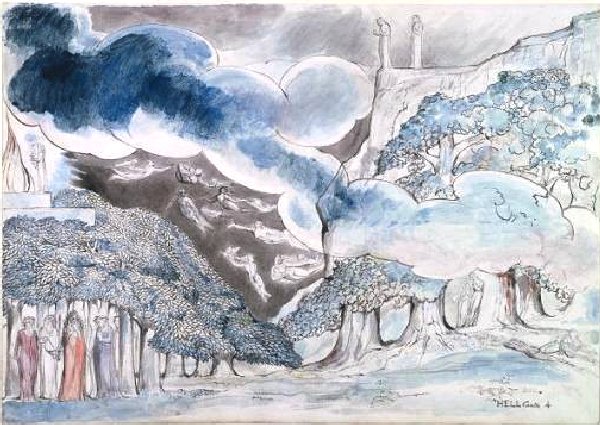
William Blake [Public domain], via Wikimedia Commons

Limbo is not a concept in Protestantism; yet often do we live there, at least this side of heaven.

As a Christian, the notion of ‘call’, of God leading and directing us to a particular path, of waiting to hear God clearly, of discerning that it is God’s voice and not my own or the voice of others, is steeped deep in my bones.

I have been called before to work in Iraq with Christian Peacemaker Teams (CPT) and have been to Iraq with CPT for roughly two-month stints from 2005-2010.  I did not go this year, mostly because I have been ambivalent about whether I am still called.

How do we know when God calls?  Even more, how do we know when God stops calling?  I wish I knew.

What follows is a random part of my own thought-process when I met an Iraqi woman this summer at the PC(USA) Big Tent event in Indianapolis.

***
Fi kelbee, anni Iraqiya.

It’s a phrase I haven’t said in a long time . . .

“In my heart, I am an Iraqi.”

As I meet Martha at the Big Tent gathering, she is introduced for her work with refugees in California.  The man who introduced us surprisingly says to Martha (about me), “She’s Iraqi.”

Martha, a Middle Eastern woman, looks at me with frank surprise.  I grin and say, “Anni Iraqiya, fi kelbee." [“I am an Iraqi, in my heart.”]

We both laugh, exchange pleasantries and basic information, and move on.

Yet the phrase hangs with me.

Am I?

Is it still true that I feel this affinity for the people of Iraq?  I think so.  But what am I going to do about it?

I haven’t been since the winter of 2010.

“What have you done for me lately” isn’t just asked by sports figures looking for the better deal (watch the movie Jerry MacGuire if you don’t get the reference).

It is a fair question for people caught in all sorts of webs to ask of those who would help them or walk alongside them as they endeavor to help themselves.

Kurdish Iraqis not allowed to vote in 2009
“What have you done for me lately?”

No one is asking me this question, at least not in person, face to face.

But I still hear the question ringing in my ears.

Will I go back?  I do not know.

What am I waiting for?  I do not know.

Do I feel the pull?  I do.

Am I exhausted by the implied rejection of the work I do in Iraq from family, friends and congregants?  I am.

Is it their ‘fault’ I haven’t gone back?  No.

What am I waiting for?

I do not know.

***

God’s voice has never boomed from the sky for me, but I have never before had such a sense of unknowing.

Limbo.  It’s a place I don’t like living in much.